
Stanford University
Overview
Stanford Management Company (SMC) was established in 1991 as Stanford University's investment office, responsible for managing Stanford's endowment within the Merged Pool. The endowment stood at $40.8 billion as of August 31, 2025. The wider Merged Pool, which also holds other long-term University and hospital funds, was approximately $61.5 billion, and endowment funds constitute approximately three-quarters of that pool. SMC operates from its headquarters at 635 Knight Way, Stanford, California 94305, and is overseen by a Board of Directors appointed by Stanford's Board of Trustees.
The Merged Pool serves as the single-largest source of funding in Stanford University's operating budget, with fiscal year 2027 distributions expected to exceed $2.2 billion, representing approximately one-fifth of total operating expenses. These distributions support the University's mission by advancing pioneering research, supporting a world-class faculty, and funding student financial aid. In fiscal year 2025, endowment payout funded 21 percent of the University's operating expenses, totaling $1.9 billion distributed from the endowment and $456 million from the expendable funds pool and other investment income. SMC operates as an independent investment office, building long-term partnerships with external managers selected based on merit, exceptional investment judgment, thorough processes, sound ethics, and strong alignment of interests with the University.
Since SMC's inception in 1991, a hundred dollars invested into the endowment has grown to more than five thousand dollars, compared to approximately thirteen hundred dollars in a benchmark portfolio of 70 percent stocks and 30 percent bonds. This long-term performance reflects SMC's equity-oriented investment strategy and disciplined approach to portfolio management. The organization is led by Chief Executive Officer Robert Wallace and staffed by dedicated investment, operations, and administrative professionals who manage relationships with carefully chosen external partners, many of whom have worked with the University for more than a decade.
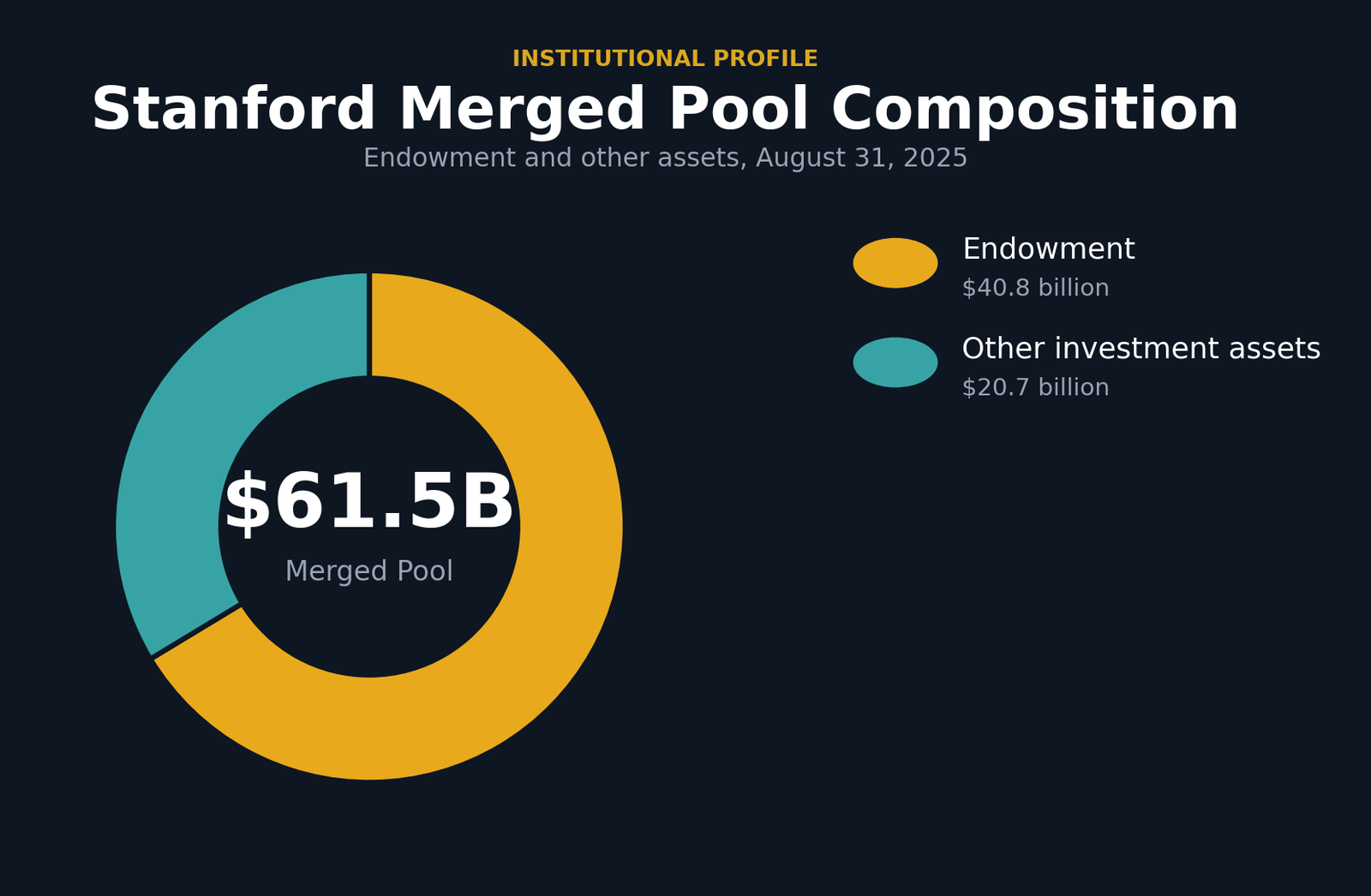
The endowment is part of the wider Merged Pool, which also holds other long-term University and hospital funds. Source: SMC mission page and FY25 Annual Financial Report.
| Component | Share |
|---|---|
| Endowment | $40.8 billion |
| Other investment assets | $20.7 billion |
Investment Mandate
SMC's investment program aims to achieve two primary goals: provide material support for current University operations, including student financial aid, and preserve the purchasing power of the endowment for current and future generations. The investment strategy is equity-oriented, designed to generate sufficiently high returns while mitigating volatility and risk through careful diversification across multiple asset classes. The Merged Pool includes domestic and foreign public equities, real assets such as real estate and natural resources, private equity investments, absolute return strategies with low correlation to broader markets, and a small portion in high-quality fixed income and cash for liquidity.
Based on mean-variance modeling, the current asset allocation is expected to generate an 8.1 percent real arithmetic annual return after higher education inflation and all costs and fees, with annualized volatility of 14.7 percent. SMC exercises discipline in managing asset class exposures and frequently rebalances the portfolio back to policy targets, with policy targets revisited annually. The organization takes a collaborative approach to partnerships, spending time to understand partners' work in depth and serving as a thought partner for investment managers at all stages of development. SMC's partners share a common belief in fundamental investment with rigorous and repeatable processes incorporating exhaustive quantitative and qualitative research.
SMC invests in accordance with laws governing fiduciaries of charitable trusts and SMC's Ethical Investment Framework, which was approved by the University Board of Trustees in 2018 and describes how ethical issues factor into investment decision-making. The organization's work is guided by the Trustee's Statement on Investment Responsibility, first adopted more than 50 years ago and amended periodically by the Board. In June 2020, the University Trustees committed to achieving at least a net-zero carbon profile by 2050, including the investment portfolio. This commitment reflects Stanford's broader institutional values while maintaining SMC's fiduciary duty to generate returns sufficient to support current operations and preserve purchasing power for future generations.
Financial Position
The University endowment stood at $40.787 billion at August 31, 2025, up from $37.631 billion at August 31, 2024. The five-year endowment values at August 31 were $37.788 billion in 2021, $36.339 billion in 2022, $36.495 billion in 2023, $37.631 billion in 2024, and $40.787 billion in 2025.
Endowment payout in support of operations was $1.95 billion in fiscal 2025, or 5.2 percent of the beginning-of-year endowment. University investments at fair value were $51.668 billion at August 31, 2025 after deducting hospitals' funds invested in University pools. The annual financial report discloses University total investment returns in dollars, net, of $5.098 billion in fiscal 2025 and $2.914 billion in fiscal 2024; it does not publish a standard endowment percentage return for fiscal 2025 in the sources used. The wider Merged Pool was approximately $61.5 billion, with endowment funds constituting approximately three-quarters of the pool.
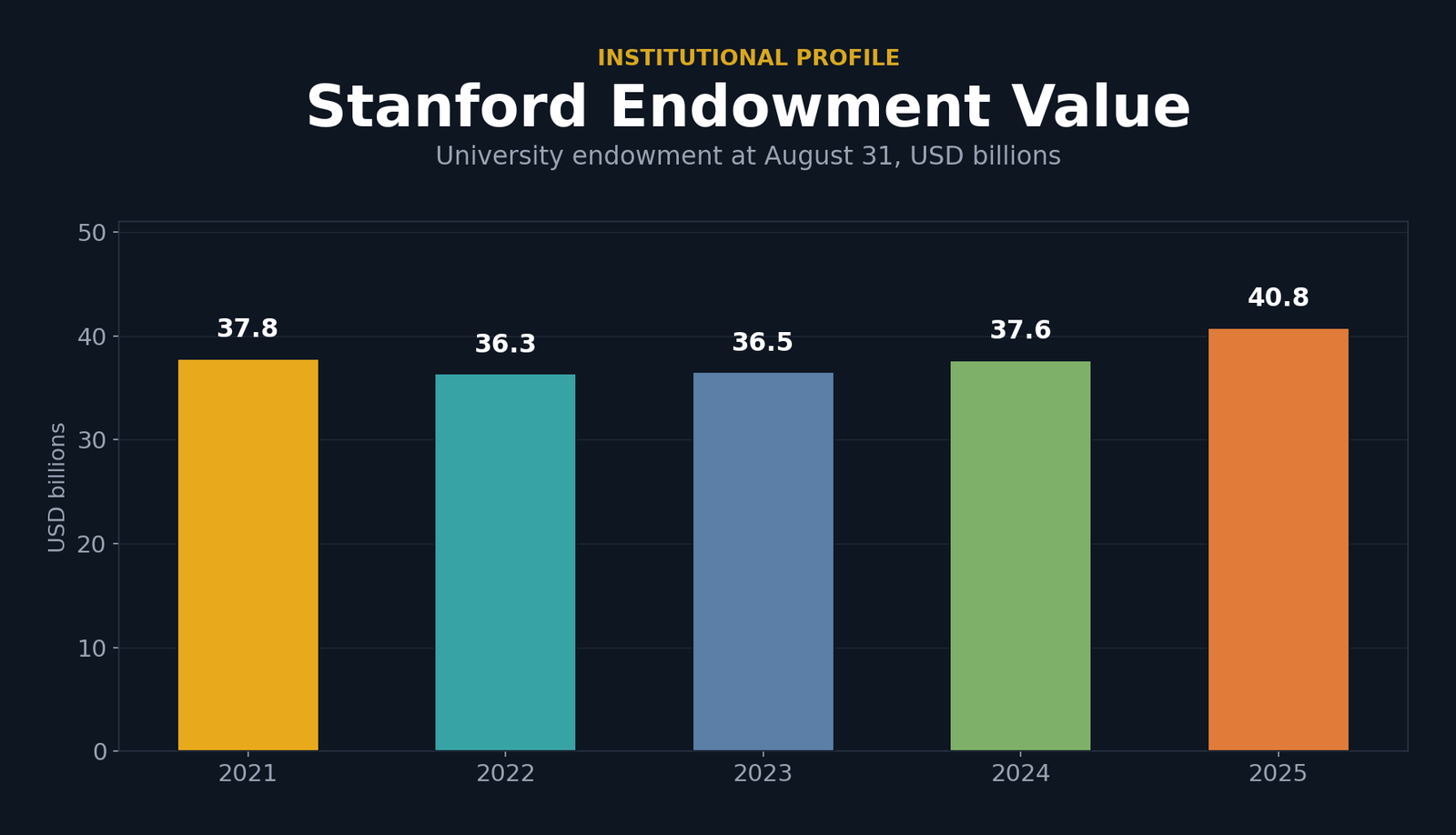
University endowment at year-end from the FY25 Annual Financial Report five-year financial data. Source: Stanford University FY25 Annual Financial Report.
| Item | Value |
|---|---|
| 2021 | 37.8 |
| 2022 | 36.3 |
| 2023 | 36.5 |
| 2024 | 37.6 |
| 2025 | 40.8 |
DEEP Disclosure Rating
The DEEP Disclosure Rating measures how much a fund discloses about itself. It is a disclosure and governance measure only, and not a judgment of investment quality or creditworthiness.
The Stanford Management Company's DEEP Disclosure Score is 50 of 100, band Limited. Last assessed October 2026.
Items that cannot apply to a fund's type are excluded from its score rather than scored as zero. The fund-specific basis is included in the DEEP Disclosure Report. A detailed, pillar-by-pillar and item-by-item breakdown of this fund's score is available as a DEEP Disclosure Report on request.
Manager Approach and Matching Profile
Pursuit verdict: Established external managers with exceptional investment judgment, sound ethics, and strong alignment with Stanford's mission should pursue this allocator through long-term partnerships. Managers who require an open RFP process, a procurement portal, published mandate benchmarks or fees, or a public unsolicited route should not pursue it.
- Target vs. actual allocation: Target allocation percentages are not disclosed. SMC describes an expected long-term return and volatility for the current allocation, which is an assumption and not an achieved return. Actual category fair values are disclosed for University investment assets, a broader basis than the endowment alone, in the mandate table below.
- Historical AUM and return series: The endowment series is the University endowment at each August 31. Return figures shown for fiscal 2024 and 2025 are dollar investment returns for University investments, not endowment percentage returns.
Period AUM Return August 31, 2021 $37.788 billion Not publicly disclosed August 31, 2022 $36.339 billion Not publicly disclosed August 31, 2023 $36.495 billion Not publicly disclosed August 31, 2024 $37.631 billion $2.914 billion (University investment returns, net) August 31, 2025 $40.787 billion $5.098 billion (University investment returns, net) - External manager roster and consultant detail: SMC invests with external partners but does not publish individual manager names, mandate benchmarks, or fees, and does not name an investment consultant of record. Amounts below are University investment assets at August 31, 2025, before the hospitals' funds deduction.
Mandate Benchmark or strategy AUM Manager Fee or expense Private equity Not publicly disclosed $21.5 billion SMC and external partners; individual managers not publicly disclosed Not publicly disclosed Real estate Not publicly disclosed $9.6 billion SMC and external partners; individual managers not publicly disclosed Not publicly disclosed Absolute return Not publicly disclosed $8.9 billion SMC and external partners; individual managers not publicly disclosed Not publicly disclosed Public equities Not publicly disclosed $9.4 billion SMC and external partners; individual managers not publicly disclosed Not publicly disclosed Fixed income Not publicly disclosed $3.5 billion SMC and external partners; individual managers not publicly disclosed Not publicly disclosed Natural resources Not publicly disclosed $1.6 billion SMC and external partners; individual managers not publicly disclosed Not publicly disclosed Cash and short-term investments Not publicly disclosed $1.2 billion SMC and external partners; individual managers not publicly disclosed Not publicly disclosed - Commitment pacing: Stanford does not disclose private-market commitment pacing or a capital deployment schedule.
- RFP, procurement, and board calendar: No investment consultant of record, procurement portal, RFP calendar, published unsolicited-proposal route, or SMC board meeting calendar is disclosed. Entry is selective and relationship-driven. SMC is overseen by a Board of Directors appointed by the Board of Trustees; board members are not named in the sources used.
Matching profile: these data points feed the cross-fund manager matching profile.
Sources: Stanford University FY25 Annual Financial Report; SMC mission, strategy, team, and partners pages.
Governance and Leadership
Stanford Management Company is overseen by a Board of Directors appointed by Stanford's Board of Trustees. SMC's work is guided by the Trustee's Statement on Investment Responsibility, first adopted more than 50 years ago and amended periodically by the Board, and by SMC's Ethical Investment Framework, approved by the University Board of Trustees in 2018, which describes how ethical issues factor into investment decision-making. Chief Executive Officer Robert Wallace leads SMC's staff of investment, operations, and administrative professionals.
Named senior leadership as of the assessment date:
- Robert Wallace, Chief Executive Officer
- Rick Devlin, Managing Director, Investments
- Andrew Elott, Director, Investments
- Charles Killebrew, Director, Investments
- Michael Lee, Managing Director, Investments
- Becca Levin, Managing Director, Investments
- Yidi Lu, Managing Director, Investments
- Mary Mei, Managing Director, Investments
- Greg Milani, Managing Director, Investments
- Steven Wright, Managing Director, Investments
- Joyce Ochoa, Director, Investment Operations
- Diane Sharp, Director, Investment Operations
- Chris King, Managing Director, Investment Operations
- Andrew Vincent Joo, Managing Director, Stakeholder Engagement
The sources do not name the individual members of the Board of Directors appointed by Stanford's Board of Trustees. The Our Team page on the SMC website was checked for board member names but lists only the investment and operations staff named above.
How to Engage
SMC states that it invests with carefully chosen external partners based exclusively on merit, looking for exceptional investment judgment, thorough processes, sound ethics, and strong alignment of interests with the University. It does not publish a manager-selection process, an investment consultant of record, a procurement portal, an RFP calendar, or a policy route for unsolicited proposals.
The realistic route in is a selective, long-term partnership developed with SMC. SMC is overseen by a Board of Directors appointed by Stanford's Board of Trustees; no board meeting calendar is published and board members are not named in the sources used.
Sources and Documents
- Stanford Management Company - Our Mission page (accessed 2026)
- Stanford Management Company - Our Strategy page (accessed 2026)
- Stanford Management Company - Our Team page (accessed 2026)
- Stanford Management Company - Our Partners page (accessed 2026)
- Stanford Management Company - Resources page (accessed 2026)
- Stanford University FY25 Annual Financial Report (published 2025, covering period ending August 31, 2025)
Data Notes and Methodology
This profile is based on Stanford Management Company's website and Stanford University's fiscal 2025 Annual Financial Report (year ended August 31, 2025), assessed as of October 1, 2026. All figures are in United States dollars.
The profile AUM is the University endowment at year-end, $40.787 billion at August 31, 2025, from the report's five-year financial data. The approximately $61.5 billion Merged Pool is the wider pool that also holds other long-term University and hospital funds and is context, not the profile AUM. Mandate amounts are University investment assets by category at August 31, 2025 and are not endowment-only allocations. Stanford discloses dollar investment returns, not a standard endowment percentage return for fiscal 2025, in the sources used. Individual external managers, mandate benchmarks, and fees are not publicly disclosed.