
Lilly Endowment
Overview
Lilly Endowment Inc. is a private foundation established in 1937 by J.K. Lilly, Sr. and his sons Eli and J.K. Jr. through gifts of Eli Lilly and Company stock. Headquartered in Indianapolis, Indiana, the foundation operates independently from Eli Lilly and Company, maintaining a separate governing board, staff, and location. The endowment's founding mission centers on community development, education, and religion, with particular emphasis on programs benefiting young people and strengthening financial self-sufficiency in the charitable sector.
The foundation maintains a special commitment to Indianapolis and Indiana while funding significant programs throughout the United States. Its organizational structure includes a board of directors and senior officers responsible for grantmaking and investment operations. The foundation has published annual reports covering stories, finances, and grant approvals from 2016 through 2025, providing transparency into its grantmaking activities while maintaining privacy around its investment operations.
Lilly Endowment operates as one of the largest private foundations in the United States, though it does not publicly disclose the precise scale of its assets. The foundation's approach reflects the founders' wishes to support causes in community development, education, and religion, with special attention to initiatives that promote philanthropy and volunteerism. The endowment's long history and substantial resources position it as a significant institutional presence in American philanthropy, particularly in its home state of Indiana.
Investment Mandate
The foundation's mission focuses on three main areas of grantmaking interest: community development, education, and religion. Within these areas, Lilly Endowment pursues initiatives that benefit youth and promote philanthropy and volunteerism. The foundation operates renewal programs for teachers, pastors, artists, arts administrators, and social service professionals, reflecting a commitment to strengthening human capital across multiple sectors of American civic life.
Lilly Endowment maintains a dual geographic focus: special commitment to Indianapolis and Indiana combined with funding for programs throughout the United States, particularly in the area of religion. This geographic strategy reflects the founders' connection to Indiana while recognizing the national scope of the foundation's religious grantmaking. The foundation does not disclose its investment strategy, asset allocation ranges, or approach to active versus passive management in its public sources. No Investment Policy Statement or equivalent investment mandate document is published.
The foundation's grantmaking guidelines and open initiatives are published on its website for grantseekers, but investment-related policies and mandates remain private. This approach is typical for private foundations, which often maintain greater privacy around investment operations than public pension funds or endowments at public institutions. The foundation's investment operations support its grantmaking mission but are not detailed in the annual reports or other public sources.
Financial Position
Lilly Endowment does not disclose its assets under management in the fund-direct sources reviewed for this profile. No AUM figure is presented as a foundation figure in this profile.
- Assets under management: Not disclosed
- Investment returns: Not publicly disclosed
- Fees and expenses: Not publicly disclosed
- Annual reports: Published for 2016 through 2025, covering grantmaking stories, finances, and grant approvals
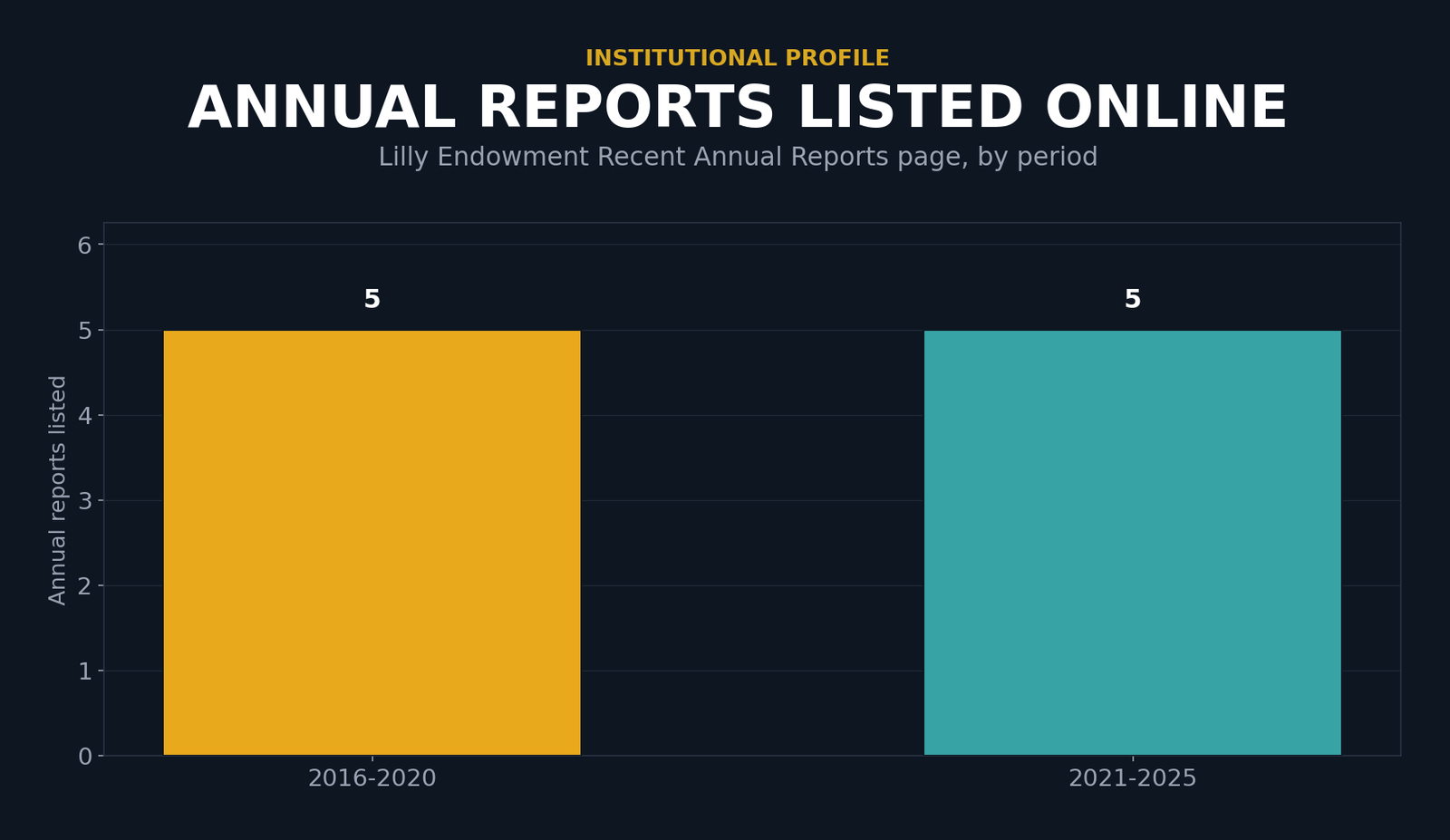
The Recent Annual Reports page lists five annual reports in each five-year period, covering 2016 through 2025. The 2020 COVID-19 Supplemental Report is not counted as an annual report. Source: Lilly Endowment Recent Annual Reports page, accessed 2026-10-01.
| Period | Annual reports listed |
|---|---|
| 2016-2020 | 5 |
| 2021-2025 | 5 |
DEEP Disclosure Rating
The DEEP Disclosure Rating measures how much a fund discloses about itself. It is a disclosure and governance measure only, and not a judgment of investment quality or creditworthiness.Lilly Endowment's DEEP Disclosure Score is 30 of 100, band Opaque. Lilly Endowment's disclosure practices focus on grantmaking transparency rather than investment operations. The foundation publishes annual reports covering its grantmaking activities, board composition, and senior leadership. It names its board members and senior officers, including Peter A. Buck, vice president for investments and grants administration, who holds the most senior investment-related role disclosed.
The foundation does not disclose investment-related information in its public sources. No AUM figure, investment returns, asset allocation, fees, investment strategy, or manager-selection process is published. The foundation does not name an investment consultant, publish an RFP calendar, or describe a procurement process for external investment managers. This level of investment privacy is typical for private foundations, which face different disclosure requirements than public pension funds or endowments at public institutions. The foundation's public sources are freely accessible and easily findable on its official website, with the 2025 Annual Report representing current disclosure as of the assessment date of 1 October 2026. Items that cannot apply to a fund's type are excluded from its score rather than scored as zero. The fund-specific basis is included in the DEEP Disclosure Report. The full scoring rubric is public on the DEEP Disclosure Rating methodology page. A detailed, pillar-by-pillar and item-by-item breakdown of this fund's score is available as a DEEP Disclosure Report on request.
Manager Approach and Matching Profile
Pursuit verdict: Lilly Endowment does not disclose an investment manager procurement process, RFP calendar, or investment consultant in its public sources. The foundation maintains privacy around its investment operations, including manager selection and external mandates. No realistic pathway for external investment managers to pursue mandates is evident from the public sources. Grantseekers may apply through published grant guidelines and open initiatives, but investment manager access is not addressed in the foundation's public materials.
- Target vs. actual allocation: The foundation does not disclose target allocation percentages, ranges, or actual allocation figures in its public sources. No Investment Policy Statement or equivalent investment mandate document is published. Asset-class totals, allocation percentages, and strategic ranges remain private.
- Historical AUM and return series: The foundation does not disclose AUM or investment returns in its public sources. No historical series of assets under management or investment performance is published in the annual reports or other public materials.
- External manager roster and consultant detail: The foundation does not disclose external investment managers, mandates, or an investment consultant in its public sources. No manager roster, mandate details, benchmarks, or fee information is published. The foundation's investment operations remain private, with no procurement process or manager-selection criteria disclosed.
- Commitment pacing: The foundation does not disclose commitment pacing for private markets or any other asset class. No information on investment flows, capital calls, distributions, or pacing strategy is published in the public sources.
- RFP, procurement, and board calendar: The foundation does not disclose an investment manager procurement process, RFP calendar, or procurement portal in its public sources. No investment consultant is named. The foundation publishes grant application guidelines and open initiatives for grantseekers on its website, but these materials do not address investment manager access or procurement. No board meeting calendar or committee schedule is published. The foundation's approach to unsolicited proposals from investment managers is not stated in the public sources.
Per-mandate detail:
| Mandate | Benchmark or strategy | AUM | Manager | Fee |
|---|---|---|---|---|
| Investment portfolio (external mandates, if any) | Not publicly disclosed | Not publicly disclosed | Not publicly disclosed | Not publicly disclosed |
Matching profile: these data points feed the cross-fund manager matching profile.
Sources: Lilly Endowment website (About, People, Annual Reports, For Grantseekers pages); Deep Institutional estimate for AUM.
Governance and Leadership
Lilly Endowment is governed by a board of directors chaired by N. Clay Robbins, who also serves as chief executive officer. Jennett M. Hill serves as president. The board includes Daniel P. Carmichael, Clarence Crain, William G. Enright, Charles E. Golden, John C. Lechleiter, Eli Lilly II (emeritus), Rebecca E. Lilly, Mary K. Lisher, David N. Shane, and John D. Witvliet. The foundation's senior officers include Peter A. Buck, vice president for investments and grants administration, who holds the most senior investment-related role disclosed. Other officers include Diane M. Stenson, vice president and treasurer, and Ben W. Blanton, vice president, secretary, and general counsel. Additional vice presidents oversee community development, education, religion, and evaluation and special initiatives.
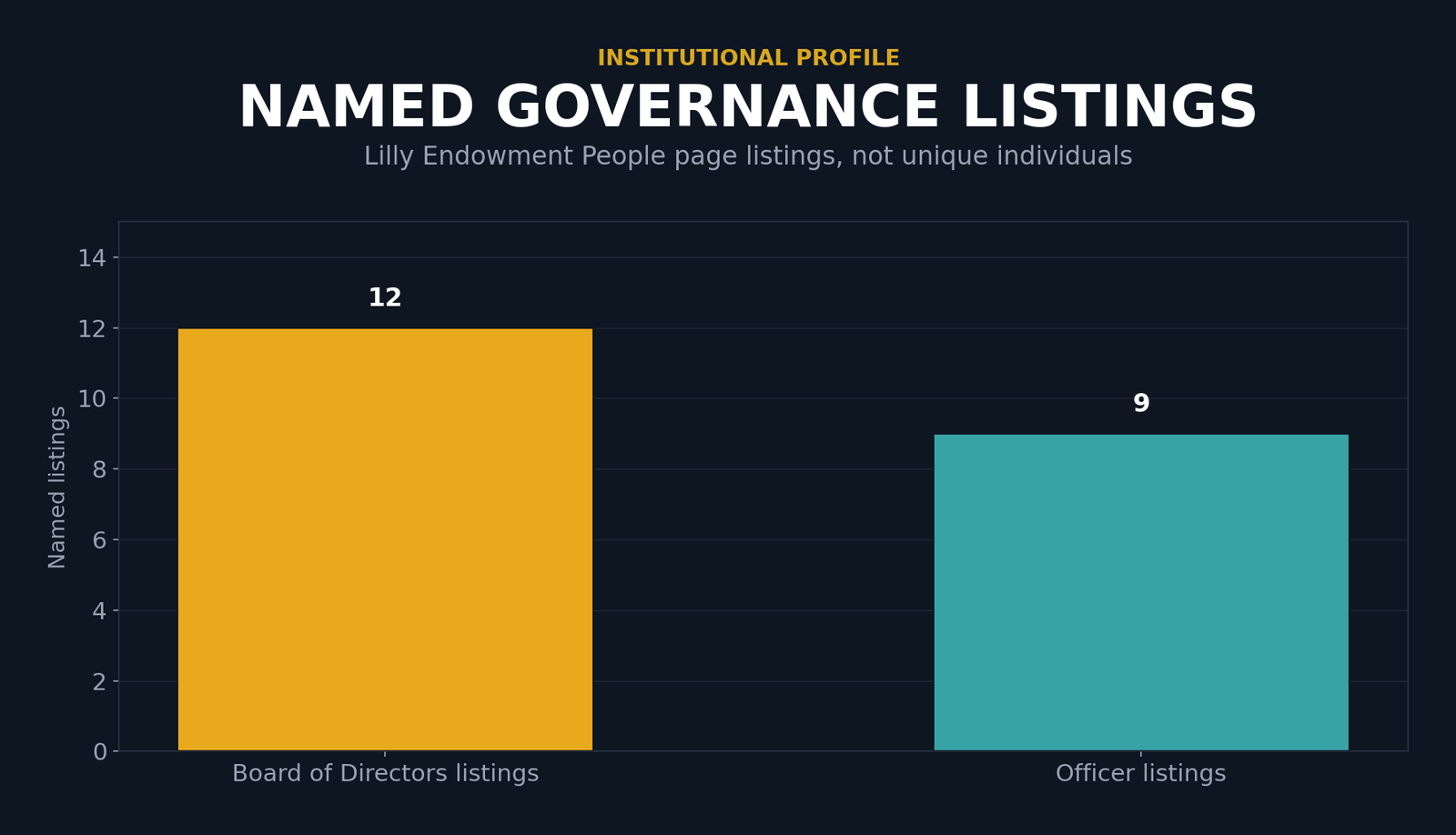
The People page contains 12 Board of Directors listings and nine officer listings. Several people appear in both groups, so the bars count listings rather than unique individuals. Source: Lilly Endowment People page, accessed 2026-10-01.
| Listing group | Named listings |
|---|---|
| Board of Directors listings | 12 |
| Officer listings | 9 |
The foundation does not disclose information on board committees, appointment processes, term lengths, or meeting schedules in its public sources. No board or committee minutes or meeting materials are published. The governance structure reflects a private foundation model with a self-perpetuating board and senior management responsible for both grantmaking and investment operations.
How to Engage
Lilly Endowment does not disclose an investment manager procurement process, RFP calendar, or investment consultant in its public sources. The foundation maintains privacy around its investment operations, including manager selection and external mandates. No pathway for external investment managers to submit proposals or participate in a procurement process is evident from the public materials. The foundation's website provides grant application guidelines and open initiatives for grantseekers, but these materials do not address investment manager access or procurement. Organizations seeking grants may review the published guidelines on the For Grantseekers page of the foundation's website. Investment managers seeking to engage with the foundation's investment operations will find no public guidance on how to do so.
Sources and Documents
- Lilly Endowment About page
- Lilly Endowment People page
- Lilly Endowment Annual Reports page (2016 through 2025)
- Lilly Endowment For Grantseekers page
Data Notes and Methodology
This profile is based on Lilly Endowment's official website, including the About, People, Annual Reports, and For Grantseekers pages, accessed on 1 October 2026. The foundation's Recent Annual Reports page lists annual reports for 2016 through 2025; the 2025 report document text was not part of the extracted source set. No AUM figure is disclosed in the reviewed fund-direct sources, and no third-party estimate is presented as a foundation figure. The foundation does not publish investment returns, asset allocation, fees, investment strategy, manager rosters, or procurement processes in its public materials. This level of investment privacy is typical for private foundations, which face different disclosure requirements than public pension funds or endowments at public institutions. The foundation's public disclosures focus on grantmaking activities, mission, and governance rather than investment operations. Peter A. Buck is titled vice president for investments and grants administration and is the most senior investment-related officer disclosed; no separate chief investment officer title is used. The next expected update is the 2026 Annual Report, anticipated in 2027.