
Koch Industries
Overview
Koch Industries, Inc. is one of the largest privately held companies in the world, headquartered in Wichita, Kansas. The company operates a diverse portfolio of subsidiaries spanning manufacturing, agriculture, energy, chemicals, consumer products, technology, healthcare, real estate and more. Koch employs approximately 130,000 people in more than 50 countries, with nearly half in the United States. The company is guided by Principle Based Management and a commitment to creating mutual benefit for customers, employees, suppliers and communities.
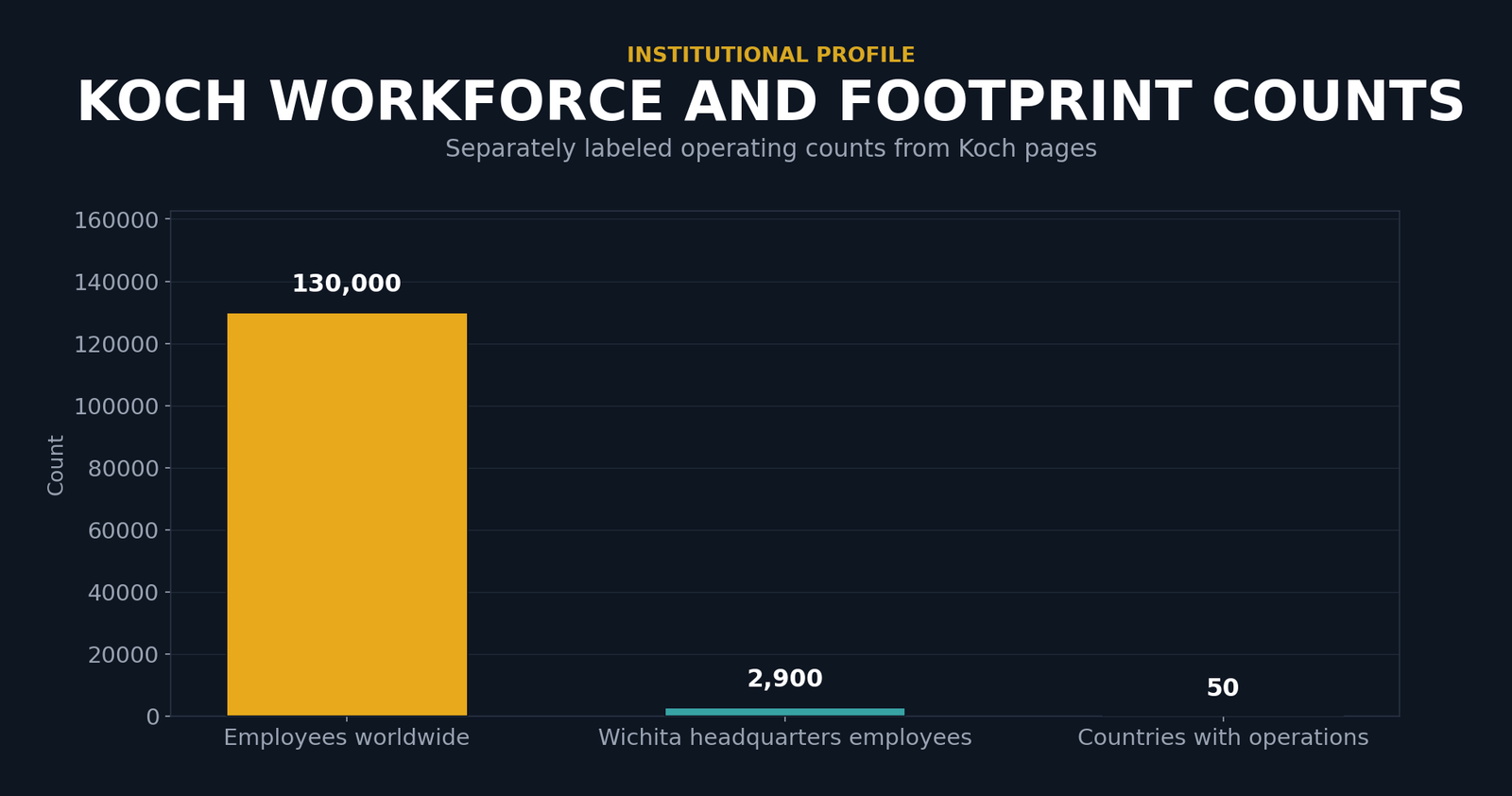
Koch's About page reports about 130,000 employees in more than 50 countries and about 2,900 employees in Wichita. A Companies page reports about 120,000 employees worldwide; that conflict is flagged in the Data Notes. Source: Koch Inc. About and Companies pages, accessed October 1, 2026.
| Operating count | Count |
|---|---|
| Employees worldwide | 130,000 |
| Wichita headquarters employees | 2,900 |
| Countries with operations | 50 |
Koch Industries is a private operating conglomerate, not an institutional capital allocator in the traditional sense of a pension fund, sovereign wealth fund, endowment, foundation, or family office managing third-party capital. The company operates through owned subsidiaries and makes strategic investments in its business operations rather than managing a disclosed pool of investment capital with external managers. Leadership includes Chairman and Co-CEO Charles Koch, Vice Chairman and Co-CEO Dave Robertson, President and Chief Operating Officer Jim Hannan, and Executive Vice President of Origination and Partnerships Chase Koch, indicating family involvement in strategic direction.
Annual revenue exceeds $125 billion, fluctuating with commodity prices. Since 2003, Koch companies have invested more than $190 billion in growth and improvements across their operations. The Wichita headquarters employs about 2,900 people and generates more than $750 million annual impact in the community. The company reinvests approximately 90% of earnings into the business, reflecting a long-term capital deployment approach focused on operational growth rather than external investment management.
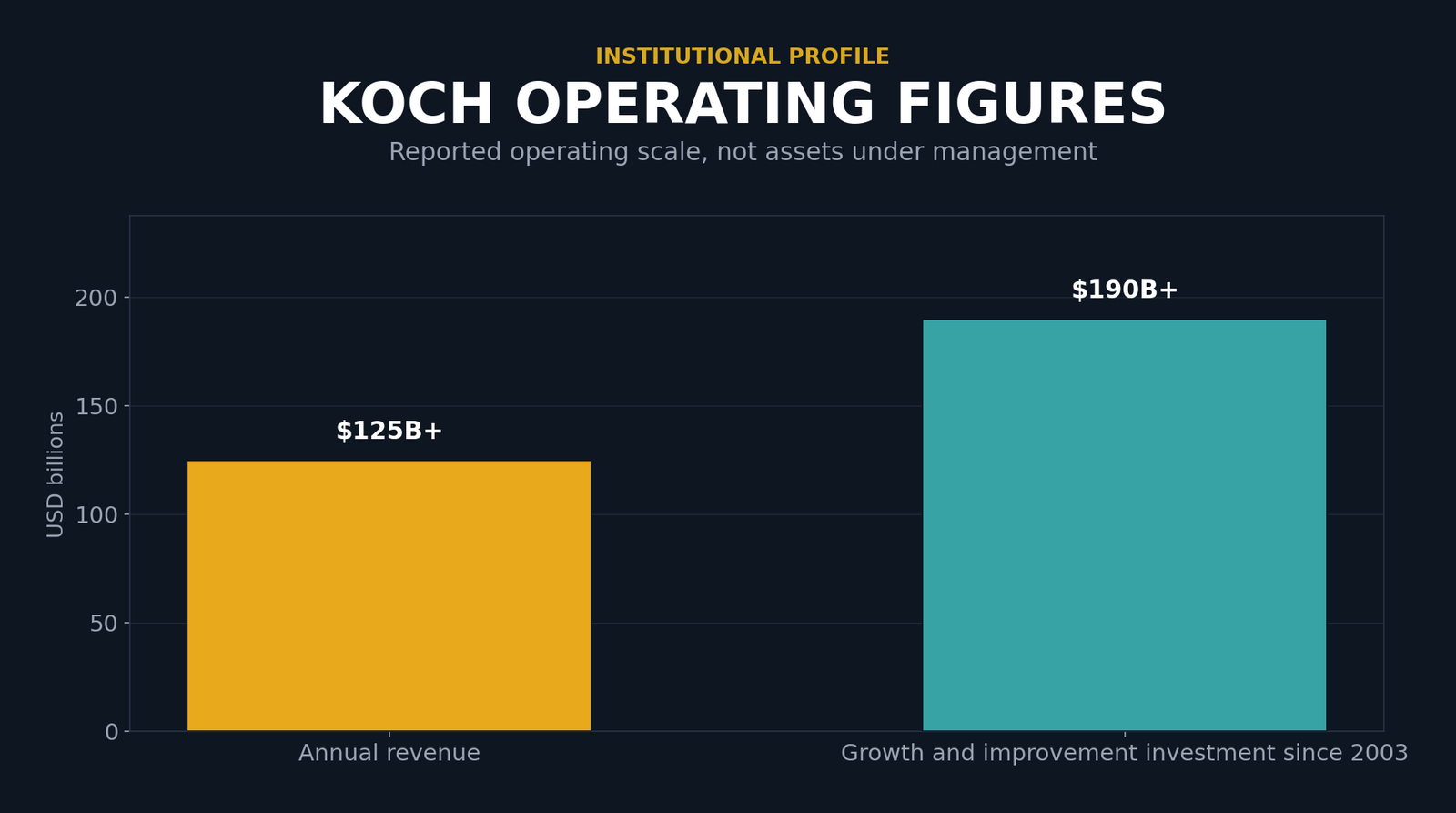
Koch reports annual revenue of more than $125 billion and more than $190 billion invested in growth and improvements since 2003. The bars show two different operating measures over different periods; neither figure is assets under management. Source: Koch Inc. About and Companies pages, accessed October 1, 2026.
| Operating measure | Amount |
|---|---|
| Annual revenue | $125B+ |
| Growth and improvement investment since 2003 | $190B+ |
Investment Mandate
Koch Industries does not operate under a traditional investment mandate as defined for institutional capital allocators. The company is a private operating conglomerate that deploys capital through direct ownership and operation of subsidiaries rather than through asset allocation to external investment managers or across defined asset classes. The company's strategic approach centers on identifying, acquiring, and operating businesses across diverse sectors including manufacturing, agriculture, energy, chemicals, consumer products, technology, healthcare, and real estate.
The company's capital deployment strategy is characterized by long-term reinvestment of earnings into business operations. With 90% of earnings historically reinvested, Koch pursues growth through organic expansion, acquisitions, and operational improvements rather than through portfolio allocation to public markets, private equity funds, or other investment vehicles typical of institutional allocators. The company operates in more than 50 countries, with operations concentrated in North America but extending globally. Strategic decisions are guided by Principle Based Management rather than by published investment policy statements, target allocation ranges, or rebalancing protocols.
Financial Position
Koch Industries reports annual revenue exceeding $125 billion, with fluctuations driven by commodity prices across its diverse business operations. The company does not disclose assets under management, as it is an operating company rather than an institutional capital allocator. Koch itself does not publish an AUM figure or audited financial statements, and third-party estimates are not used in this profile. The company is privately held and does not report to public markets or regulatory bodies requiring investment disclosure.
- Annual revenue: $125 billion or more, subject to commodity price fluctuations
- Workforce: approximately 130,000 employees worldwide across more than 50 countries
- Capital reinvestment: 90% of earnings reinvested into business operations
- Cumulative investment since 2003: more than $190 billion in growth and improvements
Koch does not publish investment returns, asset allocation figures, or performance benchmarks. The company operates through owned subsidiaries rather than through external investment managers, and its financial position is measured by operational revenue and reinvestment rather than by portfolio performance metrics. The Wichita headquarters alone generates more than $750 million in annual economic impact in the local community, reflecting the scale of the company's operations.
DEEP Disclosure Rating
The DEEP Disclosure Rating measures how much a fund discloses about itself. It is a disclosure and governance measure only, and not a judgment of investment quality or creditworthiness. Koch Industries is assessed under the standard DEEP Disclosure worksheet as a private operating conglomerate, not an institutional capital allocator such as a pension fund, sovereign wealth fund, endowment, foundation, or family office managing third-party capital. Its score reflects only what it publicly discloses. The company does not publish financial reports, investment returns, assets under management, fees, investment policy statements, target allocations, holdings, manager selections, or governance materials related to capital allocation.
Koch Industries discloses operational and leadership information on its corporate website, including senior executive names and titles, business segment descriptions, and corporate governance principles. However, it does not disclose audited financial statements, investment performance data, asset class allocations, position-level holdings, external manager rosters, request for proposal processes for investment managers, board of directors composition, or board meeting materials. As a privately held operating company, Koch is not subject to the disclosure requirements that apply to public institutional allocators, and its business model does not involve the investment management activities that the DEEP Disclosure Rating is designed to assess. Items that cannot apply to a fund's type are excluded from its score rather than scored as zero. The full scoring rubric is public on the DEEP Disclosure Rating methodology page.
Manager Approach and Matching Profile
Pursuit verdict: Koch Industries is not an appropriate target for investment managers seeking institutional allocations. The company is a private operating conglomerate that deploys capital through direct ownership and operation of subsidiaries, not through external investment managers or asset allocation to funds. There is no public manager selection process, no disclosed external manager roster, and no investment mandate structure. Managers seeking institutional allocations should focus on pension funds, sovereign wealth funds, endowments, foundations, and family offices that manage third-party capital through external managers.
- Target vs. actual allocation: Koch Industries does not publish target or actual asset class allocations. The company is an operating conglomerate that deploys capital through owned subsidiaries across manufacturing, agriculture, energy, chemicals, consumer products, technology, healthcare, real estate and other sectors. No investment policy statement, strategic asset allocation, or rebalancing ranges are disclosed. The company's capital deployment is measured by operational revenue and reinvestment rather than by portfolio allocation percentages.
- Historical AUM and return series: Koch Industries does not disclose assets under management or investment returns. The company reports operational revenue exceeding $125 billion annually, with fluctuations driven by commodity prices, but does not publish investment performance data, benchmark comparisons, or time-weighted returns. Koch does not publish an AUM figure, and third-party estimates are not used in this profile. No historical series of AUM or returns is available from the company's published materials.
- External manager roster and consultant detail: Koch Industries does not disclose external investment managers or a manager selection process. The company operates through owned subsidiaries rather than through asset allocation to external funds or separate account managers. No consultant of record, investment advisor, or outsourced chief investment officer relationship is disclosed. The company maintains a vendor management process for suppliers and consultants, documented on its vendors page, but this process relates to operational procurement rather than to investment manager selection. No mandate-level detail, benchmark assignments, assets under management by manager, or fee arrangements are published.
Mandate Benchmark or strategy AUM Manager Fee or expense No external investment mandates disclosed Not disclosed Not disclosed Not disclosed Not disclosed - Commitment pacing: Koch does not disclose commitment pacing. Koch Industries is an operating company, not an institutional capital allocator with a private markets program or commitment pacing strategy. The company reinvests approximately 90% of earnings into business operations and has invested more than $190 billion in growth and improvements since 2003, but these figures represent operational capital expenditure and business acquisitions rather than commitments to private equity, venture capital, real assets, or other alternative investment funds. No vintage year pacing, unfunded commitment levels, or distribution-to-paid-in ratios are disclosed.
- RFP, procurement, and board calendar: Koch Industries does not maintain a public request for proposal process or procurement calendar for investment managers. The company has a vendor management process for suppliers and consultants, accessible through its vendors page at kochinc.com/vendors, but this process relates to operational procurement rather than to investment manager selection. No RFP schedule, rebid calendar, or unsolicited proposal policy for investment managers is disclosed. The company does not publish a board calendar or board meeting schedule. Koch is a privately held operating company with no public pathway for investment managers seeking allocations. Managers seeking institutional allocations should focus on public pension funds, sovereign wealth funds, endowments, foundations, and family offices that maintain disclosed manager selection processes.
Matching profile: these data points feed the cross-fund manager matching profile.
Sources: Koch Inc. homepage, Koch About Us page, Koch Companies page, Koch Leadership page, Koch Governance page, Koch Vendors page.
Governance and Leadership
Koch Industries is led by Chairman and Co-CEO Charles Koch, Vice Chairman and Co-CEO Dave Robertson, and President and Chief Operating Officer Jim Hannan. Executive Vice President of Origination and Partnerships Chase Koch indicates family involvement in strategic direction. Additional senior leadership includes Executive Vice President and Chief Financial Officer Richard Dinkel, Executive Vice Presidents Mark Luetters and Jeff Ramsey, Vice President of Environmental, Health and Safety Sheryl Corrigan, Senior Vice President, General Counsel and Corporate Secretary Ray Geoffroy, and Vice President of Human Resources Cara Chennault-Reid.
Governance is guided by Principle Based Management and a Code of Conduct applicable to all employees. Risk management and compliance systems are in place to identify and address potential issues. The company does not disclose a board of directors or board structure, consistent with its status as a privately held company. No board meeting minutes, committee charters, or governance meeting materials are published. The leadership page on the company's website provides names and titles for senior executives but does not identify trustees, independent directors, or advisory board members.
How to Engage
Koch Industries is not an appropriate target for investment managers seeking institutional allocations. The company is a private operating conglomerate that deploys capital through direct ownership and operation of subsidiaries, not through external investment managers or asset allocation to funds. There is no manager sourcing process, no request for proposal calendar, no consultant of record for investment manager selection, and no stated policy on unsolicited proposals from investment managers. The company maintains a vendor management process for suppliers and consultants, documented on its vendors page, but this process relates to operational procurement rather than to investment manager selection. Managers seeking institutional allocations should focus on pension funds, sovereign wealth funds, endowments, foundations, and family offices that manage third-party capital through external managers and maintain public or semi-public pathways for manager engagement.
Sources and Documents
- Koch Inc. homepage (accessed October 2026)
- Koch About Us page (accessed October 2026)
- Koch Companies page (accessed October 2026)
- Koch Leadership page (accessed October 2026)
- Koch Governance page (accessed October 2026)
- Koch Vendors page (accessed October 2026)
Data Notes and Methodology
This profile is based on information published on the official Koch Industries website, reviewed on October 1, 2026. One Companies page carries a May 2024 update line. Employee counts conflict across Koch pages: the About page reports about 130,000 employees worldwide, while the Companies page reports about 120,000 people worldwide. The headline stat uses the About page figure, and the conflict is flagged here rather than resolved silently. Koch Industries is a private operating conglomerate, not an institutional capital allocator in the traditional sense of a pension fund, sovereign wealth fund, endowment, foundation, or family office managing third-party capital. The company does not publish audited financial statements, investment returns, assets under management, asset class allocations, external manager rosters, or investment policy statements. Revenue figures and employee counts are as reported on the company's website. Third-party estimates are not sourced from Koch's own publications and are not included in this profile's financial data. No inception year was found in the sources reviewed. As a privately held company, Koch is not subject to the disclosure requirements that apply to public institutional allocators, and its business model centers on operating subsidiaries rather than on investment management activities.