
Harvard University
Overview
Harvard Management Company (HMC) was established in 1974 to manage Harvard University's endowment and related financial assets. Headquartered in Cambridge, Massachusetts, HMC operates as an independent subsidiary of Harvard University, managing more than 14,000 individual funds invested as a single pooled entity. The endowment's scale and long-term focus have positioned HMC among the earliest institutional investors in venture capital, timberland, and absolute return strategies, with a track record spanning five decades.
Since inception, HMC has distributed more than $46 billion to Harvard University, supporting educational and research programs across the institution's schools and departments. Endowment distributions now account for nearly 40 percent of Harvard University's annual operating revenue, making the endowment's performance central to the university's financial sustainability. Approximately 80 percent of Harvard's endowed funds are restricted by donors to specific schools or purposes, while unrestricted funds support nearly every aspect of university operations.
HMC operates a generalist investment model that breaks down traditional silos among asset classes, enabling the organization to search globally for risk-adjusted returns. The firm maintains partnerships with more than 100 investment partners across multiple mandates and geographies, reflecting a partnership culture that emphasizes focused debates about investment opportunities and long-term value creation. HMC's Board of Directors is elected by the President and Fellows of Harvard College and includes ex officio members (Harvard University's President, Treasurer, Chief Financial Officer, and HMC's Chief Executive Officer) alongside 14 elected members drawn from investment, academic, and industry leadership.
Investment Mandate
HMC's mission is to generate strong long-term results to support Harvard University's educational and research goals. The organization operates with a long-term focus, emphasizing returns above a benchmark of approximately 8 percent per year, which reflects annual distributions of roughly 5 percent plus inflation of approximately 3 percent. This benchmark guides portfolio construction and risk management, with the understanding that the endowment must preserve purchasing power while funding a substantial share of university operations.
The portfolio strategy emphasizes risk-adjusted returns and has undergone a measured increase in equity exposure to enhance long-term growth while preserving resilience. HMC's generalist investment model enables early entry into emerging asset classes and strategies, a philosophy that led the organization to venture capital, natural resources, emerging markets, and absolute return strategies ahead of many institutional peers. The long-term outlook allows HMC to commit capital to illiquid investments and to maintain positions through market cycles, a structural advantage relative to investors with shorter time horizons or liquidity constraints.
HMC is committed to achieving net-zero greenhouse gas emissions in the endowment portfolio by 2050, the first among United States higher education endowments to make such a commitment. Environmental, social, and governance (ESG) considerations are integrated across all investments, and HMC exercises active ownership through shareholder responsibility committees that have operated since 1972. Harvard joined the United Nations-sponsored Principles for Responsible Investment (PRI) in 2014 as the first U.S. endowment signatory. Collaborative efforts with peer institutions and corporations through CDP, Ceres, the Sustainability Accounting Standards Board (SASB), the Task Force on Climate-related Financial Disclosures (TCFD), and Climate Action 100+ advance sustainable investing practices across the portfolio.
Financial Position
The endowment was valued at $56.9 billion as of June 30, 2025, up from $53.2 billion as of June 30, 2024. The fiscal year 2025 return was 11.9 percent. Over the eight-year tenure of the current management team, the endowment returned 9.6 percent annualized, and the annualized return since 1974 was about 11 percent, against a long-term benchmark of about 8 percent that reflects roughly 5 percent distributions plus about 3 percent inflation.
Actual portfolio composition at June 30, 2025 was private equity 41 percent, hedge funds 31 percent, public equities 14 percent, real estate 5 percent, bonds and TIPs 4 percent, other real assets 3 percent, and cash 3 percent. The annual report notes that rounding makes the total greater than 100 percent. HMC has distributed more than $46 billion to Harvard University since 1974, and endowment distributions account for nearly 40 percent of Harvard's annual operating revenue.
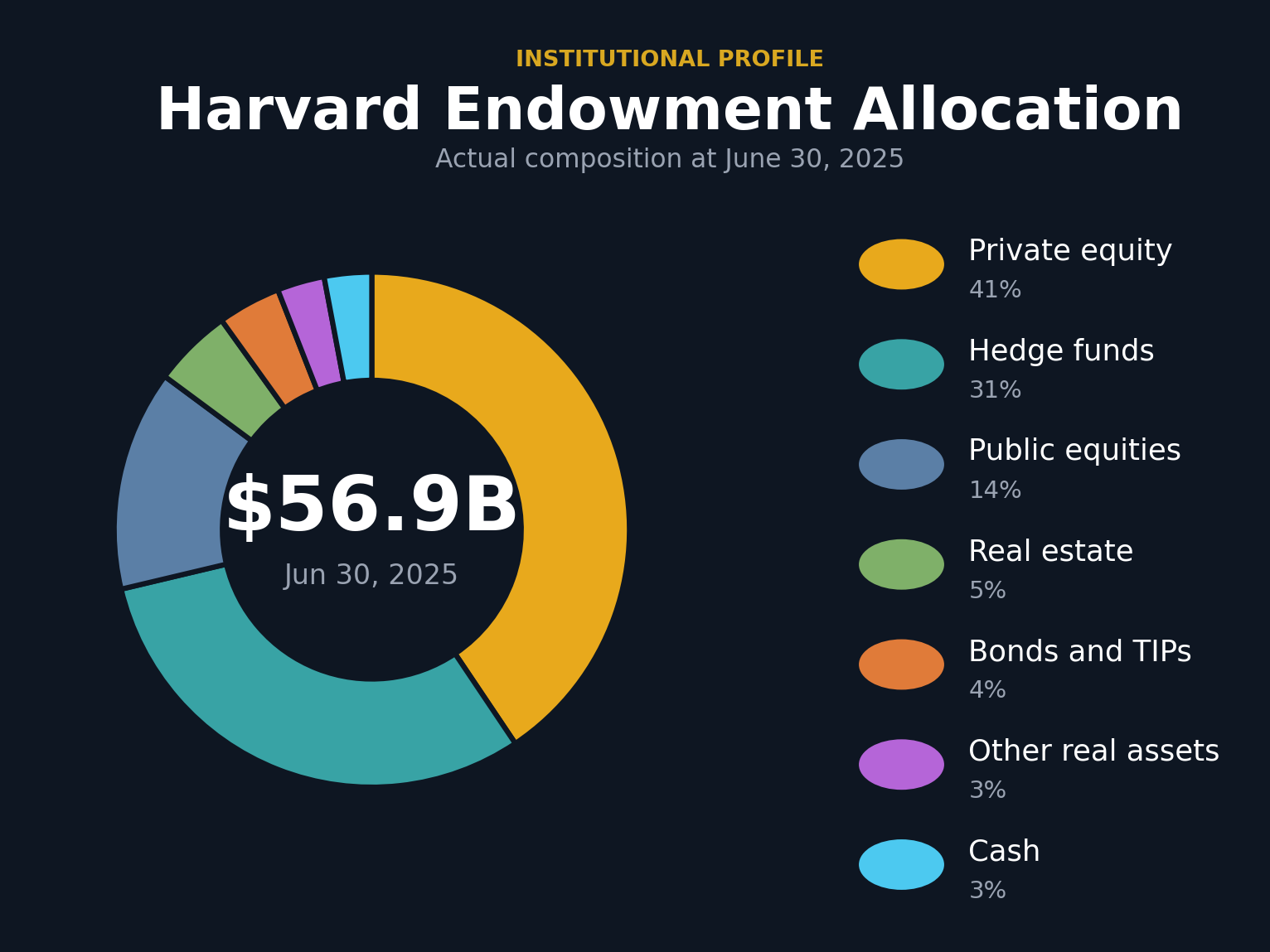
Top-level portfolio composition reported by HMC. The annual report notes rounding makes the total greater than 100 percent. Source: FY25 HMC Annual Report, October 2025.
| Component | Share |
|---|---|
| Private equity | 41% |
| Hedge funds | 31% |
| Public equities | 14% |
| Real estate | 5% |
| Bonds and TIPs | 4% |
| Other real assets | 3% |
| Cash | 3% |
DEEP Disclosure Rating
The DEEP Disclosure Rating measures how much a fund discloses about itself. It is a disclosure and governance measure only, and not a judgment of investment quality or creditworthiness.
The Harvard Management Company's DEEP Disclosure Score is 49 of 100, band Limited. Last assessed October 2026.
Items that cannot apply to a fund's type are excluded from its score rather than scored as zero. The fund-specific basis is included in the DEEP Disclosure Report. A detailed, pillar-by-pillar and item-by-item breakdown of this fund's score is available as a DEEP Disclosure Report on request.
Manager Approach and Matching Profile
Pursuit verdict: External managers in private equity, venture capital, hedge funds, and public equities who can enter HMC's long-term partner network should pursue this allocator. Managers who need a published RFP calendar, named mandate benchmarks or fees, or a direct contact address should not expect a public route in.
- Target vs. actual allocation: Target allocation ranges are not disclosed. Actual composition at June 30, 2025 is listed in the Financial Position section: private equity 41%, hedge funds 31%, public equities 14%, real estate 5%, bonds and TIPs 4%, other real assets 3%, and cash 3%, with rounding noted in the report.
- Historical AUM and return series: HMC discloses the June 30, 2025 and June 30, 2024 endowment values and the fiscal 2025, eight-year, and since-1974 returns.
Period AUM Return Fiscal 2025 (ended June 30, 2025) $56.9 billion 11.9% Fiscal 2024 (ended June 30, 2024) $53.2 billion Not publicly disclosed Eight-year annualized (current management team) Not publicly disclosed 9.6% Annualized since 1974 Not publicly disclosed About 11% 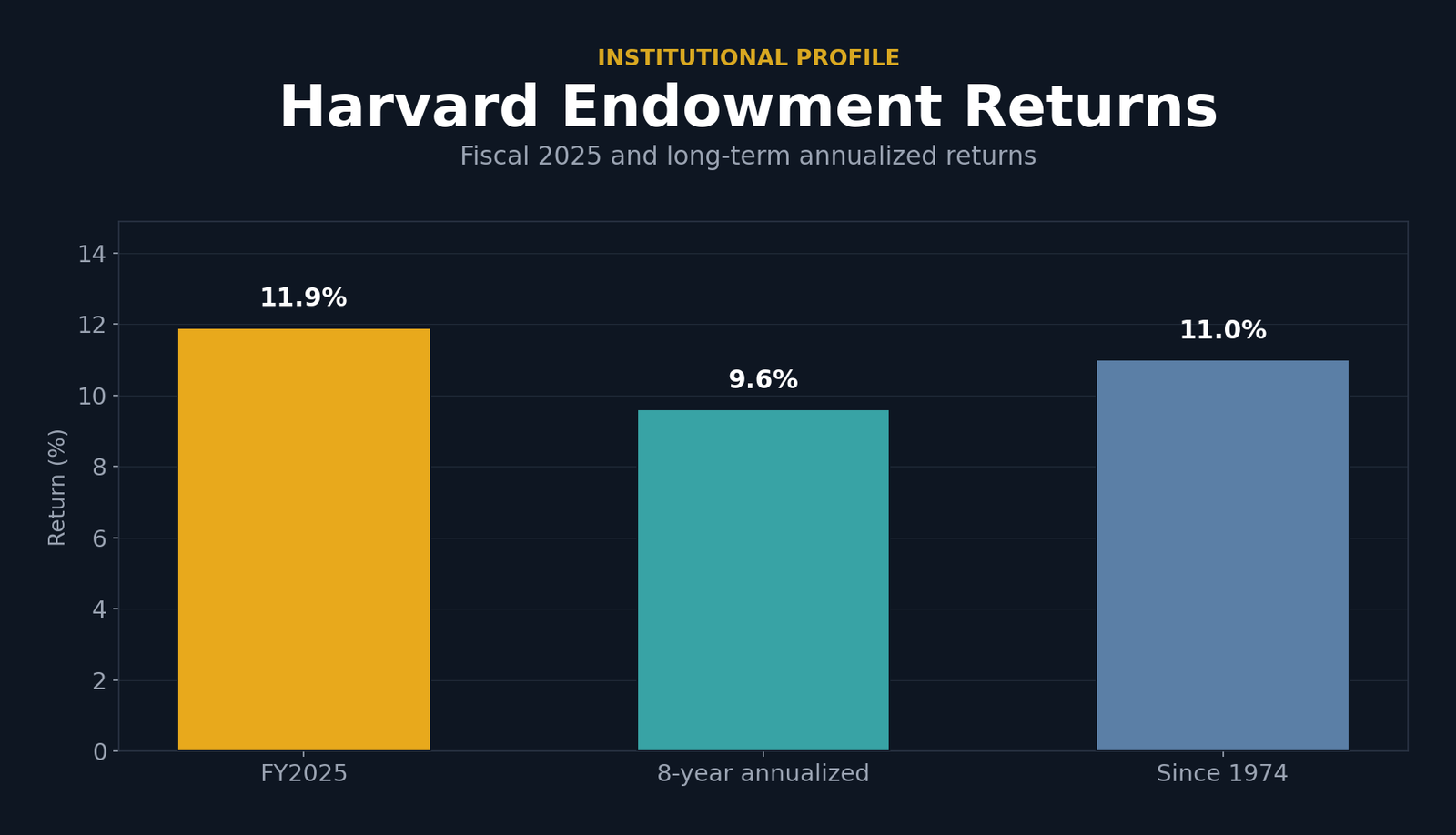
Fiscal 2025 return and long-term annualized returns reported by HMC. Source: FY25 HMC Annual Report, October 2025.
Item Value FY2025 11.9% 8-year annualized 9.6% Since 1974 11.0% - External manager roster and consultant detail: HMC reports more than 100 investment partners but does not name individual external managers, mandate benchmarks, or fees, and does not name an investment consultant of record.
Mandate Benchmark or strategy AUM Manager Fee or expense Private equity Not publicly disclosed 41% of endowment HMC internal team and external investment partners; individual managers not publicly disclosed Not publicly disclosed Hedge funds Not publicly disclosed 31% of endowment HMC internal team and external investment partners; individual managers not publicly disclosed Not publicly disclosed Public equities Not publicly disclosed 14% of endowment HMC internal team and external investment partners; individual managers not publicly disclosed Not publicly disclosed Real estate Not publicly disclosed 5% of endowment HMC internal team and external investment partners; individual managers not publicly disclosed Not publicly disclosed Bonds and TIPs Not publicly disclosed 4% of endowment HMC internal team and external investment partners; individual managers not publicly disclosed Not publicly disclosed Other real assets Not publicly disclosed 3% of endowment HMC internal team and external investment partners; individual managers not publicly disclosed Not publicly disclosed Cash Not publicly disclosed 3% of endowment HMC internal team and external investment partners; individual managers not publicly disclosed Not publicly disclosed - Commitment pacing: HMC does not disclose private-market commitment pacing or a capital deployment schedule.
- RFP, procurement, and board calendar: No investment consultant of record, procurement portal, RFP calendar, or board meeting calendar is published. Unsolicited proposals are selective and relationship-driven through the partnerships route published on the HMC website. The realistic entry route is an introduction into HMC's partner network.
Matching profile: these data points feed the cross-fund manager matching profile.
Sources: FY25 HMC Annual Report, October 2025; HMC website partners and leadership pages.
Governance and Leadership
The HMC Board of Directors is elected by the President and Fellows of Harvard College. Ex officio board members include Harvard University's President, Treasurer, Chief Financial Officer, and HMC's Chief Executive Officer. Elected board members are leaders in investment, academic, and industry fields; the current board includes 14 elected members plus ex officio members. The Advisory Committee on Shareholder Responsibility (ACSR) and the Corporation Committee on Shareholder Responsibility (CCSR) have operated since 1972 to consider shareholder responsibility matters and proxy guidelines, reflecting Harvard's long-standing commitment to active ownership.
- N.P. 'Narv' Narvekar, Chief Executive Officer
- Rick Slocum, Chief Investment Officer
- Sanjeev Daga, Chief Operating Officer
- Timothy R. Barakett, Chair, Board of Directors
How to Engage
HMC runs a generalist, partnership-based model and reports more than 100 investment partners across mandates and geographies. Individual external managers, mandate benchmarks, and fees are not published, and no investment consultant of record, RFP calendar, or procurement portal is disclosed.
The realistic route in is selective: a prospective partner uses the partnerships route published on the HMC website and is evaluated within HMC's partner network. There is no published board or committee meeting calendar. Method and policy detail beyond this route is not published.
Sources and Documents
- HMC homepage
- HMC leadership and board
- HMC endowment overview
- HMC performance and partnerships
- HMC sustainable investing and net-zero commitment
- FY25 HMC Annual Report (published October 2025)
Data Notes and Methodology
This profile is based on the FY25 HMC Annual Report (published October 2025, fiscal year ended June 30, 2025) and materials on the HMC website, assessed as of October 1, 2026. All figures are in United States dollars and are as of June 30, 2025 unless otherwise stated.
The $56.9 billion value is the endowment value reported by HMC. Actual allocation percentages are top-level portfolio sleeves from the annual report; subcategory detail inside hedge funds is not double counted in the mandate table. Individual external managers, mandate-level benchmarks, and fees are not publicly disclosed. No investment policy statement, target allocation ranges, procurement portal, RFP calendar, or board meeting materials are published in the sources used.