
Gates Foundation
Overview
The Gates Foundation was founded in 2000 by Bill Gates, Melinda French Gates, and Warren Buffett, who joined as a trustee in 2006. Headquartered in Seattle, Washington, the foundation operates regional offices in Washington D.C., Beijing, Addis Ababa, Berlin, New Delhi, Nairobi, Abuja, Dakar, Johannesburg, and London. Its mission is to create a world where every person has the opportunity to live a healthy, productive life. Since 2000, the foundation has distributed more than $100 billion in grant funding to thousands of organizations worldwide.
The foundation operates through a two-entity structure established in October 2006. The Gates Foundation serves as the operating entity that makes grants and strategic investments, while the Gates Foundation Trust functions as a separate legal entity that holds and manages investment assets. Both entities changed their names in 2025. Bill Gates serves as trustee of the Trust and chair of the Foundation's board. The foundation employs 2,215 staff and manages 2,506 active grants as of 2025.
The foundation organizes its work across 51 program strategies spanning global health, global development, U.S. education, and gender equality. It partners with nonprofits, governments, research institutions, private enterprises, and community groups to deliver impact. The foundation's approach centers on identifying promising ideas, investing in people and institutions, and helping solutions reach scale.
Investment Mandate
The foundation operates three primary program areas. The Global Programs division improves health outcomes and alleviates extreme poverty in developing countries, focusing on infectious disease, agricultural development, and financial services. The U.S. Program ensures all students have opportunity to earn a degree or credential for successful career, focusing on education access and economic mobility. Local and regional initiatives promote strategies and programs helping low-income families in the Seattle region.
The foundation's funding model directs more than 90 percent of charitable giving to grants to organizations, with additional strategic investments in for-profit companies for charitable purposes. Grantee selection primarily occurs through direct solicitation of identified organizations by foundation staff. The foundation also uses requests for proposals (RFPs) and Grand Challenges initiatives for specific program areas. The foundation does not accept unsolicited proposals.
The foundation requires that scientific knowledge generated through its research funding be promptly and broadly disseminated. Products developed with foundation funding must be broadly available and affordable in developing countries. Foundation staff may join advisory committees or boards of grantee organizations to support implementation. The foundation's Strategic Investment Fund designs partnerships with private companies, including equity investments, loans, and volume guarantees. Program-related investments include loans, equity investments, and guarantees structured to further charitable purposes while potentially generating financial returns.
Financial Position
The Gates Foundation holds a beneficial interest in the net assets of the Gates Foundation Trust, which manages investment assets on behalf of the foundation. As of December 31, 2025, this beneficial interest totaled $89.25 billion, up from $77.24 billion at the end of 2024. The foundation holds a legal right to call upon the Trust's unrestricted net assets to achieve charitable goals. The Trust is a separate legal entity; Bill Gates serves as its trustee and manages investment strategy. The foundation does not disclose investment returns, asset allocation percentages, or external investment managers employed by the Trust.
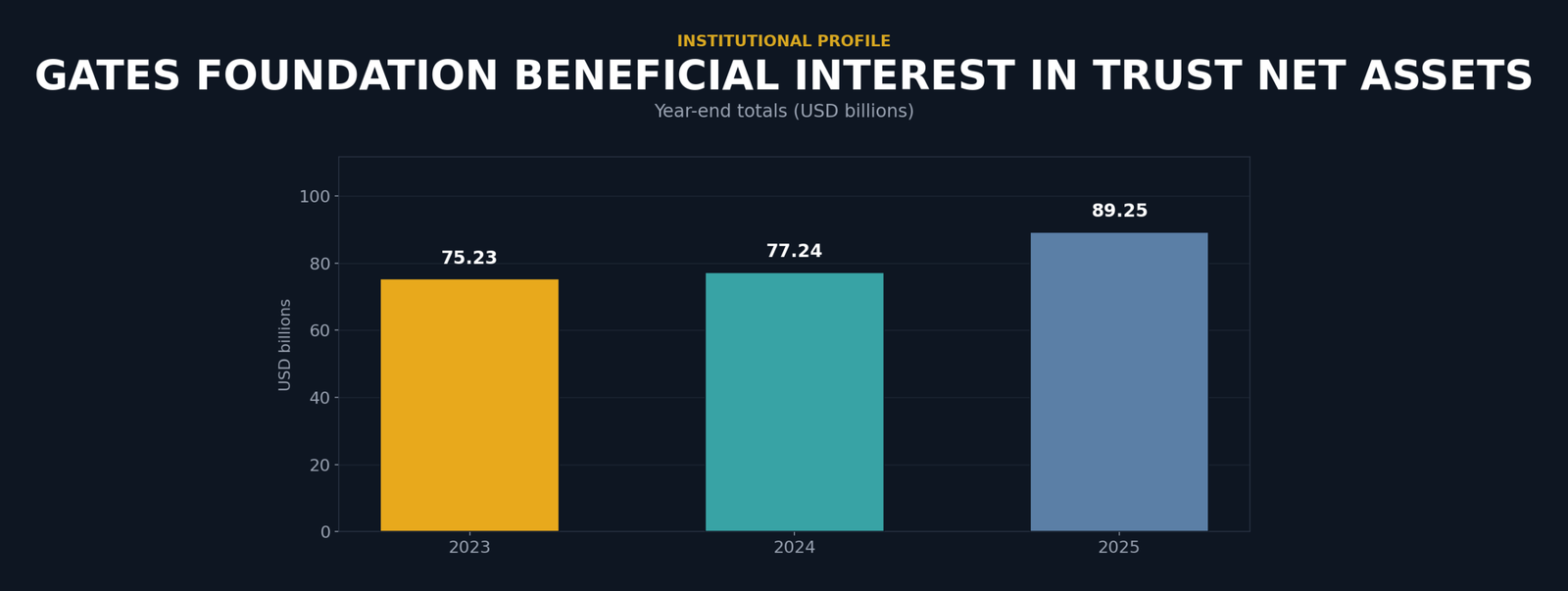
The Gates Foundation's beneficial interest in Gates Foundation Trust net assets was $75.23 billion at the end of 2023, $77.24 billion at the end of 2024, and $89.25 billion at the end of 2025. The 2023 amount is the beginning balance for 2024 in the audited changes table. Source: 2025 Audited Financial Statements, Consolidated Statements of Financial Position and beneficial-interest changes table.
| Year-end | Beneficial interest (USD billions) |
|---|---|
| 2023 | 75.23 |
| 2024 | 77.24 |
| 2025 | 89.25 |
In 2025, the foundation provided $8.47 billion in charitable support, including grants and strategic investments. Total program expenses reached $7.70 billion, with Global Programs accounting for $6.62 billion, the U.S. Program $796.6 million, Other Charitable activities $176 million, and Programmatic Support $104.4 million. Management and general expenses totaled $447.9 million. The foundation's net assets stood at $85.89 billion as of December 31, 2025, with $85.84 billion without donor restrictions and $50.9 million with donor restrictions.
- Beneficial interest in Trust net assets: $89.25 billion as of December 31, 2025
- Charitable support: $8.47 billion in 2025
- Grants payable: $4.72 billion as of December 31, 2025, discounted at rates ranging from 0.17 percent to 4.27 percent
- Program-related investments: $572.4 million net as of December 31, 2025, comprising loans, equity, and guarantees
- Employees: 2,215 as of 2025
- Active grants: 2,506 as of 2025
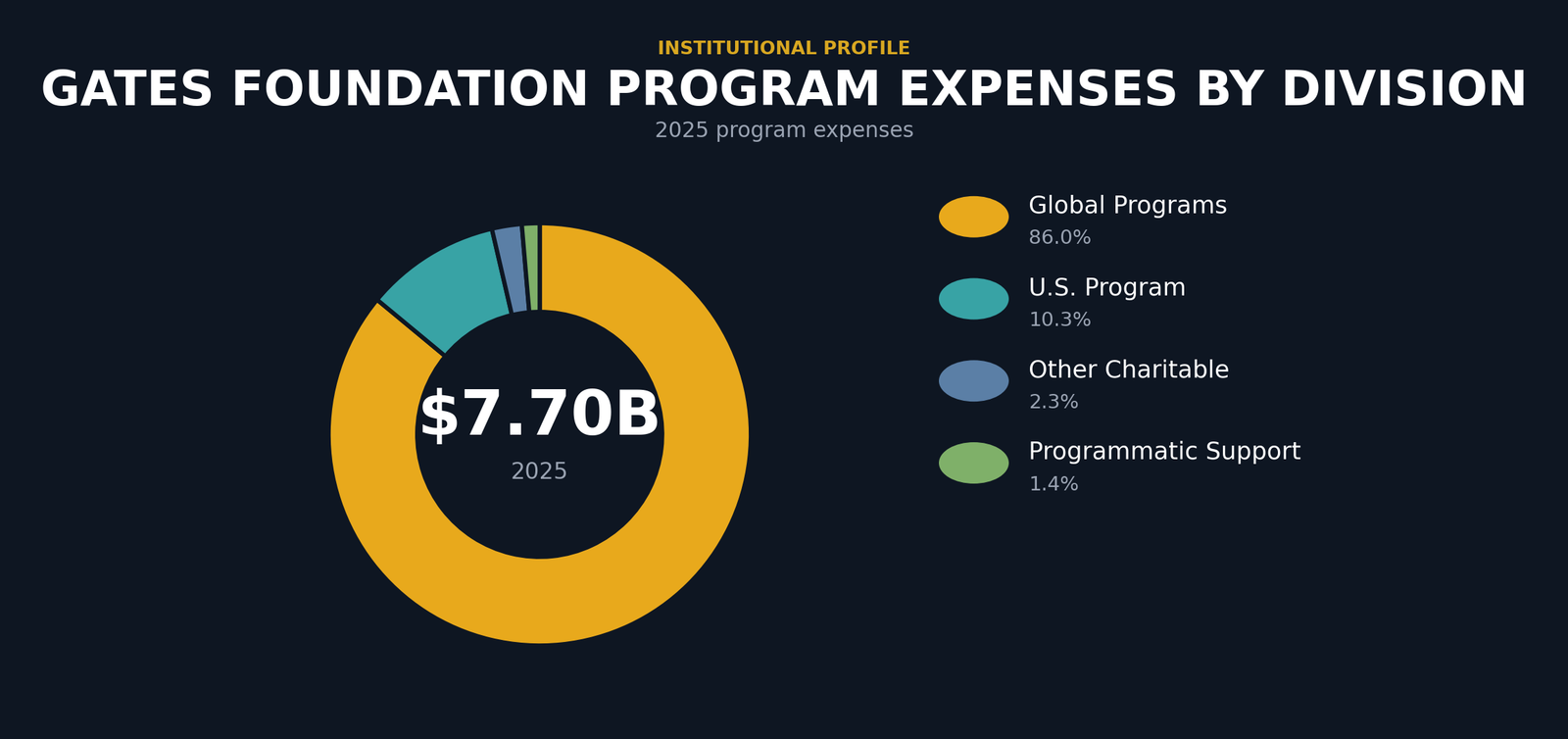
Global Programs accounted for 86.0 percent of the Gates Foundation's $7.70 billion in total program expenses in 2025. These are program expenses, not the separate $8.47 billion charitable support figure. Source: 2025 Audited Financial Statements, Consolidated Statements of Activities.
| Division | 2025 program expenses |
|---|---|
| Global Programs | 86.0% |
| U.S. Program | 10.3% |
| Other Charitable | 2.3% |
| Programmatic Support | 1.4% |
DEEP Disclosure Rating
The DEEP Disclosure Rating measures how much a fund discloses about itself. It is a disclosure and governance measure only, and not a judgment of investment quality or creditworthiness.The Gates Foundation's DEEP Disclosure Score is 35 of 100, band Limited. Based on preliminary assessment of available materials, the foundation publishes audited financial statements, annual reports from 1998 through 2025, detailed program information, and comprehensive leadership and governance information. It discloses its beneficial interest in Trust net assets, charitable support totals, program expenses by division, grants payable, and program-related investment portfolios. It identifies its chair, trustee, CEO, board members, and senior executives with titles.
The foundation does not disclose investment returns, target or actual asset allocation percentages, external investment managers, investment fees or expense ratios, position-level holdings, or a formal Investment Policy Statement. It does not publish board or committee minutes or meeting materials. It does not publish an investment-manager RFP process, procurement portal, or RFP calendar. Its posted RFPs and Grand Challenges initiatives are grant funding opportunities, not investment-manager procurement. Items that cannot apply to a fund's type are excluded from its score rather than scored as zero. The fund-specific basis is included in the DEEP Disclosure Report. The full scoring rubric is public on the DEEP Disclosure Rating methodology page. A detailed, pillar-by-pillar and item-by-item breakdown of this fund's score is available as a DEEP Disclosure Report on request.
Manager Approach and Matching Profile
Pursuit verdict: Traditional investment managers: no public opportunity is disclosed. The Gates Foundation Trust holds and manages investment assets, but the foundation does not disclose whether the Trust uses external investment managers, and it publishes no manager-selection process, procurement portal, RFP calendar, or investment consultant. The foundation itself makes grants and strategic investments to further charitable purposes. Organizations seeking foundation funding should respond to posted RFPs and Grand Challenges initiatives or wait for direct solicitation by foundation staff, as the foundation does not accept unsolicited proposals.
- Target vs. actual allocation: The foundation does not disclose target or actual asset allocation percentages. The Gates Foundation Trust manages investment assets; the foundation reports only its beneficial interest in Trust net assets and its program-related investment portfolio. No breakdown by asset class, geography, or strategy is published.
- Historical AUM and return series: The foundation discloses beneficial interest in Trust net assets for three year-ends. The 2023 value is the beginning balance for 2024 reported in the audited changes table. No investment returns are disclosed. The foundation reports programmatic investment losses on program-related investments in its audited financial statements, but these reflect charitable investments structured to further program goals rather than market-rate investment returns.
Period AUM (USD millions) Return 2025 year-end (beneficial interest in Trust) $89.25 billion Not disclosed 2024 year-end (beneficial interest in Trust) $77.24 billion Not disclosed 2023 year-end (beneficial interest in Trust) $75.23 billion Not disclosed - External manager roster and consultant detail: The foundation does not disclose external investment managers or an investment consultant. The Gates Foundation Trust holds and manages investment assets on behalf of the foundation. Bill Gates serves as trustee of the Trust; whether external investment managers are used is not disclosed. The foundation makes grants to organizations and strategic investments in for-profit companies for charitable purposes; these are not traditional manager mandates. The foundation's program-related investment portfolio totaled $572.4 million net as of December 31, 2025, comprising loans, equity investments, and guarantees structured to further charitable goals. No manager roster, fee schedule, or consultant relationship is published.
- Commitment pacing: The foundation does not disclose commitment pacing for its program-related investments or strategic investments. Grants payable totaled $4.72 billion as of December 31, 2025, recorded at present value and discounted at rates ranging from 0.17 percent to 4.27 percent. These represent committed grants to be paid over future periods as grantees meet performance milestones. The foundation provided $8.47 billion in charitable support in 2025, including $7.70 billion in program expenses. No pacing schedule, vintage-year commitments, or deployment timeline for future investments is disclosed.
- RFP, procurement, and board calendar: The foundation posts RFPs and Grand Challenges initiatives on its website as they become available; no formal RFP calendar is published. The foundation does not accept unsolicited proposals. In most cases, foundation staff directly contact organizations identified through research and program development work, inviting them to submit funding proposals. Organizations may also respond to posted RFPs or compete in Grand Challenges initiatives. The foundation describes a four-stage grantmaking process: developing the project, soliciting proposals through direct solicitation or RFP, proposal review and approval, and grant allocation and closeout. No procurement portal, board meeting calendar, or committee meeting schedule is published. Realistic entry route: organizations should monitor the foundation website for posted RFPs and Grand Challenges in their program area, or build relationships with foundation program staff working in relevant strategies.
Per-mandate detail:
| Mandate | Benchmark or strategy | AUM | Manager | Fee |
|---|---|---|---|---|
| Gates Foundation Trust beneficial interest | Trust asset allocation not disclosed | $89.25 billion | Not publicly disclosed | Not publicly disclosed |
| Program-related investments | Loans, equity investments, and guarantees for charitable purposes | $572.4 million | Not publicly disclosed | Not publicly disclosed |
| Strategic Investment Fund | Private-company partnerships, including equity investments, loans, and volume guarantees | Not publicly disclosed | Not publicly disclosed | Not publicly disclosed |
Matching profile: these data points feed the cross-fund manager matching profile.
Sources: 2025 Audited Financial Statements, How We Work page, About page.
Governance and Leadership
Bill Gates serves as trustee of the Gates Foundation Trust, chair of the Gates Foundation board, and a board member. The foundation's board comprises eight named members: Bill Gates as chair, Mark Suzman as CEO, and six additional board members: Ashish Dhawan, Helene Gayle, Sri Mulyani Indrawati, Strive Masiyiwa, Minouche Shafik, and Tom Tierney. The foundation also maintains a Scientific Advisory Committee that provides independent assessments of Global Health Division strategies.
The foundation's senior leadership team includes Carolyn Ainslie (Chief Financial Officer), Lauren Bright (Chief Legal Officer and Corporate Secretary), Alex Reid (Chief Communications Officer), Shana Tarbell (Chief Operating Officer), Ankur Vora (Chief Strategy Officer and President of Africa and India Offices), and June Yoshinari Davis (Chief People Officer). Program division presidents are Christopher J. Elias (Global Development), Kalpana Kochhar (Interim President, Global Policy and Advocacy Division), M. Hari Menon (Global Growth and Opportunity), Patrick Methvin (Interim President, U.S. Program), Trevor Mundel (Global Health), and Anita Zaidi (Gender Equality Division). The foundation is organized as a charitable trust under Washington law. No investment committee or chief investment officer is named in published materials; Carolyn Ainslie oversees investment strategy and processes as CFO.
How to Engage
The Gates Foundation does not accept unsolicited grant proposals. In most cases, foundation staff identify promising organizations through research and program development work, then directly contact those organizations and invite them to submit funding proposals. Organizations may also pursue foundation funding by responding to posted requests for proposals or competing in Grand Challenges initiatives. The foundation posts public RFPs, including for Grand Challenges grants, on its website as they become available. No formal RFP calendar or procurement portal is maintained.
The foundation's grantmaking process follows four stages: developing the project (identifying problems and potential solutions), soliciting proposals (through direct solicitation, discussion, or RFP), proposal review and approval (by program teams and leadership), and grant allocation and closeout (monitoring performance and impact). Organizations seeking foundation funding should monitor the foundation website for posted RFPs and Grand Challenges in their program area, or work to build relationships with foundation program staff working in relevant strategies. The foundation partners with nonprofits, governments, research institutions, private companies, and community groups. It requires that scientific knowledge generated through foundation-funded research be promptly and broadly disseminated, and that products developed with foundation funding be broadly available and affordable in developing countries.
Sources and Documents
- Gates Foundation About page
- Gates Foundation Financials page
- Gates Foundation Annual Reports page (1998-2025)
- Gates Foundation Leadership page
- Gates Foundation How We Work page
- 2025 Audited Financial Statements (published May 12, 2026)
Data Notes and Methodology
This profile is based on the Gates Foundation's 2025 Audited Financial Statements published May 12, 2026, annual reports available from 1998 through 2025, and official website content accessed October 1, 2026. The beneficial interest in Trust net assets figure ($89.25 billion as of December 31, 2025) represents the foundation's legal right to call upon the unrestricted net assets of the Gates Foundation Trust to achieve charitable goals. The Trust is a separate legal entity that holds and manages investment assets; the foundation itself makes grants and strategic investments. The foundation does not disclose investment returns, asset allocation, external investment managers, or investment fees. The 2025 charitable support figure ($8.47 billion) includes grants and strategic investments. All figures are reported in U.S. dollars. Audited statement amounts are reported in thousands; the beneficial interest figure converts 89,249,227 thousand to $89,249,227,000. Audited statement amounts are reported in thousands; the beneficial interest figure converts 89,249,227 thousand to $89,249,227,000. Audited statement amounts are reported in thousands; the beneficial interest figure converts 89,249,227 thousand to $89,249,227,000. Audited statement amounts are reported in thousands; the beneficial interest figure converts 89,249,227 thousand to $89,249,227,000. Audited statement amounts are reported in thousands; the beneficial interest figure converts 89,249,227 thousand to $89,249,227,000. The foundation is a philanthropic organization, not a traditional institutional capital allocator such as a pension fund, sovereign wealth fund, or endowment. Its investment approach and manager relationships are not disclosed in public filings or website materials.