
Federal Retirement Thrift Investment Board
Overview
The Thrift Savings Plan (TSP) was created in 1986 under the Federal Employees' Retirement System Act (FERSA) as a defined contribution retirement plan for civilian federal employees and uniformed service members. Administered by the Federal Retirement Thrift Investment Board (FRTIB), an independent federal agency, the plan operates without congressional appropriations and is funded entirely by participant contributions, agency matching contributions, loan fees, and forfeited automatic contributions from departing employees. Headquartered in Washington, D.C., the TSP is the largest defined contribution plan in the world, serving over 6.5 million participants (as of March 2022) and managing $1.06 trillion in assets as of the third quarter of 2025.
The plan offers five individual index funds (the G Fund for government securities, F Fund for fixed income, C Fund for large-cap equity, S Fund for small-cap equity, and I Fund for international equity) and eleven lifecycle funds (L Income and L 2030 through L 2075) that automatically adjust allocation as participants approach retirement. All funds are passively managed by BlackRock Institutional Trust Company and State Street Global Advisors Trust Company to minimize costs and avoid political influence in investment decisions. The TSP's expense ratios range from 0.034 percent to 0.051 percent for individual funds and 0.035 percent to 0.041 percent for lifecycle funds, placing it among the lowest-cost retirement plans in the United States.
FRTIB operates under a fiduciary mandate codified in federal law (5 U.S.C. section 8477(b)(1)), requiring the board and its Executive Director to act solely in the interest of TSP participants and beneficiaries. The board comprises five members appointed by the President and confirmed by the Senate, with day-to-day operations managed by Executive Director Ravindra Deo, who also serves as Chief Investment Officer. The plan's statutory mandate emphasizes keeping administrative costs low while prudently managing returns, a dual objective reflected in its passive index-based investment approach and operational efficiency.
Investment Mandate
The TSP's investment mandate is defined by statute (5 U.S.C. sections 8438 and 8475) and implemented through FRTIB's Strategic Plan and individual fund investment policies. The plan's mission is to provide federal employees and service members with retirement savings and investment options similar to those available to private-sector workers under section 401(k) plans, with an emphasis on low costs, broad market exposure, and passive index replication. All five individual funds track established market benchmarks: the G Fund invests in special-issue U.S. Treasury securities with a rate calculated as the weighted average yield of approximately 202 Treasury securities; the F Fund tracks the Bloomberg U.S. Aggregate Bond Index; the C Fund tracks the S&P 500 Index; the S Fund tracks the Dow Jones U.S. Completion Total Stock Market Index; and the I Fund tracks the MSCI ACWI IMI ex USA ex China ex Hong Kong Index.
The lifecycle funds (L Income and L 2030 through L 2075 in five-year increments) are composed of varying proportions of the five individual funds and automatically adjust their allocation from equities to bonds as the target retirement date approaches. Since 2014, the age-appropriate lifecycle fund has served as the default investment option for automatic contributions, replacing the G Fund as the default under the Smart Savings Act. Participants may transfer between funds up to twice per month, and the lifecycle funds rebalance automatically to maintain their glide-path allocations.
Geographic allocation is primarily domestic-focused through the G, F, C, and S Funds, with international exposure provided by the I Fund, which covers 44 countries across 21 developed and 23 emerging markets. As of the fund fact sheets dated December 31, 2025, the I Fund excludes China and Hong Kong. FRTIB deferred a proposed benchmark change in May 2020 that would have shifted the I Fund to the MSCI ACWI ex USA IMI (which includes China and emerging markets), citing COVID-19 disruptions and pending board member nominations; no further action on that proposal has been announced. The plan operates entirely on a passive basis, with no active management, no direct co-investments, and no private-market allocations. A Mutual Fund Window launched in summer 2022 allows participants to invest up to 25 percent of their account balance in over 5,000 external mutual funds, subject to a $10,000 initial transfer minimum, a $40,000 account balance minimum, and annual fees of $55 administrative, $95 maintenance, and $28.75 per trade.
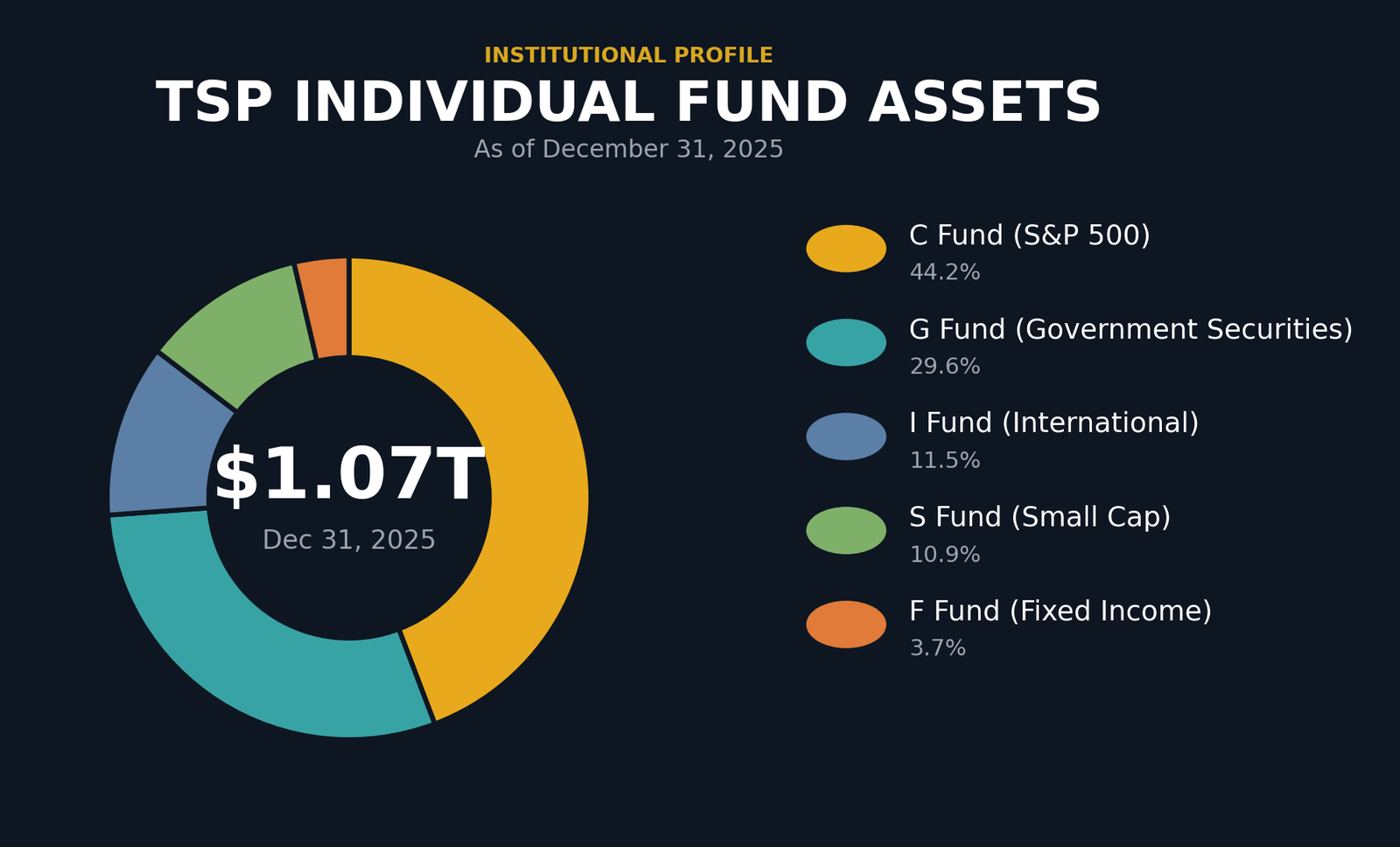
The C Fund (S&P 500) held the largest share of individual fund assets at $474.3 billion, followed by the G Fund (government securities) at $317.7 billion. Source: TSP.gov individual fund fact sheets, December 31, 2025.
| Fund | Assets |
|---|---|
| C Fund (S&P 500) | 44.2% |
| G Fund (Government Securities) | 29.6% |
| I Fund (International) | 11.5% |
| S Fund (Small Cap) | 10.9% |
| F Fund (Fixed Income) | 3.7% |
Financial Position
The TSP held $1.06 trillion in assets as of the third quarter of 2025, according to the Federal Reserve Financial Accounts of the United States (Z.1, L.119.c, released January 9, 2026). This figure represents an increase from $962.5 billion at year-end 2024. The TSP does not publish a consolidated plan-level assets-under-management figure, but individual fund assets as of December 31, 2025, totaled $1.073 trillion: G Fund $317.7 billion, C Fund $474.3 billion, F Fund $39.3 billion, S Fund $117.4 billion, and I Fund $123.6 billion. The difference between the Federal Reserve figure and the sum of individual fund assets reflects timing differences and lifecycle fund holdings, which are composed of the five individual funds and are not reported separately.
Calendar year 2025 returns varied by fund: the G Fund returned 4.44 percent, the F Fund 7.21 percent, the C Fund 17.85 percent, the S Fund 11.38 percent, and the I Fund 32.45 percent. Lifecycle fund returns for calendar year 2025 ranged from 9.36 percent (L Income) to 21.89 percent (L 2070). Year-to-date returns through April 2026 were: G Fund 0.35 percent, F Fund 2.2 percent, C Fund negative 0.03 percent, S Fund negative 4.53 percent, and I Fund negative 4.33 percent. The plan's expense ratios for 2025 were among the lowest in the defined contribution industry:
- G Fund: 0.034 percent total expense ratio (0.034 percent net administrative, 0.000 percent investment)
- F Fund: 0.035 percent total expense ratio (0.034 percent net administrative, 0.001 percent investment)
- C Fund: 0.035 percent total expense ratio (0.034 percent net administrative, 0.001 percent investment)
- S Fund: 0.051 percent total expense ratio (0.034 percent net administrative, 0.017 percent investment)
- I Fund: 0.048 percent total expense ratio (0.033 percent net administrative, 0.015 percent investment)
- Lifecycle funds: 0.035 percent to 0.041 percent total expense ratio
FRTIB is self-funded and receives no congressional appropriations. Administrative expenses are paid from TSP loan fees, 1 percent agency automatic contributions forfeited by departing employees before vesting, and administrative charges against participant accounts. The plan does not disclose workforce size in its published materials.
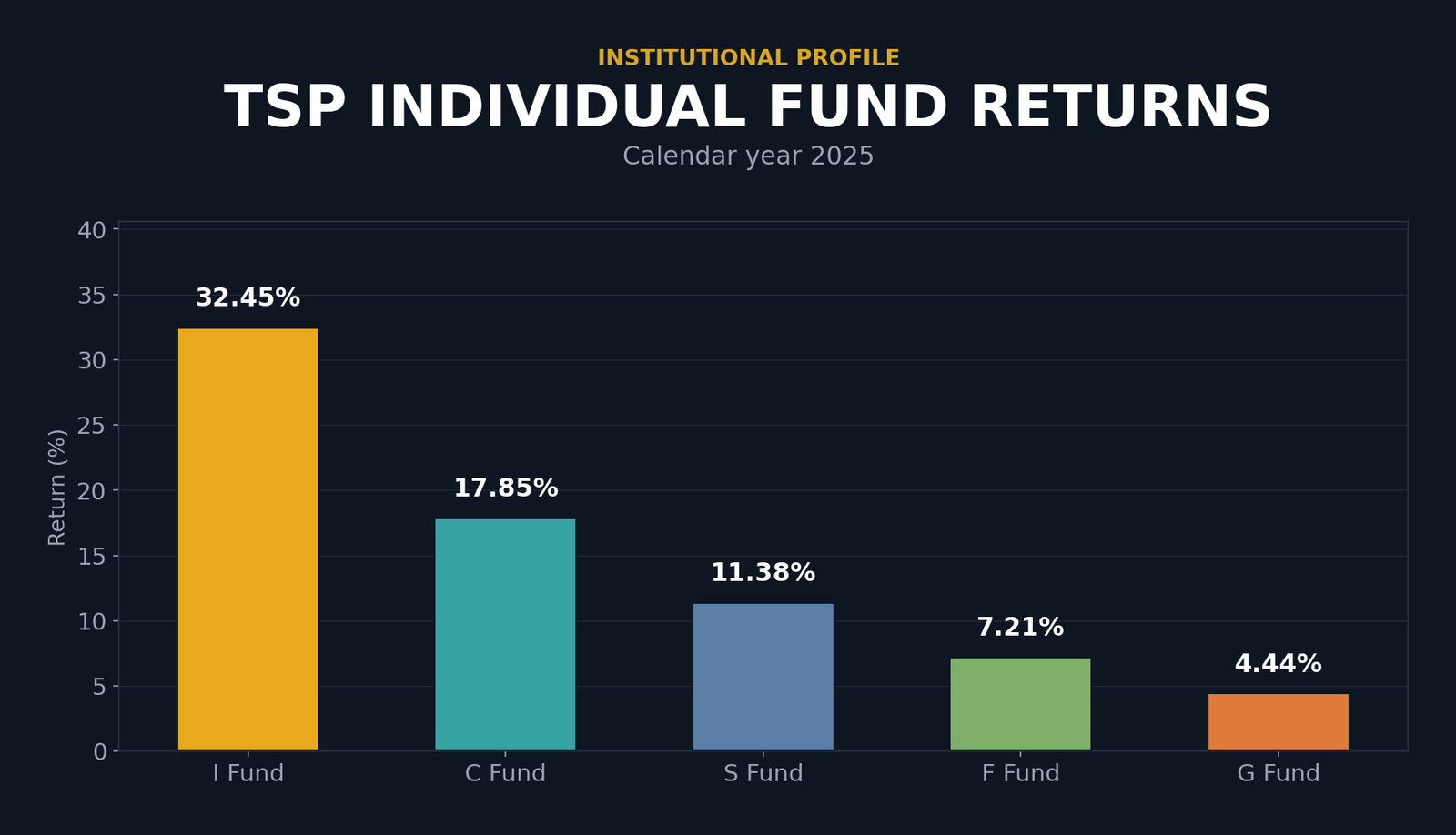
The I Fund (international equity) returned 32.45 percent in calendar year 2025, the highest among the five individual funds. Source: TSP.gov rates of return, calendar year 2025.
| Fund | Return |
|---|---|
| I Fund | 32.45% |
| C Fund | 17.85% |
| S Fund | 11.38% |
| F Fund | 7.21% |
| G Fund | 4.44% |
DEEP Disclosure Rating
The DEEP Disclosure Rating measures how much a fund discloses about itself. It is a disclosure and governance measure only, and not a judgment of investment quality or creditworthiness. The Federal Retirement Thrift Investment Board's DEEP Disclosure Score is 89 of 100, band Exemplary. It publishes an annual report or audited financial statements, discloses assets under management or reserves with as-of date, discloses investment performance or return earned, discloses fees or investment costs, publishes an Investment Policy Statement or equivalent mandate document, discloses target asset allocation, discloses actual asset allocation, publishes an RFP or procurement process or portal, names governing board or trustees and senior investment staff, publishes board or committee meeting materials or minutes, makes disclosures freely and publicly accessible without paywall, keeps most recent disclosures current within the fund's reporting cycle, and consolidates disclosures in reasonably findable locations. It does not disclose portfolio holdings at the position level for all funds (partial disclosure for equity funds only) and does not disclose how it selects managers or name its investment consultant in its own publications, which places it in the Exemplary band. Last assessed October 2026, on Federal Reserve Financial Accounts of the United States (Z.1) Q3 2025, TSP.gov individual fund fact sheets as of December 31, 2025, and FRTIB.gov governance and procurement materials. Items that cannot apply to a fund's type are excluded from its score rather than scored as zero. The fund-specific basis is included in the DEEP Disclosure Report. The full scoring rubric is public on the DEEP Disclosure Rating methodology page. A detailed, pillar-by-pillar and item-by-item breakdown of this fund's score is available as a DEEP Disclosure Report on request.
Manager Approach and Matching Profile
Pursuit verdict: Active managers have no opportunity; every mandate is a passive index mandate tracking established benchmarks with minimal tracking error. Index managers face a closed roster; BlackRock Institutional Trust Company and State Street Global Advisors Trust Company hold all five individual fund mandates and the lifecycle fund mandates under ongoing contracts. No public rebid calendar exists for investment manager selection, and FRTIB does not disclose a manager review schedule, so entry depends on a future manager review or contract expiration that is not publicly announced. Vendors seeking non-investment contracts (recordkeeping, administration, technology) should register in the System for Award Management (SAM) and monitor FedBizOpps, GSA eBuy, and NASA SEWP for FRTIB solicitations per the FRTIB FY26-28 Procurement Forecast.
- Target vs. actual allocation: The TSP discloses actual allocation percentages for individual funds as of December 31, 2025: G Fund $317.7 billion, F Fund $39.3 billion, C Fund $474.3 billion, S Fund $117.4 billion, I Fund $123.6 billion. Lifecycle funds disclose glide-path allocations by retirement year on the L Funds page, with automatic rebalancing to maintain target allocations as participants approach retirement. The plan does not publish a separate plan-level target allocation table, as allocation is participant-directed. Individual fund benchmarks define target allocations: the G Fund invests in special-issue U.S. Treasury securities, the F Fund tracks the Bloomberg U.S. Aggregate Bond Index, the C Fund tracks the S&P 500 Index, the S Fund tracks the Dow Jones U.S. Completion Total Stock Market Index, and the I Fund tracks the MSCI ACWI IMI ex USA ex China ex Hong Kong Index. Lifecycle fund glide-paths constitute target allocations by retirement date, with the most aggressive funds (L 2070, L 2065, L 2060, L 2055) holding higher equity allocations and the most conservative (L Income) holding higher fixed-income and G Fund allocations.
- Historical AUM and return series: AUM series covers year-end 2024 ($962.5 billion) and third quarter 2025 ($1.06 trillion) from Federal Reserve Z.1. Individual fund assets as of December 31, 2025, are disclosed on TSP.gov. Return series covers calendar year 2025 and year-to-date through April 2026 for all five individual funds and selected lifecycle funds. Longer-term annualized returns are available on TSP.gov but are not extracted in the sources provided.
Period AUM Return 2024 year-end $962.5 billion Not disclosed Q3 2025 $1.06 trillion Not disclosed Fund Period Return G Fund Calendar year 2025 4.44% F Fund Calendar year 2025 7.21% C Fund Calendar year 2025 17.85% S Fund Calendar year 2025 11.38% I Fund Calendar year 2025 32.45% G Fund YTD through April 2026 0.35% F Fund YTD through April 2026 2.2% C Fund YTD through April 2026 -0.03% S Fund YTD through April 2026 -4.53% I Fund YTD through April 2026 -4.33% L Income Calendar year 2025 9.36% L 2030 Calendar year 2025 15.17% L 2070 Calendar year 2025 21.89% - External manager roster and consultant detail: All five individual funds and lifecycle funds are managed by BlackRock Institutional Trust Company, N.A., and State Street Global Advisors Trust Company under ongoing contracts. The G Fund is not externally managed; it invests in special-issue U.S. Treasury securities issued directly to the TSP. No external investment consultant is named in the sources. FRTIB manages investment policy and manager selection internally.
Mandate Benchmark or strategy AUM Manager Fee or expense G Fund (Government Securities Investment Fund) U.S. Treasury securities; rate calculated as weighted average yield of approximately 202 Treasury securities $317.7 billion Not applicable (special Treasury securities issued directly to TSP) 0.034% total expense ratio (0.034% net administrative, 0.000% investment) F Fund (Fixed Income Index Investment Fund) Bloomberg U.S. Aggregate Bond Index $39.3 billion BlackRock Institutional Trust Company, N.A.; State Street Global Advisors Trust Company 0.035% total expense ratio (0.034% net administrative, 0.001% investment) C Fund (Common Stock Index Investment Fund) S&P 500 Index $474.3 billion BlackRock Institutional Trust Company, N.A.; State Street Global Advisors Trust Company 0.035% total expense ratio (0.034% net administrative, 0.001% investment) S Fund (Small Cap Stock Index Investment Fund) Dow Jones U.S. Completion Total Stock Market Index $117.4 billion BlackRock Institutional Trust Company, N.A.; State Street Global Advisors Trust Company 0.051% total expense ratio (0.034% net administrative, 0.017% investment) I Fund (International Stock Index Investment Fund) MSCI ACWI IMI ex USA ex China ex Hong Kong Index $123.6 billion BlackRock Institutional Trust Company, N.A.; State Street Global Advisors Trust Company 0.048% total expense ratio (0.033% net administrative, 0.015% investment) L Income Fund (Lifecycle Income Fund) Composite of G, F, C, S, I funds; low-risk asset preservation allocation Not disclosed BlackRock Institutional Trust Company, N.A.; State Street Global Advisors Trust Company (underlying funds) 0.035% total expense ratio L 2030 through L 2075 Funds (Lifecycle Target-Date Funds) Composite of G, F, C, S, I funds with glide-path allocation based on target retirement year Not disclosed BlackRock Institutional Trust Company, N.A.; State Street Global Advisors Trust Company (underlying funds) 0.038% to 0.041% total expense ratio (varies by fund) - Participant flows and pacing: The TSP is a defined contribution plan with participant-directed accounts. Participants choose among five individual funds and eleven lifecycle funds, with the age-appropriate lifecycle fund serving as the default investment option for automatic contributions since 2014 (changed from the G Fund under the Smart Savings Act). The default contribution rate is 5 percent for employees enrolled after October 1, 2020, and 3 percent for those enrolled between August 1, 2010, and September 30, 2020. Participants may transfer between funds up to twice per month, and lifecycle funds automatically rebalance allocations as retirement dates approach. A Mutual Fund Window launched in summer 2022 allows participants to invest up to 25 percent of their account balance in over 5,000 external mutual funds, subject to a $10,000 initial transfer minimum, a $40,000 account balance minimum, and annual fees of $55 administrative, $95 maintenance, and $28.75 per trade. Specific contribution and allocation flow data are not disclosed in the sources.
- RFP, procurement, and board calendar: FRTIB publishes a FY26-28 Procurement Forecast and a Vendor Communication Plan on its procurement page. Vendors must register in the System for Award Management (SAM) and monitor Federal Business Opportunities (FedBizOpps), GSA eBuy, or NASA SEWP for FRTIB solicitations. FRTIB follows the Federal Acquisition Regulation (FAR) with deviations specified in the Thrift Federal Acquisition Supplement (T-FAS). No dedicated RFP calendar for investment manager selection is disclosed; manager contracts with BlackRock and State Street are ongoing and not subject to periodic rebid. FRTIB does not explicitly state its stance on unsolicited proposals, but the procurement page notes that inquiries should be directed to the FRTIB contracting office through the FRTIB procurement page. Board meetings are held generally on the fourth Tuesday of each month and are open to public observation; meeting minutes are published on frtib.gov for 2026, 2025, 2024, 2023, 2022, and earlier years. The realistic entry route for investment managers is a future manager review or contract expiration that is not publicly announced; for non-investment vendors, the route is through SAM registration and monitoring of federal procurement portals.
Matching profile: these data points feed the cross-fund manager matching profile.
Sources: Federal Reserve Financial Accounts of the United States (Z.1), L.119.c, Q3 2025; TSP.gov individual fund fact sheets as of December 31, 2025; FRTIB.gov procurement page and board meeting minutes.
Governance and Leadership
The Federal Retirement Thrift Investment Board is governed by a five-member board appointed by the President and confirmed by the Senate. The current board chair is Mike Gerber, with members Dana Bilyeu, Leona M. Bridges, and Stacie Olivares. The board appoints the Executive Director, who manages daily operations and serves as Chief Investment Officer; the current Executive Director is Ravindra Deo. FRTIB members and the Executive Director are fiduciaries obligated by federal law (5 U.S.C. section 8477(b)(1)) to act solely in the interest of TSP participants and beneficiaries. The Employee Thrift Advisory Council (ETAC) comprises representatives from federal and postal unions, management associations, and the Department of Defense (for uniformed service members); it provides advice on TSP investment policies and plan administration and meets with the board and Executive Director at least annually.
Board meetings are held generally on the fourth Tuesday of each month and are open to public observation. Meeting minutes are published on frtib.gov for 2026, 2025, 2024, 2023, 2022, and earlier years. The statutory mandate (5 U.S.C. section 8475) requires FRTIB to keep administrative costs low and prudently manage returns, a dual objective reflected in the plan's passive index-based investment approach and operational efficiency. The sources do not name senior investment staff beyond the Executive Director, and no separate leadership or investment team page was found in the sources.
- Mike Gerber, Board Chair
- Dana Bilyeu, Board Member
- Leona M. Bridges, Board Member
- Stacie Olivares, Board Member
- Ravindra Deo, Executive Director
How to Engage
The TSP is a passive index-based plan with no active manager engagement or direct co-investments. Fund managers (BlackRock Institutional Trust Company and State Street Global Advisors Trust Company) are selected by FRTIB to replicate benchmark indices with minimal tracking error. FRTIB sets benchmarks (S&P 500 for the C Fund, Bloomberg U.S. Aggregate Bond Index for the F Fund, MSCI ACWI IMI ex USA ex China ex Hong Kong for the I Fund) to provide broad market exposure. Manager contracts are ongoing and not subject to periodic rebid; no public RFP calendar for investment manager selection is disclosed. Investment managers seeking entry face a closed roster and must await a future manager review or contract expiration that is not publicly announced.
Vendors seeking non-investment contracts (recordkeeping, administration, technology) should register in the System for Award Management (SAM) and monitor Federal Business Opportunities (FedBizOpps), GSA eBuy, or NASA SEWP for FRTIB solicitations. FRTIB follows the Federal Acquisition Regulation (FAR) with deviations specified in the Thrift Federal Acquisition Supplement (T-FAS). The FRTIB procurement page publishes a FY26-28 Procurement Forecast and a Vendor Communication Plan. FRTIB does not explicitly state its stance on unsolicited proposals, but the procurement page notes that inquiries should be directed to the FRTIB contracting office through the FRTIB procurement page. Board meetings are open to public observation and are held generally on the fourth Tuesday of each month; meeting minutes are published on frtib.gov.
Sources and Documents
- Federal Reserve Financial Accounts of the United States (Z.1), L.119.c, Q3 2025 (released January 9, 2026)
- TSP G Fund fact sheet (as of December 31, 2025)
- TSP F Fund fact sheet (as of December 31, 2025)
- TSP C Fund fact sheet (as of December 31, 2025)
- TSP S Fund fact sheet (as of December 31, 2025)
- TSP I Fund fact sheet (as of December 31, 2025)
- TSP expenses and fees page (2025)
- TSP rates of return page (calendar year 2025 and year-to-date 2026)
- FRTIB homepage, mission, and strategic plan
- FRTIB board members and Executive Director page
- FRTIB board meeting calendar and minutes
- FRTIB procurement policy and calendar
- Congressional Research Service In Focus: Thrift Savings Plan Investment Issues (2022)
Data Notes and Methodology
This profile is based on Federal Reserve Financial Accounts of the United States (Z.1) Q3 2025 (released January 9, 2026), TSP.gov individual fund fact sheets as of December 31, 2025, FRTIB.gov governance and procurement materials, and Congressional Research Service In Focus report IF12110 (2022). The AUM figure of $1.06 trillion is from the Federal Reserve Z.1 Q3 2025 (L.119.c), the most recent published consolidated figure as of the assessment date (October 1, 2026). TSP.gov does not publish a consolidated plan-level AUM; individual fund assets as of December 31, 2025, total $1.073 trillion, which exceeds the Federal Reserve figure likely due to timing differences and lifecycle fund holdings. Return figures for calendar year 2025 and year-to-date through April 2026 are sourced from TSP.gov and cross-checked with FEDweek, Government Executive, and Morningstar. The I Fund benchmark as of December 31, 2025, is the MSCI ACWI IMI ex USA ex China ex Hong Kong Index; FRTIB deferred a proposed benchmark change to MSCI ACWI ex USA IMI (which would include China and emerging markets) in May 2020, and no further action has been announced. Lifecycle fund glide-path allocations are referenced but not detailed in the sources provided. No external investment consultant is named in the sources; FRTIB manages investment policy and manager selection internally. Specific contribution and allocation flow data are not disclosed in the sources. All figures are in U.S. dollars; no currency conversion is required.