
CDPQ (Caisse de dépôt et placement du Québec)
Overview
La Caisse de dépôt et placement du Québec (La Caisse, formerly CDPQ) is a global investment group managing funds for 48 depositors representing over 6 million Quebecers, primarily pension and insurance plans. Founded in 1965 and headquartered in Montreal, the organization operates with a dual mandate: to generate optimal long-term returns and to contribute to Québec's economic development. As of December 31, 2025, net assets totalled CAD 517 billion, converted to approximately $387 billion USD at the year-end exchange rate of 1.3361 CAD per USD.
La Caisse maintains investment-grade ratings of AAA from DBRS, S&P, and Fitch, and Aaa from Moody's, all with stable outlook. The organization invests actively in major financial markets globally and manages direct investments across private equity, infrastructure, real estate, and private credit. Its scale and independence position it as one of the largest institutional investors in Canada and a significant global allocator.
The fund's operating model emphasizes constructive partnership with portfolio companies and co-investors. In Québec specifically, La Caisse supports company growth through equity investments, financing, and minority interests in key sectors including renewable energy, steel processing, maritime, hospitality, and telecommunications. The organization's 60-year history reflects a consistent focus on long-term value creation aligned with the retirement security needs of its depositor base.
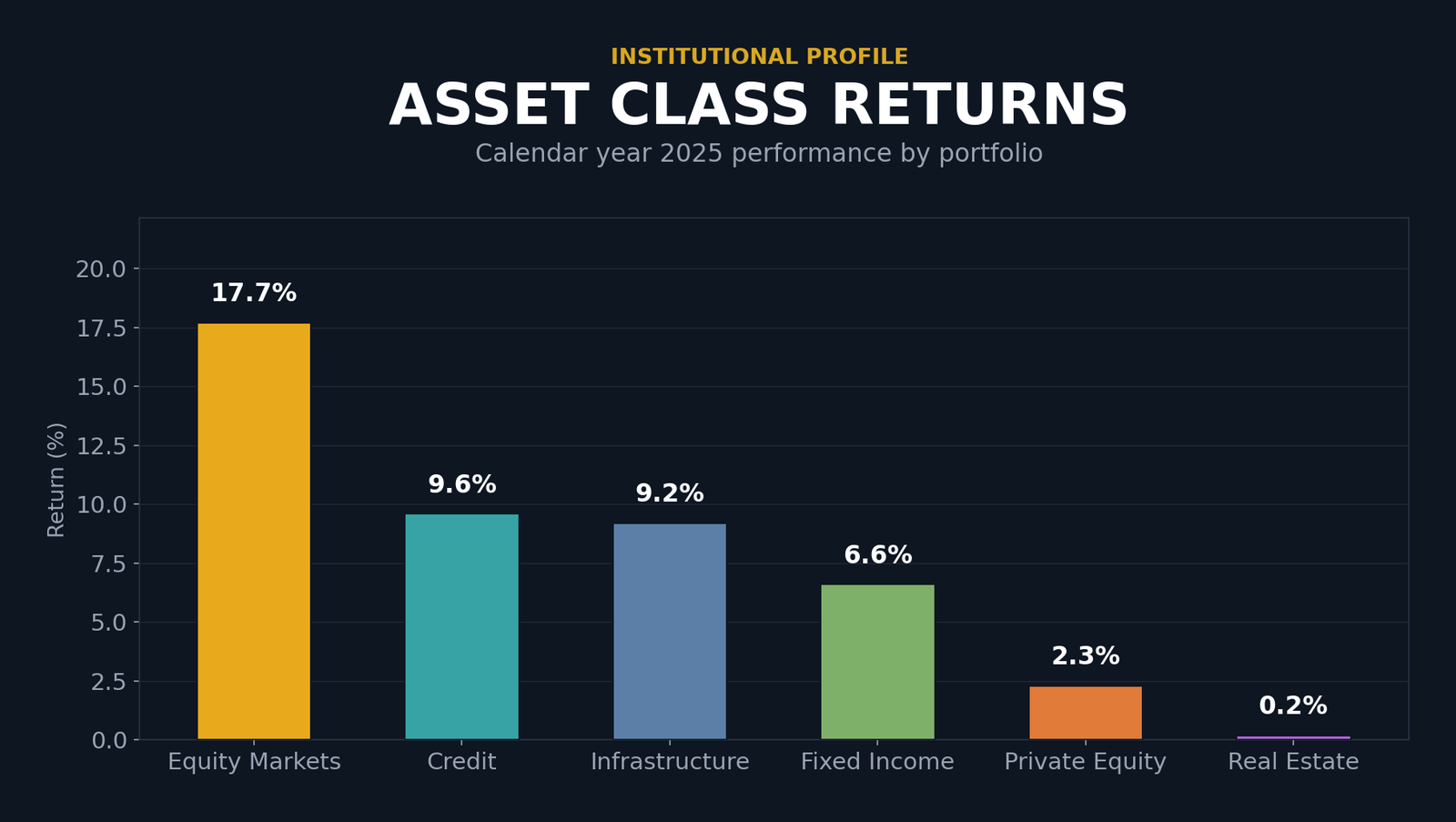
Equity Markets led with 17.7% return for 2025, while Real Estate posted 0.2%. Source: La Caisse press release, February 25, 2026.
| Asset Class | 2025 Return |
|---|---|
| Equity Markets | 17.7% |
| Credit | 9.6% |
| Infrastructure | 9.2% |
| Fixed Income | 6.6% |
| Private Equity | 2.3% |
| Real Estate | 0.2% |
Investment Mandate
La Caisse manages 48 depositor funds, each with distinct objectives. Investment strategies are adapted to individual depositor risk tolerances and investment policies. The largest fund is the Québec Pension Plan base plan, administered by Retraite Québec, which held CAD 163 billion in net assets as of December 31, 2025 (approximately $122 billion USD). The organization does not disclose target allocation percentages or ranges for asset classes, nor does it publish actual allocation percentages by asset class.
The fund invests across six primary asset classes: Equity Markets, Private Equity, Fixed Income (Credit and Rates), Infrastructure, Real Estate, and Global Strategies (macro tactical and currency management). Geographic focus is global, with strategic emphasis on Québec investments. By the end of 2025, La Caisse achieved CAD 100.1 billion in Québec assets, reaching a previously announced target one year ahead of schedule. The organization does not publish an Investment Policy Statement or equivalent mandate document.
Climate strategy represents a significant mandate component. La Caisse aims to increase Climate Action investments to CAD 400 billion by 2030, aligned with a carbon neutrality commitment by 2050. During 2025, the organization deployed CAD 6.3 billion in new investments and commitments in Québec, including positions in renewable energy companies Innergex and Boralex, steel processor Honco Group, maritime operator Ocean Group, hospitality group Germain Hotels, wireless tower operator Terrion, and Laurentian Bank. Major infrastructure projects include the REM light rail network (Deux-Montagnes branch commissioned in 2025), TramCité (Quebec City tramway), and Alto high-speed rail (Cadence team selected as private partner).
Financial Position
La Caisse reported net assets of CAD 517 billion as of December 31, 2025, converted to approximately $387 billion USD at the year-end exchange rate of 1.3361 CAD per USD. The one-year return for 2025 was 9.3 percent, measured as a weighted average across the 48 depositor funds, compared to a benchmark portfolio return of 10.9 percent. Five-year annualized return was 6.5 percent versus benchmark 6.2 percent. Ten-year annualized return was 7.2 percent versus benchmark 6.9 percent. Investment results totaled CAD 43 billion for one year, CAD 134 billion over five years, and CAD 245 billion over ten years.
The Québec Pension Plan base plan, the largest depositor fund, posted a 9.8 percent return for calendar year 2025, with five-year annualized return of 7.8 percent and ten-year annualized return of 8.0 percent. Returns varied significantly by asset class: Equity Markets returned 17.7 percent for 2025 (12.4 percent five-year annualized), Private Equity returned 2.3 percent for 2025 (11.6 percent five-year annualized), Fixed Income returned 6.6 percent for 2025 (negative 0.2 percent five-year annualized), Credit returned 9.6 percent for 2025, Infrastructure returned 9.2 percent for 2025 (10.8 percent five-year annualized), and Real Estate returned 0.2 percent for 2025 (1.2 percent five-year annualized).
- Operating expenses: 21 cents per $100 of average net assets in 2025, down from 23 cents in 2024 and 26 cents in 2023.
- Total investment management cost: 74 cents per $100 of average net assets as of December 31, 2025, compared to 67 cents in 2024, reflecting both internal and external investment management expenses.
- Depositor funds: 48 distinct funds managed, representing pension plans, insurance plans, and other institutional depositors across Québec.
- Québec investments: CAD 100.1 billion in Québec assets as of year-end 2025, with CAD 6.3 billion in new investments and commitments deployed during the year.
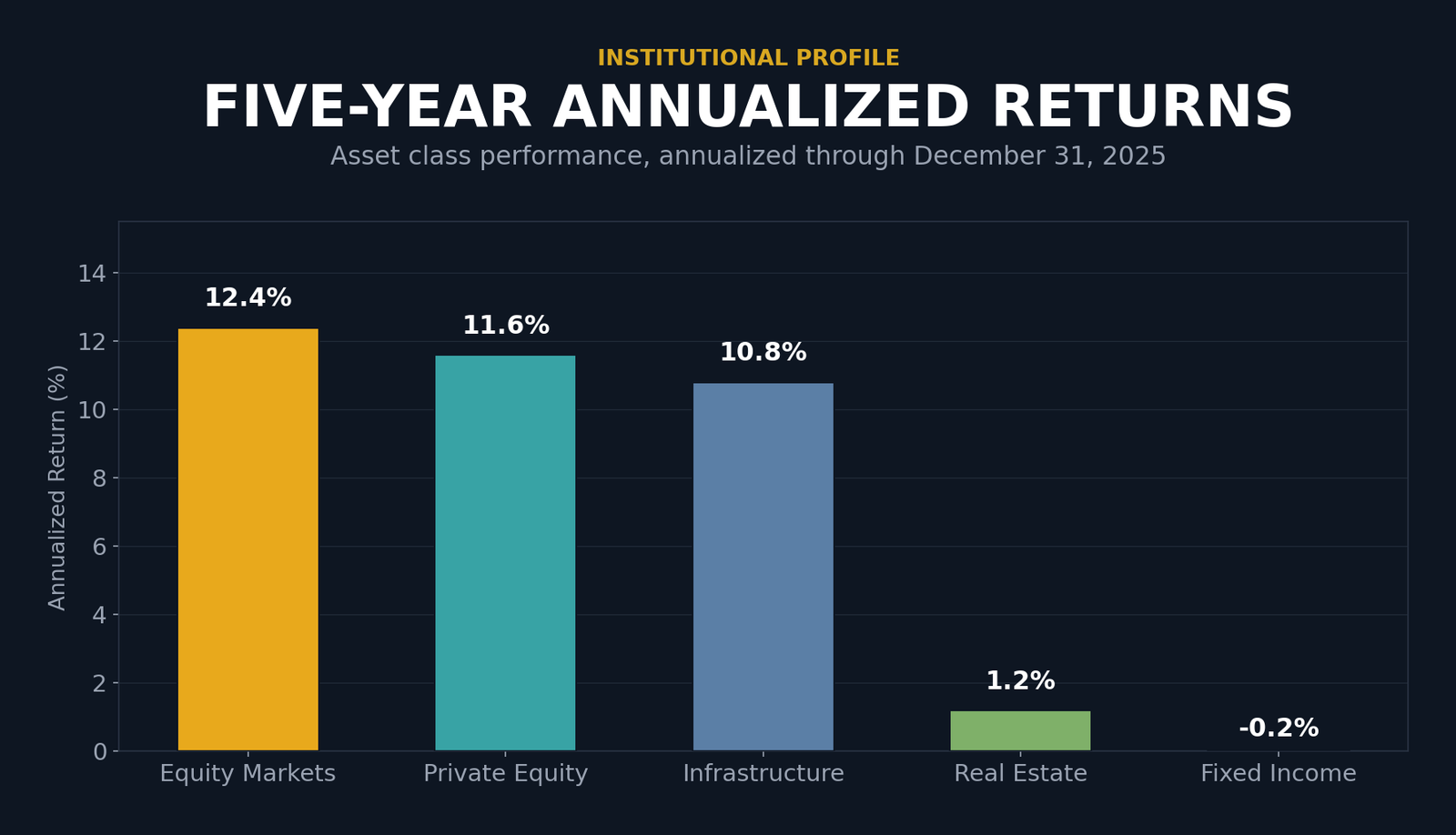
Equity Markets posted 12.4% five-year annualized return, while Fixed Income returned negative 0.2%. Source: La Caisse press release, February 25, 2026.
| Asset Class | 5-Year Annualized Return |
|---|---|
| Equity Markets | 12.4% |
| Private Equity | 11.6% |
| Infrastructure | 10.8% |
| Real Estate | 1.2% |
| Fixed Income | -0.2% |
DEEP Disclosure Rating
The DEEP Disclosure Rating measures how much a fund discloses about itself. It is a disclosure and governance measure only, and not a judgment of investment quality or creditworthiness. La Caisse de dépôt et placement du Québec's DEEP Disclosure Score is 51 of 100, band Limited. It publishes an annual report and audited financial statements, discloses assets under management or reserves with as-of date, discloses investment performance and return earned, discloses fees and investment costs, names governing board and trustees and senior investment staff, makes disclosures freely and publicly accessible with no paywall, publishes disclosures current within the fund's reporting cycle, and consolidates disclosures in a reasonably findable manner. It does not disclose an Investment Policy Statement or equivalent mandate document, target asset allocation, actual asset allocation percentages, full portfolio holdings across all asset classes, how it selects managers or names its investment consultant, an RFP or procurement process or portal, or board and committee meeting materials or minutes, which places it in the Limited band. Last assessed October 2026, on La Caisse press release dated February 25, 2026 presenting financial results for year ended December 31, 2025, and published governance materials. Items that cannot apply to a fund's type are excluded from its score rather than scored as zero. The fund-specific basis is included in the DEEP Disclosure Report. The full scoring rubric is public on the DEEP Disclosure Rating methodology page. A detailed, pillar-by-pillar and item-by-item breakdown of this fund's score is available as a DEEP Disclosure Report on request.
Manager Approach and Matching Profile
Pursuit verdict: External managers face limited opportunity. La Caisse operates primarily as a direct investor across private equity, infrastructure, and real estate, and does not disclose external manager names, an RFP process, or a procurement portal. The organization describes its investment activities across asset classes but does not identify external manager relationships in its public disclosures. No public pathway exists for unsolicited proposals or competitive procurement. Managers seeking access would depend on direct relationship development with investment staff, but no formal entry route is published.
- Target vs. actual allocation: La Caisse does not disclose target allocation percentages or ranges for asset classes. The organization does not publish actual allocation percentages by asset class. Investment activities are described across six primary asset classes (Equity Markets, Private Equity, Fixed Income, Infrastructure, Real Estate, and Global Strategies), but the dollar amounts or percentage weights allocated to each asset class are not disclosed. The fund manages 48 depositor funds with different objectives and risk tolerances, but individual fund allocations are not published.
- Historical AUM and return series: La Caisse discloses AUM as of December 31, 2025 (CAD 517 billion, approximately $387 billion USD) and returns for calendar year 2025 (9.3 percent), five-year annualized (6.5 percent), and ten-year annualized (7.2 percent). Returns are also disclosed for the largest depositor fund (Québec Pension Plan) and for individual asset-class portfolios.
Returns by asset class for calendar year 2025: Equity Markets 17.7 percent, Private Equity 2.3 percent, Fixed Income 6.6 percent, Credit 9.6 percent, Infrastructure 9.2 percent, Real Estate 0.2 percent. Five-year annualized returns by asset class: Equity Markets 12.4 percent, Private Equity 11.6 percent, Fixed Income negative 0.2 percent, Infrastructure 10.8 percent, Real Estate 1.2 percent.Period AUM (USD) Return 2025 year-end $387 billion 9.3% 5-year annualized Not disclosed 6.5% 10-year annualized Not disclosed 7.2% - External manager roster and consultant detail: La Caisse does not disclose a roster of external managers or name specific external managers for its mandates. The organization does not name an investment consultant. The fund describes its investment activities across asset classes and names specific direct investments in Québec (Innergex, Boralex, Honco Group, Ocean Group, Germain Hotels, Terrion, Laurentian Bank) and infrastructure projects (REM, TramCité, Alto), but does not identify external manager relationships for public equity, private equity, fixed income, or real estate mandates.
Mandate Benchmark or strategy AUM Manager Fee or expense Québec Pension Plan (base plan) Diversified pension plan $122 billion Not publicly disclosed Not publicly disclosed Equity Markets portfolio Global equities with geographic diversification Not publicly disclosed Not publicly disclosed Not publicly disclosed Private Equity portfolio Private equity investments Not publicly disclosed Not publicly disclosed Not publicly disclosed Fixed Income portfolio Credit and Rates Not publicly disclosed Not publicly disclosed Not publicly disclosed Infrastructure portfolio Infrastructure investments Not publicly disclosed Not publicly disclosed Not publicly disclosed Real Estate portfolio Real estate investments Not publicly disclosed Not publicly disclosed Not publicly disclosed - Commitment pacing: La Caisse does not disclose commitment pacing or capital deployment schedules. The organization reported that CAD 6.3 billion in new investments and commitments were deployed in Québec during 2025, but does not provide forward-looking commitment guidance, annual commitment targets, or pacing schedules for private equity, infrastructure, or real estate programs. The fund's climate strategy aims to increase Climate Action investments to CAD 400 billion by 2030, but specific annual pacing or commitment schedules to reach this target are not disclosed.
- RFP, procurement, and board calendar: La Caisse does not publish an RFP process, procurement portal, or upcoming board or committee meeting calendar. No public procurement or RFP calendar is disclosed on the fund's website. The organization does not describe its manager-selection process, evaluation criteria, or procurement method in its public disclosures. No consultant of record is named. The fund does not publish a stated policy on unsolicited proposals. No realistic entry route for external managers is disclosed; access would depend on direct relationship development with investment staff, but no formal pathway is published.
Matching profile: these data points feed the cross-fund manager matching profile.
Sources: La Caisse press release dated February 25, 2026 presenting financial results for year ended December 31, 2025; La Caisse governance page.
Governance and Leadership
Jean St-Gelais serves as Chairman of the Board, appointed in October 2021 and reappointed in December 2025. Charles Emond is President and Chief Executive Officer, with his mandate renewed in February 2024 for a five-year term through February 6, 2029. The Board of Directors appoints the President and CEO, subject to approval by the Government of Québec per the organization's incorporating act. Board committees include Governance and Ethics, and Human Resources.
The sources provided do not include a complete roster of board members beyond the Chairman. The governance page on lacaisse.com names Jean St-Gelais as Chairman of the Board, and press releases name Charles Emond as President and Chief Executive Officer, but a full list of board members, trustees, or senior investment staff beyond these two officers is not published in the materials reviewed.
- Jean St-Gelais, Chairman of the Board
- Charles Emond, President and Chief Executive Officer
How to Engage
La Caisse invests constructively alongside partners to build enterprises that drive performance and progress. In Québec, the fund supports company growth through equity investments, financing, and minority interests in key sectors. The organization participates in major infrastructure and real estate projects including REM (Deux-Montagnes branch commissioned in 2025), TramCité (Quebec City tramway), Alto high-speed rail (Cadence team selected as private partner), and Terrion wireless tower operator. The fund's climate engagement strategy launched a new approach to accelerate decarbonization of portfolio companies and increase Climate Action investments to CAD 400 billion by 2030.
La Caisse does not publish a manager-selection process, procurement portal, RFP calendar, or stated policy on unsolicited proposals. No investment consultant is named in public disclosures. The organization does not describe how external managers are sourced, evaluated, or selected. No formal pathway for external managers to engage with the fund is disclosed. Managers seeking access would depend on direct relationship development with investment staff, but no public entry route, registration process, or procurement calendar is published.
Sources and Documents
- La Caisse press release: La Caisse posted a 9.3% return in 2025 and net assets of $517 billion (February 25, 2026)
- La Caisse governance page: Jean St-Gelais, Chairman of the Board
- La Caisse press release: Charles Emond's mandate as President and Chief Executive Officer of CDPQ is renewed (February 7, 2024)
Data Notes and Methodology
This profile is based on La Caisse press release dated February 25, 2026 presenting financial results for year ended December 31, 2025, and published governance materials on lacaisse.com. AUM of CAD 517 billion was converted to approximately $387 billion USD using the December 31, 2025 exchange rate of 1.3361 CAD per USD. The Québec Pension Plan base plan AUM of CAD 163 billion was converted to approximately $122 billion USD at the same rate. La Caisse manages 48 depositor funds; the sources name only the Québec Pension Plan (largest) and describe asset-class portfolios but do not provide a complete roster of all 48 depositors or their individual AUMs. Returns are disclosed for the total plan (weighted average) and for the largest depositor fund (Québec Pension Plan), as well as for individual asset-class portfolios, but not for all 48 depositor funds individually. The fund does not disclose target or actual asset-class allocations, external manager names, an investment consultant, a procurement portal, RFP calendar, or unsolicited-proposal policy. The sources do not include a complete board roster beyond the Chairman and CEO. As of the assessment date of October 1, 2026, the most recent published report (February 25, 2026) is nine months old, well within the 18-month timeliness threshold for annual reporters.