
California Public Employees Retirement System
Overview
The California Public Employees' Retirement System (CalPERS) is the largest defined-benefit public pension in the United States. Founded in 1932, CalPERS manages the Public Employees' Retirement Fund (PERF) with $637.1 billion in assets as of June 30, 2026. Headquartered in Sacramento, California, the system serves 2.4 million members across state, school, and public agency employees who invest their careers in public service. CalPERS contracts with 2,906 employer partners across California and provides health benefits to more than 1.5 million members and their families. The system expanded in 1962 to include health benefits administration alongside its core retirement security mission.
CalPERS operates as an independent state agency governed by a 13-member Board of Administration. The board consists of elected, appointed, and ex officio members serving four-year terms, representing state, school, and public agency constituencies plus a retired member representative. As of 2026, the system paid $34.6 billion in pension benefits in fiscal year 2024-25 to more than 825,000 retirees and beneficiaries. The funded status improved to 85% as of June 30, 2026, up from 79% at the end of fiscal year 2024-25 and 68% when Chief Executive Officer Marcie Frost arrived in October 2016. This improvement reflects both strong investment returns and disciplined actuarial management.
The system's scale and public-sector mandate distinguish it from private-sector institutional investors. CalPERS invests exclusively on behalf of its defined-benefit plan participants and does not manage external capital or operate as a multi-client asset manager. The board has authority to set the assumed rate of return (discount rate), currently 6.8%, and to consider changes based on investment performance and actuarial projections. The system's investment decisions impact all active and retired members, and its governance structure reflects the diverse constituencies it serves through elected and appointed board representation.
Investment Mandate
CalPERS' mission is to provide retirement security and pension benefits for state, school, and public agency employees who invest their careers in public service. The system's investment strategy evolved significantly in July 2026 with the launch of the Total Portfolio Approach, which evaluates each investment strategy for its potential to benefit the entire fund rather than adhering to fixed asset-class allocations. This approach represents a shift from traditional allocation-based portfolio construction to a more flexible, opportunity-driven framework. CalPERS measures active approach performance against a standard reference portfolio of 75% global equities and 25% U.S. Treasury bonds, providing a transparent benchmark for evaluating the value added by the Total Portfolio Approach.
The system invests globally across public equity, fixed income, private equity, real assets, and private debt. The assumed rate of return is 6.8%, set by the CalPERS Board of Administration. The system increasingly diversifies into alternative investment categories including private equity and private debt to deliver higher returns while spreading risk. Private market asset valuations (private equity, real assets, private debt) lag one quarter and are as of March 31, 2026, per the July 2026 news release. The system does not disclose target allocation percentages or ranges in its public materials, consistent with the Total Portfolio Approach framework that moves away from fixed allocations.
CalPERS employs a mixed investment approach combining in-house management with external manager mandates. The system's Deputy Chief Investment Officer for Private Markets, Anton Orlich, oversees the private equity, real assets, and private debt portfolios. The system does not disclose the proportion of assets managed internally versus externally, nor does it name its external managers or investment consultant in the sources provided. The Total Portfolio Approach framework suggests a more dynamic allocation process than traditional fixed-target models, with investment decisions evaluated on a total-fund basis rather than within rigid asset-class silos.
Financial Position
The Public Employees' Retirement Fund held $637.1 billion in assets as of June 30, 2026, up from $563 billion at June 30, 2025, and $506.6 billion at June 30, 2024. The fiscal year 2025-26 preliminary net investment return of 14.8% exceeded the assumed 6.8% rate of return by a substantial margin. This performance followed an 11.6% return in fiscal year 2024-25. Longer-term returns show a five-year annualized return of 6.83% (to June 30, 2026), a ten-year annualized return of 8.57%, and a twenty-year annualized return of 6.81%. The fiscal year 2025-26 return is preliminary and will be finalized after review by investment and finance staff and outside experts.
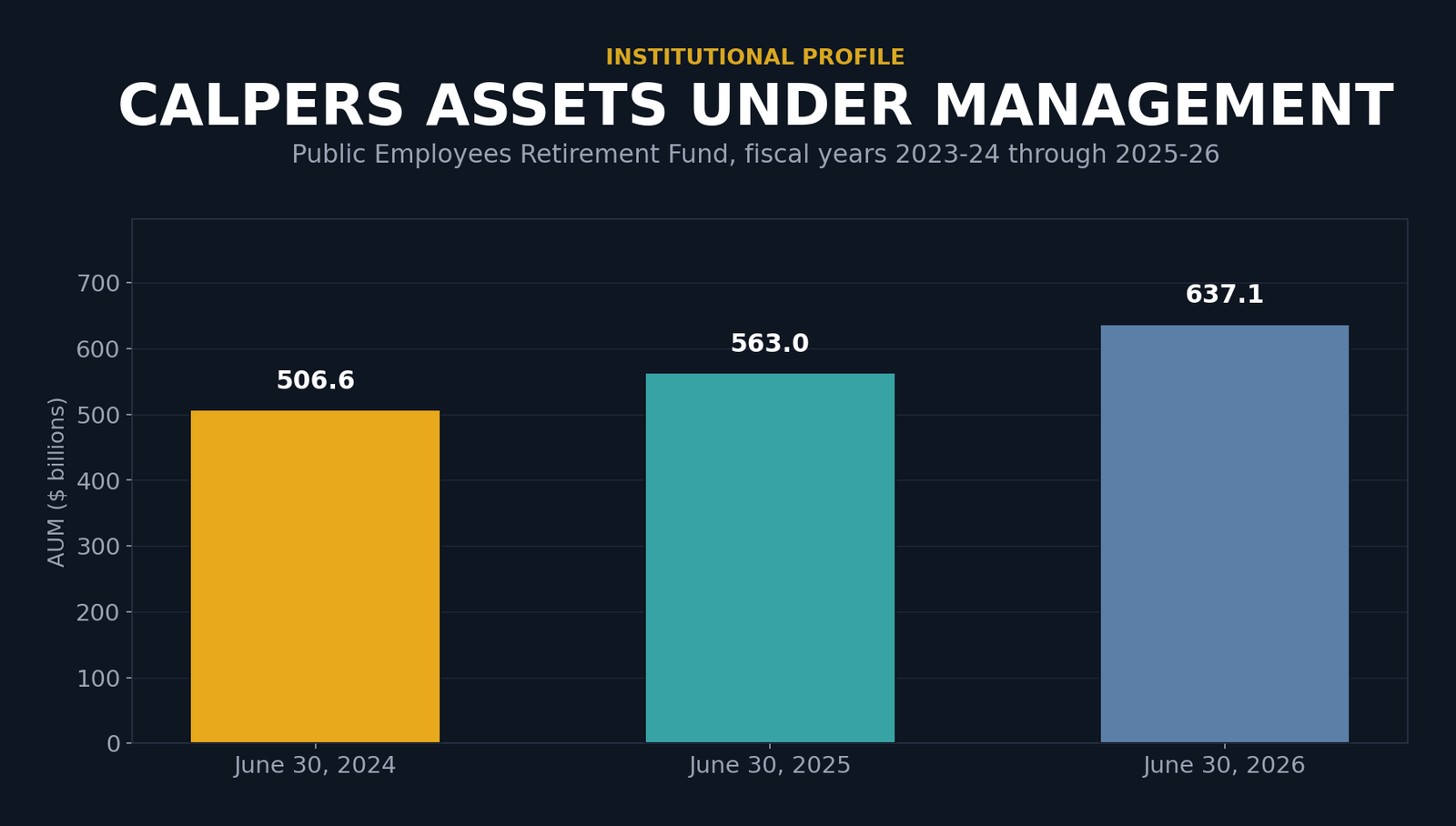
CalPERS assets under management grew from $506.6 billion at June 30, 2024, to $637.1 billion at June 30, 2026. Source: CalPERS news release, July 13, 2026; CalPERS PERSpective.
| As of Date | AUM ($ billions) |
|---|---|
| June 30, 2024 | 506.6 |
| June 30, 2025 | 563.0 |
| June 30, 2026 | 637.1 |
Asset-class returns for fiscal year 2025-26 varied significantly: public equity returned 24.1%, private equity 17.0%, private debt 11.0%, real assets 6.3%, and fixed income 5.9%. These returns reflect the system's diversified global investment strategy and the strong performance of public equity markets during the period. The system's funded status improved to 85% as of June 30, 2026, up from 79% at June 30, 2025, reflecting both investment gains and actuarial discipline. Key financial metrics include:
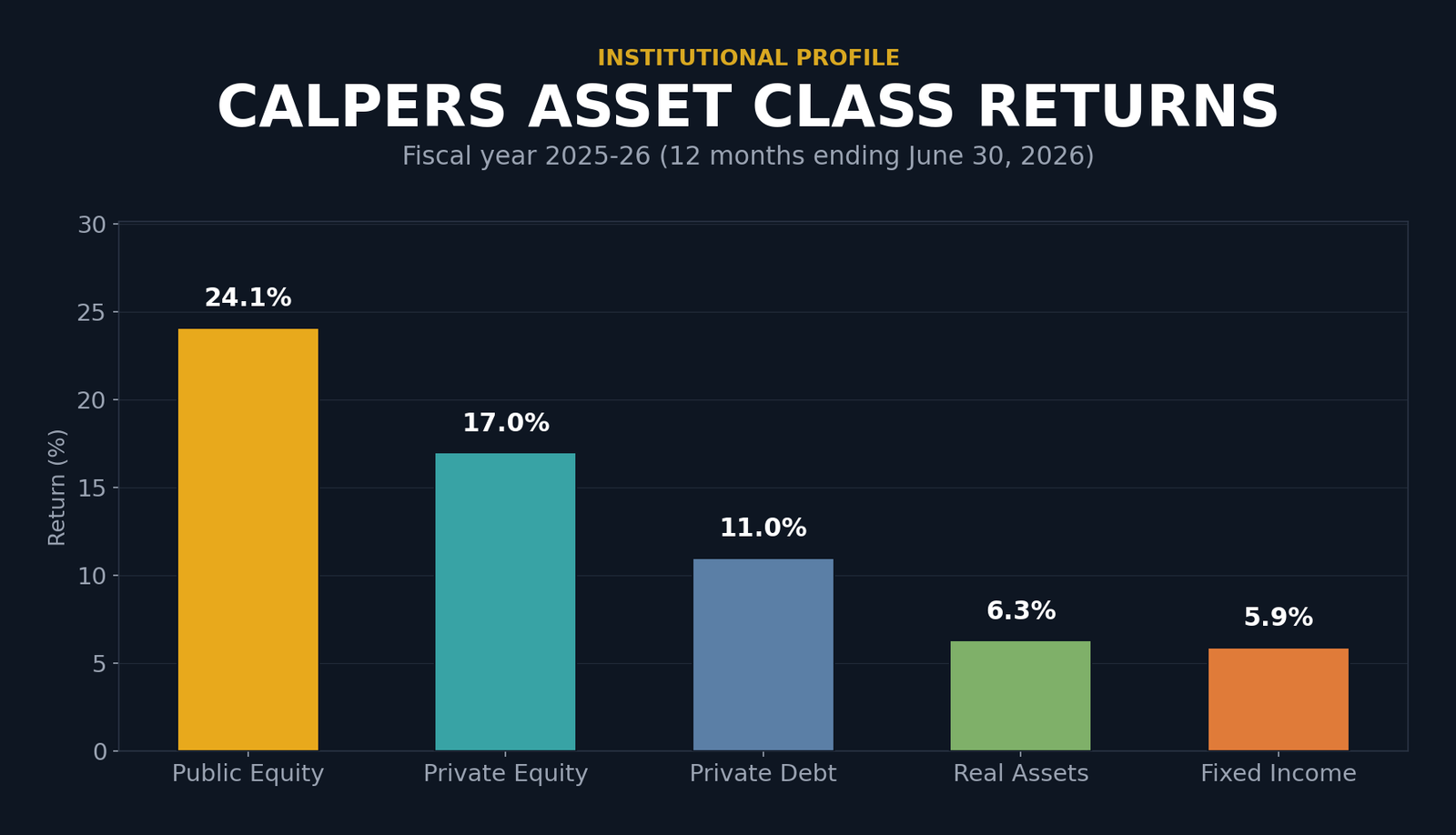
Public equity led asset class returns in fiscal year 2025-26 at 24.1%, followed by private equity at 17.0% and private debt at 11.0%. Source: CalPERS news release, July 13, 2026.
| Asset Class | Return (%) |
|---|---|
| Public Equity | 24.1% |
| Private Equity | 17.0% |
| Private Debt | 11.0% |
| Real Assets | 6.3% |
| Fixed Income | 5.9% |
- Assets under management: $637.1 billion as of June 30, 2026
- Fiscal year 2025-26 net investment return: 14.8% (preliminary)
- Funded status: 85% as of June 30, 2026
- Annual benefit payments: $34.6 billion in fiscal year 2024-25 to more than 825,000 retirees and beneficiaries
DEEP Disclosure Rating
The DEEP Disclosure Rating measures how much a fund discloses about itself. It is a disclosure and governance measure only, and not a judgment of investment quality or creditworthiness. The California Public Employees' Retirement System's DEEP Disclosure Score is 57 of 100, band Adequate. It publishes an annual report and audited financial statements, discloses assets under management with as-of date, discloses investment performance and return earned, discloses actual asset allocation, publishes an RFP or procurement process and portal, names governing board and trustees and senior investment staff, makes disclosures freely and publicly accessible with no paywall, publishes current disclosures within the fund's reporting cycle, and consolidates disclosures in a reasonably findable manner. It does not disclose fees or investment costs, does not publish an Investment Policy Statement or equivalent mandate document, does not disclose target asset allocation, does not disclose portfolio holdings, does not disclose how it selects managers or name its investment consultant, and does not publish board or committee meeting materials or minutes, which places it in the Adequate band. Last assessed October 2026, on the 2024-25 Annual Comprehensive Financial Report and 2024-25 Annual Investment Report and published governance materials. Items that cannot apply to a fund's type are excluded from its score rather than scored as zero. The fund-specific basis is included in the DEEP Disclosure Report. The full scoring rubric is public on the DEEP Disclosure Rating methodology page. A detailed breakdown of this fund's score is available as a DEEP Disclosure Report on request.
Manager Approach and Matching Profile
Pursuit verdict: CalPERS operates a competitive procurement process through its public Bid Opportunities portal, where prospective managers can register to receive email notifications of advertised Requests for Proposals. The system does not disclose a public RFP calendar, external manager roster, or investment consultant, and no unsolicited-proposal process is published. Active managers across public equity, fixed income, private equity, real assets, and private debt should monitor the Bid Opportunities portal for relevant RFPs. Incumbent managers are not named, so competitive entry depends on advertised procurement cycles. Managers without portal registration will miss opportunities.
- Target vs. actual allocation: CalPERS does not disclose target allocation percentages or ranges in the sources provided. The Total Portfolio Approach, launched in July 2026, evaluates each investment strategy for its potential to benefit the entire fund rather than adhering to fixed asset-class allocations. Actual asset-class returns for fiscal year 2025-26 show the fund invested across public equity (24.1% return), fixed income (5.9% return), private equity (17.0% return), real assets (6.3% return), and private debt (11.0% return). The system measures active approach performance against a standard reference portfolio of 75% global equities and 25% U.S. Treasury bonds. No target allocation table is published.
- Historical AUM and return series: CalPERS discloses assets under management and investment returns for the Public Employees' Retirement Fund across multiple periods. The most recent three fiscal years show steady asset growth and strong investment performance. Asset-class returns are disclosed for fiscal year 2025-26, and annualized returns are disclosed for five-year, ten-year, and twenty-year periods to June 30, 2026.
Period AUM Return June 30, 2026 $637.1 billion 14.8% (fiscal year 2025-26, preliminary) June 30, 2025 $563.0 billion 11.6% (fiscal year 2024-25) June 30, 2024 $506.6 billion Not disclosed Five-year annualized to June 30, 2026 Not disclosed 6.83% Ten-year annualized to June 30, 2026 Not disclosed 8.57% Twenty-year annualized to June 30, 2026 Not disclosed 6.81% - External manager roster and consultant detail: CalPERS does not disclose its external manager roster, named mandates, or investment consultant in the sources provided. The system employs a mixed investment approach combining in-house management with external manager mandates, but no manager names, mandate details, benchmarks, assets under management by mandate, or fee structures are publicly disclosed. The Deputy Chief Investment Officer for Private Markets, Anton Orlich, oversees the private equity, real assets, and private debt portfolios, but the division of responsibilities between in-house and external management is not disclosed.
Mandate Benchmark or strategy AUM Manager Fee or expense Not publicly disclosed Not publicly disclosed Not publicly disclosed Not publicly disclosed Not publicly disclosed - Commitment pacing: CalPERS does not disclose commitment pacing for its private equity, real assets, or private debt programs in the sources provided. The system invests across these asset classes and reports returns for each category, but no vintage-year commitments, deployment schedules, or pacing targets are published.
- RFP, procurement, and board calendar: CalPERS operates a Bid Opportunities portal where prospective managers can register to receive email notifications of advertised Requests for Proposals. Registration is available at calpers.ca.gov/page/about/doing-business-with-calpers/bid-opportunities/register. The system procures selectively through advertised RFPs, but no public RFP calendar or upcoming procurement schedule is disclosed. No investment consultant is named in the sources. The system does not publish a board or committee meeting calendar, and no unsolicited-proposal policy is disclosed. Realistic entry for prospective managers depends on portal registration and monitoring for relevant RFP announcements. The system's procurement process is competitive, and no pathway for unsolicited proposals is published.
Matching profile: these data points feed the cross-fund manager matching profile.
Sources: CalPERS news release (July 13, 2026), 2024-25 Annual Comprehensive Financial Report, 2024-25 Annual Investment Report, CalPERS Bid Opportunities registration page.
Governance and Leadership
The CalPERS Board of Administration consists of 13 members elected, appointed, or holding office ex officio for four-year terms. Board members include state, school, and public agency representatives, plus a retired member representative. As of 2026, elected board members include Cecelia Wilson (state member representative, first term beginning January 16, 2027), Kevin Palkki (school member representative, second term), and Mullissa Willette (public agency member representative, second term). A retired member representative election is scheduled for 2027. The board has authority to make decisions impacting all active and retired members, including consideration of changes to the discount rate based on investment performance.
Executive leadership includes Marcie Frost, Chief Executive Officer, who arrived in October 2016; Stephen Gilmore, Chief Investment Officer; and Anton Orlich, Deputy Chief Investment Officer for Private Markets. The sources do not name additional senior investment staff, board committee chairs, or other governance officers. No board or committee meeting materials, minutes, or governance documents beyond the elected member roster are disclosed in the sources provided.
How to Engage
CalPERS procures investment managers selectively through advertised Requests for Proposals. Prospective managers can register on the CalPERS Bid Opportunities portal to receive email notifications of advertised RFPs. Registration is available at calpers.ca.gov/page/about/doing-business-with-calpers/bid-opportunities/register. The system does not disclose a public RFP calendar, so managers must monitor the portal for relevant opportunities. No investment consultant is named in the sources, and no unsolicited-proposal policy is published. The system's procurement process is competitive, and entry depends on advertised RFP cycles. Managers without portal registration will not receive RFP notifications and will miss procurement opportunities.
Sources and Documents
- CalPERS news release, "CalPERS Posts 14.8% Preliminary Investment Return for Fiscal Year 2025-26," July 13, 2026
- CalPERS PERSpective, "7 Things to Know About Our Financial Report" (covering fiscal year 2024-25)
- CalPERS Investment & Financial Reports page (listing annual reports and investment committee reports)
- CalPERS Bid Opportunities registration page
- CalPERS Board Elections page
Data Notes and Methodology
This profile is based on CalPERS' 2024-25 Annual Comprehensive Financial Report (published December 2025), 2024-25 Annual Investment Report, news release of July 13, 2026, and official website materials as of October 1, 2026. Assets under management and fiscal year 2025-26 return are as of June 30, 2026. The fiscal year 2025-26 return of 14.8% is preliminary and will be finalized after review by investment and finance staff and outside experts. Private market asset valuations (private equity, real assets, private debt) lag one quarter and are as of March 31, 2026. The sources do not include CalPERS' Investment Policy Statement, target allocations, external manager roster, or fee schedule. No investment consultant is named, and no unsolicited-proposal policy is disclosed. The next expected update is the 2025-26 Annual Comprehensive Financial Report and Annual Investment Report, expected December 2026.