
Berkshire Hathaway
Overview
Berkshire Hathaway Inc. is a diversified holding company founded in 1956 and headquartered in Omaha, Nebraska. Warren Buffett serves as Chairman, and Greg Abel became Chief Executive Officer on 1 January 2026, having been appointed in May 2025. The company's core business is insurance, operating GEICO, a primary insurance group, and a reinsurance operation. At year-end 2025, Berkshire's insurance operations held float of $176 billion, a liability-derived capital pool deployed across equity investments, operating businesses, and cash holdings. The company employs nearly 400,000 people across its insurance and non-insurance operations.
Berkshire operates 51 non-insurance businesses spanning railroads, utilities and energy, manufacturing, service, and retailing. BNSF Railway is a major freight railroad serving the Western two-thirds of the United States. Berkshire Hathaway Energy (BHE) operates utilities and energy infrastructure serving customers in the Western and Midwestern United States. The company's manufacturing, service, and retailing businesses include Precision Castparts (aerospace components), Lubrizol (specialty chemicals), and a portfolio of consumer brands. In 2025, Berkshire announced acquisitions of OxyChem, an industrial chemicals business, and Bell Laboratories, a rodent control company, reflecting its capital discipline and focus on businesses with durable competitive advantages.
Berkshire maintains a fortress balance sheet with over $370 billion in cash and United States Treasury holdings at year-end 2025. The company uses debt sparingly and prioritizes financial strength and independence. Its decentralized operating model grants autonomy to business leaders grounded in deserved trust, with no layers of management between the corporate office and operating business chief executives. Berkshire does not operate as a traditional institutional allocator seeking external asset managers; it is a publicly traded holding company that makes direct equity investments and acquires operating businesses based on capital discipline and intrinsic-value criteria.
The company's insurance operations returned $29 billion to Berkshire in 2025 and are permitted to return up to $31 billion annually without regulatory approval. Berkshire's insurance businesses are authorized to underwrite large and complex risks without quarterly earnings targets, enabling disciplined pricing and long-term risk management. The company's investment approach emphasizes concentration in high-conviction ideas, businesses with durable competitive advantages, and leadership teams with high integrity. Berkshire does not pay dividends, as retained earnings are expected to create more than one dollar of market value per dollar retained.
Investment Mandate
Berkshire Hathaway's mission is to maximize growth in intrinsic value per share over the long term through disciplined capital allocation and stewardship of shareholders' capital. The company's strategy is to invest in businesses with durable competitive advantages and long-term economic prospects, led by high-integrity managers, and to concentrate capital in high-conviction ideas. Berkshire maintains financial strength and liquidity as foundational principles, with a fortress balance sheet and substantial cash reserves to support opportunistic capital deployment.
The company's insurance operations focus on growing underwriting profits and float in a disciplined manner. In 2025, Berkshire's property and casualty insurance businesses achieved a combined ratio of 87.1 percent, reflecting underwriting discipline and pricing rigor. The five-year average combined ratio was 90.7 percent. Insurance float increased from $88 billion at year-end 2015 to $176 billion at year-end 2025, providing a growing pool of capital for deployment. The insurance businesses operate with autonomy to underwrite large and complex risks, guided by risk pricing discipline rather than quarterly earnings targets.
Berkshire's non-insurance operations follow a decentralized model with autonomy grounded in deserved trust. Chief executives of operating businesses are expected to pursue operational excellence and accountability without allocated targets or layers of management. The company evaluates capital allocation opportunities, including acquisitions, equity investments, and share repurchases, based on their potential to grow intrinsic value per share. Berkshire's geographic focus is primarily the United States for insurance and operating businesses, with global equity investments. BHE serves Western and Midwestern United States utilities markets. The company does not disclose target asset allocation percentages; actual holdings are visible in the consolidated balance sheet, and allocation decisions are made opportunistically based on capital discipline and intrinsic-value criteria rather than fixed targets.
Financial Position
Berkshire Hathaway is an insurance holding company and conglomerate; assets under management is not a standard metric for this allocator type. Total assets stood at $1.22 trillion at year-end 2025, converted from the reported figure of $1,222,176 million USD. Insurance float, the primary balance-sheet measure for capital deployment, stood at $176 billion at year-end 2025. Total equity (shareholders' equity) and insurance float are the relevant financial metrics for Berkshire's scale and capital position.
- Operating earnings: $44.5 billion in 2025, compared to $47.4 billion in 2024. The five-year average was $37.5 billion.
- Net cash flows from operating activities: $46 billion in 2025. The five-year average exceeded $40 billion.
- Insurance float: $176 billion at year-end 2025, up from $171 billion at year-end 2024 and $88 billion at year-end 2015.
- BNSF Railway: $8.1 billion in net operating cash flows in 2025, with $4.4 billion returned in dividends. The five-year average dividend was $4.1 billion. Operating margin was 34.5 percent in 2025, compared to 32.0 percent in 2024.
- Berkshire Hathaway Energy: $8.4 billion in net operating cash flows in 2025, consistent with the five-year average. BHE serves customers at rates 24 percent below the national retail electric rate.
- Precision Castparts: $2.4 billion in net operating cash flows in 2025, compared to a $0.9 billion average in 2021 through 2022.
- Investment portfolio at 31 December 2025: U.S. Treasury Bills $321.4 billion; equity securities $297.8 billion; cash and cash equivalents $47.7 billion; equity method investments $20.0 billion; fixed maturity securities $17.8 billion.
- Largest equity positions at 31 December 2025 (market value): Apple $62.0 billion, American Express $56.1 billion, Coca-Cola $28.0 billion, Moody's $12.6 billion, and five Japanese trading companies $35.4 billion combined. Together the nine named positions totaled $194 billion, nearly two thirds of the equity securities portfolio.
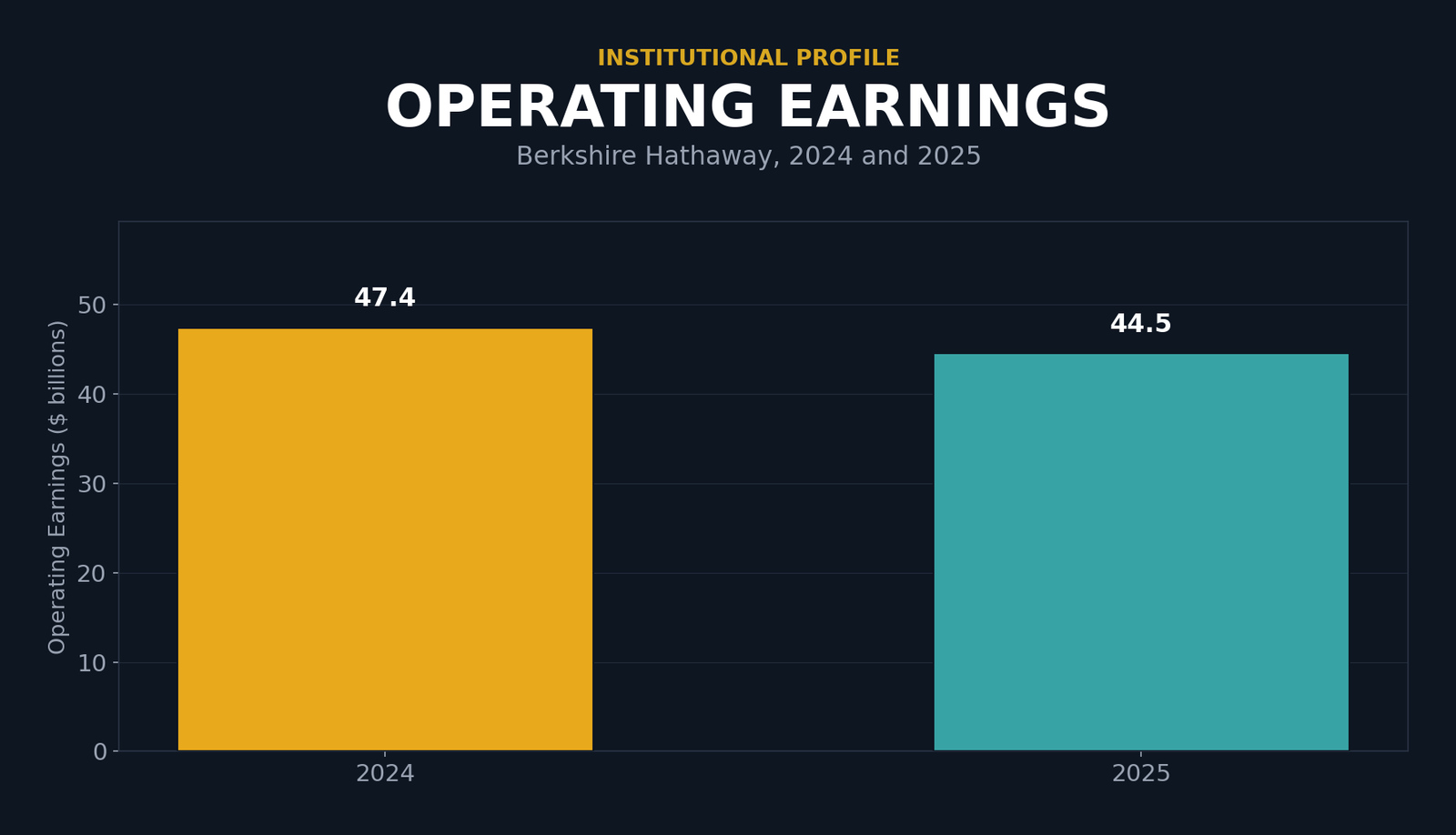
Operating earnings were $44.5 billion in 2025, compared to $47.4 billion in 2024, with a five-year average of $37.5 billion. Source: Berkshire Hathaway 2025 Annual Report.
| Year | Operating Earnings ($ billions) |
|---|---|
| 2024 | 47.4 |
| 2025 | 44.5 |
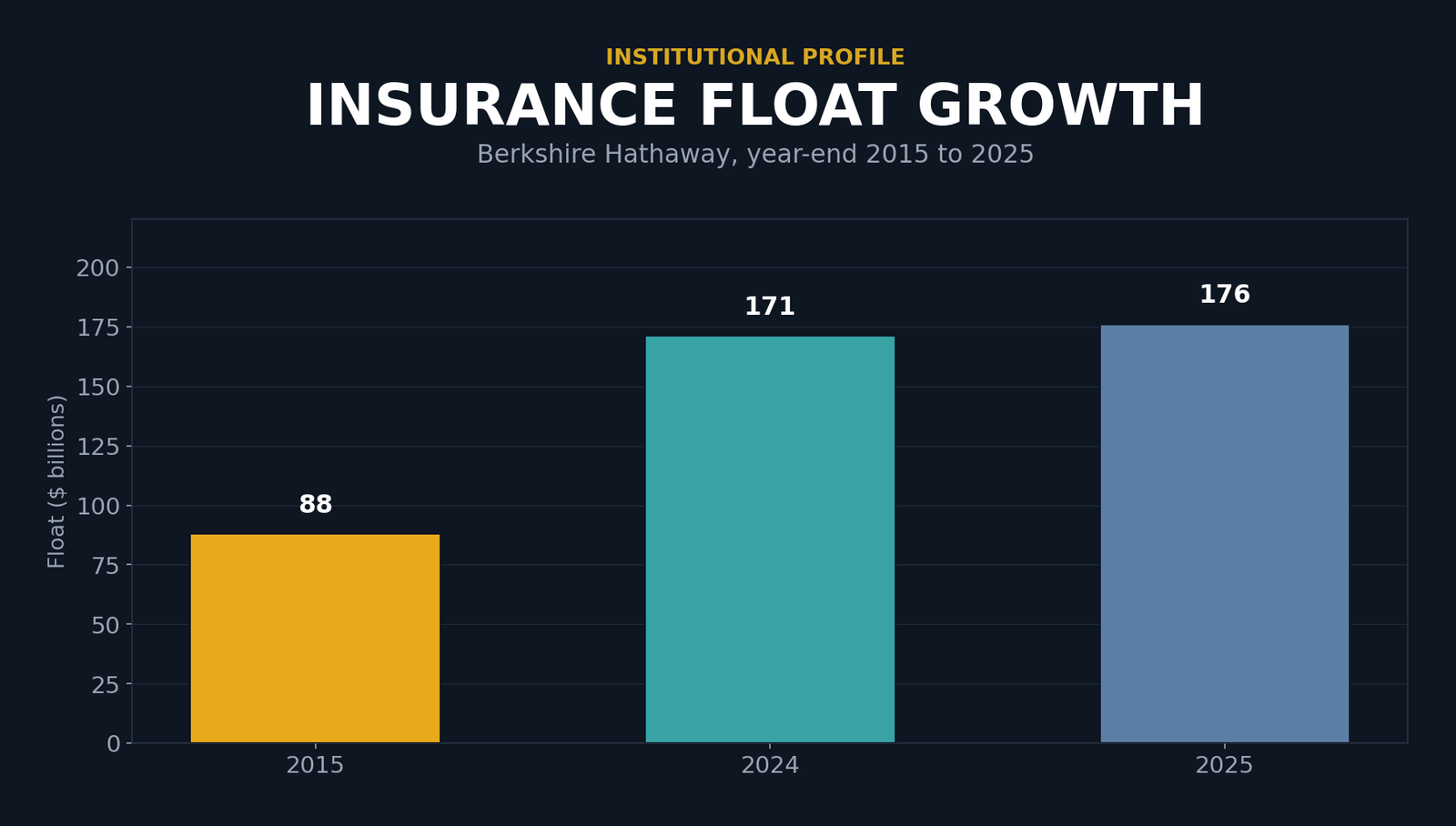
Insurance float increased from $88 billion at year-end 2015 to $176 billion at year-end 2025, reflecting growth in underwriting profits and disciplined capital deployment. Source: Berkshire Hathaway 2025 Annual Report.
| Period | Float ($ billions) |
|---|---|
| 2015 | 88 |
| 2024 | 171 |
| 2025 | 176 |
DEEP Disclosure Rating
Under the DEEP Disclosure Rating, Berkshire Hathaway scores 53 of 100 (Limited) for disclosure and governance transparency as of this assessment. Berkshire publishes audited financial statements, investment results, the composition of its investment portfolio in the consolidated balance sheet, its board and executive officers, and its largest equity positions by name and value. It does not publish an investment policy statement, target allocation, a complete position-level holdings list, an investment fee or cost schedule, a manager-selection process, an RFP process, or board and committee meeting minutes and materials. The DEEP Disclosure Rating measures disclosure and governance practices; it does not assess investment quality, performance, or creditworthiness. Last assessed October 2026. Items that cannot apply to a fund's type are excluded from its score rather than scored as zero. The fund-specific basis is set out in the DEEP Disclosure Report. The full scoring rubric is public on the DEEP Disclosure Rating methodology page. A detailed, pillar-by-pillar and item-by-item breakdown of this fund's score is available as a DEEP Disclosure Report on request.
Manager Approach and Matching Profile
Pursuit verdict: Active managers and index managers: no opportunity. Berkshire Hathaway is a publicly traded holding company that operates its own insurance and non-insurance businesses. The company does not retain external asset managers or allocate capital to external funds. Capital deployment is directed by the Chief Executive Officer and Board of Directors based on opportunities that meet Berkshire's investment criteria: durable competitive advantages, long-term economic prospects, and high-integrity leadership. No public pathway exists for external managers to pitch mandates or participate in procurement processes.
- Target vs. actual allocation: Berkshire Hathaway does not disclose target asset allocation percentages. Actual allocation is disclosed through the consolidated balance sheet: at 31 December 2025 the company held $321.4 billion in U.S. Treasury Bills, $297.8 billion in equity securities, $47.7 billion in cash and cash equivalents, $20.0 billion in equity method investments, and $17.8 billion in fixed maturity securities, within total assets of $1.22 trillion. Insurance float stood at $176 billion at year-end 2025. Allocation decisions are made opportunistically based on capital discipline and intrinsic-value criteria rather than fixed targets.
- Historical AUM and return series: Berkshire Hathaway does not report assets under management in the traditional sense. Insurance float, a liability-derived metric, is disclosed annually and serves as the primary balance-sheet measure for capital deployment. Operating earnings and cash flows are disclosed annually. Investment returns are not separately reported; the company emphasizes operating earnings and intrinsic value per share as performance measures.
Period Insurance Float Year-end 2025 $176 billion Year-end 2024 $171 billion Year-end 2015 $88 billion - External manager roster and consultant detail: Berkshire Hathaway operates its own insurance and non-insurance businesses and does not retain external asset managers. The company is itself an active investor in public equities and operates 51 non-insurance operating businesses with internal leadership. Capital allocation decisions are made by the Chief Executive Officer and Board of Directors. No investment consultant is retained, and no external manager roster exists.
Mandate Benchmark or strategy AUM Manager Fee or expense Equity securities portfolio Not publicly disclosed $297.8 billion Berkshire Hathaway (managed internally) Not publicly disclosed Fixed maturity securities and U.S. Treasury bills Not publicly disclosed $339.3 billion Berkshire Hathaway (managed internally) Not publicly disclosed - Commitment pacing: Berkshire Hathaway is not a limited-partner investor in external funds. The company manages its own capital deployment through acquisitions, equity investments, and share repurchases, guided by capital discipline and intrinsic-value criteria. In 2025, Berkshire announced acquisitions of OxyChem and Bell Laboratories, reflecting opportunistic capital deployment based on durable competitive advantages and long-term economic prospects.
- RFP, procurement, and board calendar: Berkshire Hathaway does not publish an RFP calendar or procurement portal for external managers. The company is a publicly traded holding company, not a fund seeking external managers. Capital allocation decisions are made by the Chief Executive Officer and Board of Directors based on opportunities that meet Berkshire's investment criteria. No public access pathway exists for external managers to pitch mandates. The company holds an annual shareholder meeting in Omaha, but this is a shareholder engagement event, not a manager procurement process. Board meeting schedules and committee calendars are not publicly disclosed.
Matching profile: these data points feed the cross-fund manager matching profile.
Sources: 2025 Annual Report, CEO Letter; 2025 Annual Report, Form 10-K.
Governance and Leadership
Berkshire Hathaway is led by Warren Buffett as Chairman and Greg Abel as Chief Executive Officer from 1 January 2026, appointed in May 2025 to succeed Buffett. Ajit Jain serves as Vice Chairman, Insurance Operations, leading underwriting discipline and risk pricing for the company's insurance businesses. Adam Johnson was appointed President of Consumer Products, Service, and Retailing in 2025. The company's governance structure follows a decentralized model with autonomy grounded in deserved trust. No layers of management exist between the corporate office and operating business chief executives. Chief executives are expected to pursue operational excellence and accountability without quarterly earnings targets.
Berkshire's culture and values emphasize a partnership attitude with shareholders, integrity and reputation protection, financial strength and a fortress balance sheet, capital discipline, risk management (the Chief Executive Officer serves as Chief Risk Officer), and operational excellence. The company engages with shareholders through annual shareholder meetings held in Omaha and annual Chief Executive Officer letters published in the annual report. Shareholders are treated as partners with a long-term orientation.
- Warren Buffett, Chairman of the Board
- Greg Abel, Chief Executive Officer
- Ajit Jain, Vice Chairman, Insurance Operations
- Marc D. Hamburg, Senior Vice President and Chief Financial Officer
- Ted Weschler, Investment Manager
- Adam Johnson, President, Consumer Products, Service, and Retailing Businesses
- Howard G. Buffett, Director
- Susan A. Buffett, Director
- Stephen B. Burke, Director
- Kenneth I. Chenault, Director
- Christopher C. Davis, Director
- Susan L. Decker, Director
- Charlotte Guyman, Director
- Thomas S. Murphy Jr., Director
- Wallace R. Weitz, Director
- Meryl B. Witmer, Director
The 2025 Annual Report names the full board of directors and the executive officers, and the CEO Letter states that investment responsibility ultimately resides with the Chief Executive Officer and that Ted Weschler manages about 6 percent of Berkshire's investments. Board and committee meeting minutes are not published.
How to Engage
Berkshire Hathaway operates its own insurance and non-insurance businesses and does not engage with external asset managers. The company does not publish an RFP calendar, procurement portal, or stated policy on unsolicited proposals from asset managers. Berkshire is a publicly traded holding company, not a fund allocating capital to external managers. Capital deployment decisions are made by the Chief Executive Officer and Board of Directors based on opportunities that meet the company's investment criteria: durable competitive advantages, long-term economic prospects, and high-integrity leadership.
Insurance operations are led by Ajit Jain, who directs underwriting discipline and risk pricing. Insurance teams have autonomy to underwrite large and complex risks without quarterly earnings targets. Operating businesses follow a decentralized leadership model with accountability. Chief executives are given autonomy to run businesses and focus on customers, efficiency, and continuous improvement. The Chief Executive Officer and Board evaluate acquisition and investment opportunities based on durable competitive advantages, long-term economic prospects, and high-integrity leadership. Berkshire makes direct equity investments in public companies and acquires operating businesses. In 2025, the company acquired OxyChem and Bell Laboratories, demonstrating its opportunistic approach to capital deployment.
Sources and Documents
- 2025 Annual Report, CEO Letter (Greg Abel), published 2026
- 2025 Annual Report, Form 10-K (Business Description, Management's Discussion and Analysis, Consolidated Financial Statements), published 2026
Data Notes and Methodology
This profile is based on Berkshire Hathaway's 2025 Annual Report, including the Chief Executive Officer letter, Form 10-K, and audited consolidated financial statements. The report covers the year ended 31 December 2025 and was published in 2026. Berkshire Hathaway is an insurance holding company and conglomerate, not a traditional institutional capital allocator such as a pension fund, sovereign wealth fund, or endowment. Assets under management is not a standard metric for this allocator type. Insurance float ($176 billion at year-end 2025) and shareholders' equity are the relevant balance-sheet measures. The company does not disclose target asset allocation percentages or a complete position-level holdings list; actual allocation is visible in the consolidated balance sheet, and the largest equity positions are named in the CEO Letter. It does not disclose an external manager selection process because it operates as a holding company with internal management, not as a fund allocating to external managers. Board and committee meeting minutes are not published. Operating earnings ($44.5 billion in 2025) and cash flows ($46 billion in 2025) are the primary performance metrics disclosed. GAAP net earnings are de-emphasized due to volatility from investment gains and losses. The next expected update is the 2026 Annual Report, expected in 2026. This profile was verified against primary filings and last updated 1 October 2026.