
GIC
Overview
GIC was established in 1981 by Dr Goh Keng Swee, then Deputy Prime Minister of Singapore, making it the world's first non-commodity-based sovereign wealth fund. The fund is mandated by the Government of Singapore, through the Ministry of Finance, to manage Singapore's foreign reserves with the aim of achieving good long-term real returns. GIC is headquartered in Singapore with global offices in London, New York, and other key markets.
GIC manages most of the Government's financial assets and is one of three investment entities managing Singapore's reserves, alongside the Monetary Authority of Singapore (MAS) and Temasek Holdings. The fund operates autonomously on individual investment decisions without influence from the Client or Board. The Board is accountable to the President of Singapore as a Fifth Schedule company under the Singapore Constitution. GIC has over 40 years of investing in technology and established an AI Council in 2023, transitioning to an AI-native organization.
The fund does not disclose assets under management or reserves under management. GIC manages Singapore's foreign reserves but does not publish the total amount in any form. This non-disclosure is a stated policy position maintained across all published sources.
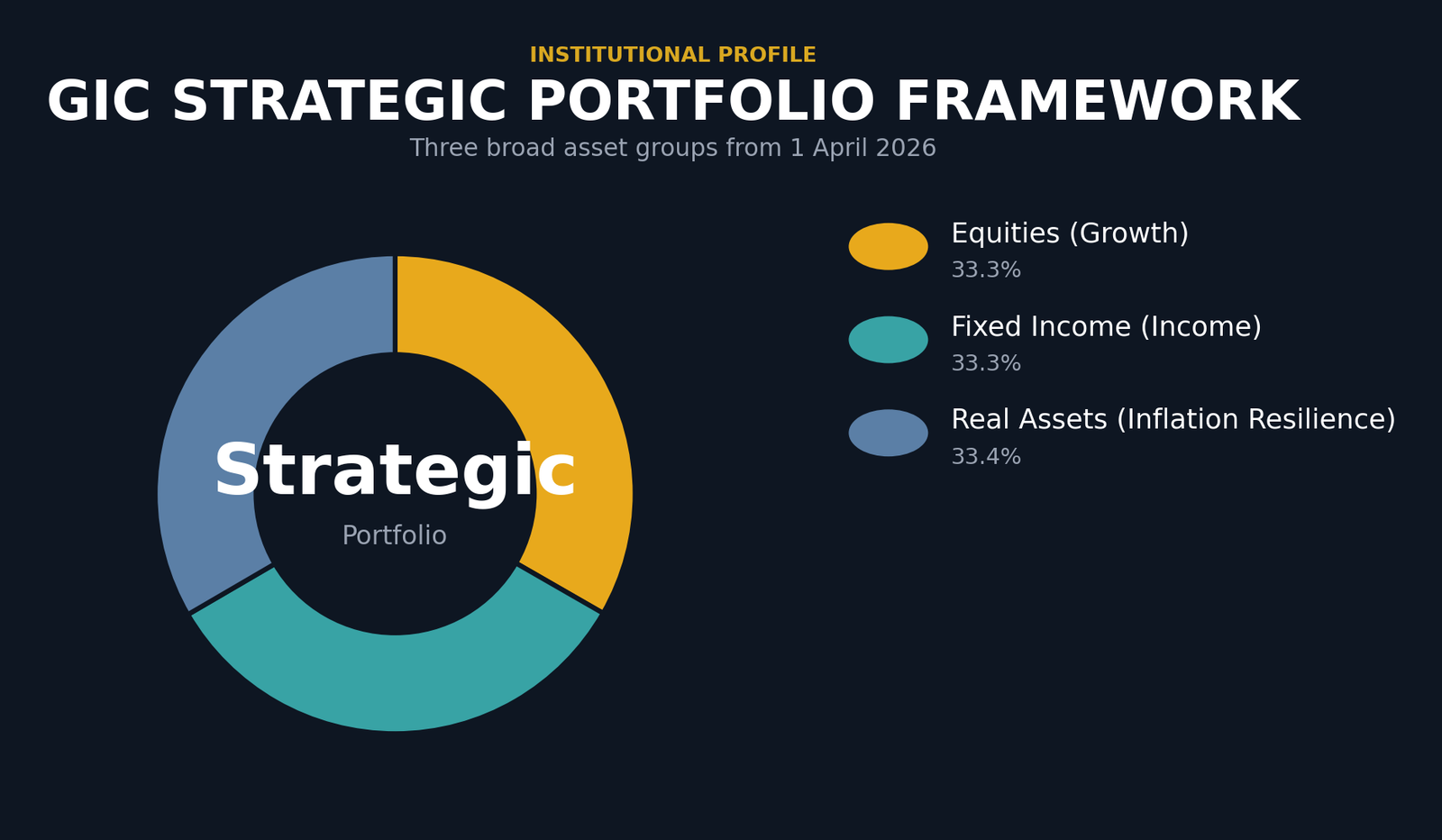
From 1 April 2026, GIC adopted a Strategic Portfolio framework comprising three broad asset groups: Equities for growth, Fixed Income for income, and Real Assets for inflation resilience. Source: Report on the Management of the Government's Portfolio for the Year 2025/26 (published 24 July 2026).
| Asset Group | Framework Share (%) |
|---|---|
| Equities (Growth) | 33.3% |
| Fixed Income (Income) | 33.3% |
| Real Assets (Inflation Resilience) | 33.4% |
Investment Mandate
GIC's mandate is to preserve and enhance the international purchasing power of Singapore's foreign reserves over the long term by achieving good long-term real returns above global inflation. The fund operates with a long-term investment horizon, using a 20-year rolling return as its primary performance metric. From 1 April 2026, GIC adopted a Strategic Portfolio framework comprising three broad asset groups: Equities (for growth), Fixed Income (for income), and Real Assets (for inflation resilience). The GIC Portfolio is designed to outperform the Strategic Portfolio over the long term within approved risk parameters through active investing.
Portfolio construction is guided by three principles: diversification, granularity, and agility. GIC invests globally across public and private markets, including public equity, fixed income, private equity, real estate, infrastructure, hedge funds, and cash. The fund does not allocate by geography but monitors regional exposures. As a rule, GIC invests outside Singapore, though it can invest in appropriate Singapore companies with a global footprint. The fund does not invest in countries subject to United Nations Security Council sanctions.
GIC describes the Strategic Portfolio framework and asset groups in its published materials but does not disclose specific target allocation percentages or ranges. The fund's annual report shows the structure of asset-class allocation (Equities, Fixed Income, Real Assets) and geographic distribution, though the actual percentage figures for asset classes as of 31 March 2026 are not filled in the source template provided. Geographic mix percentages are disclosed in the report.
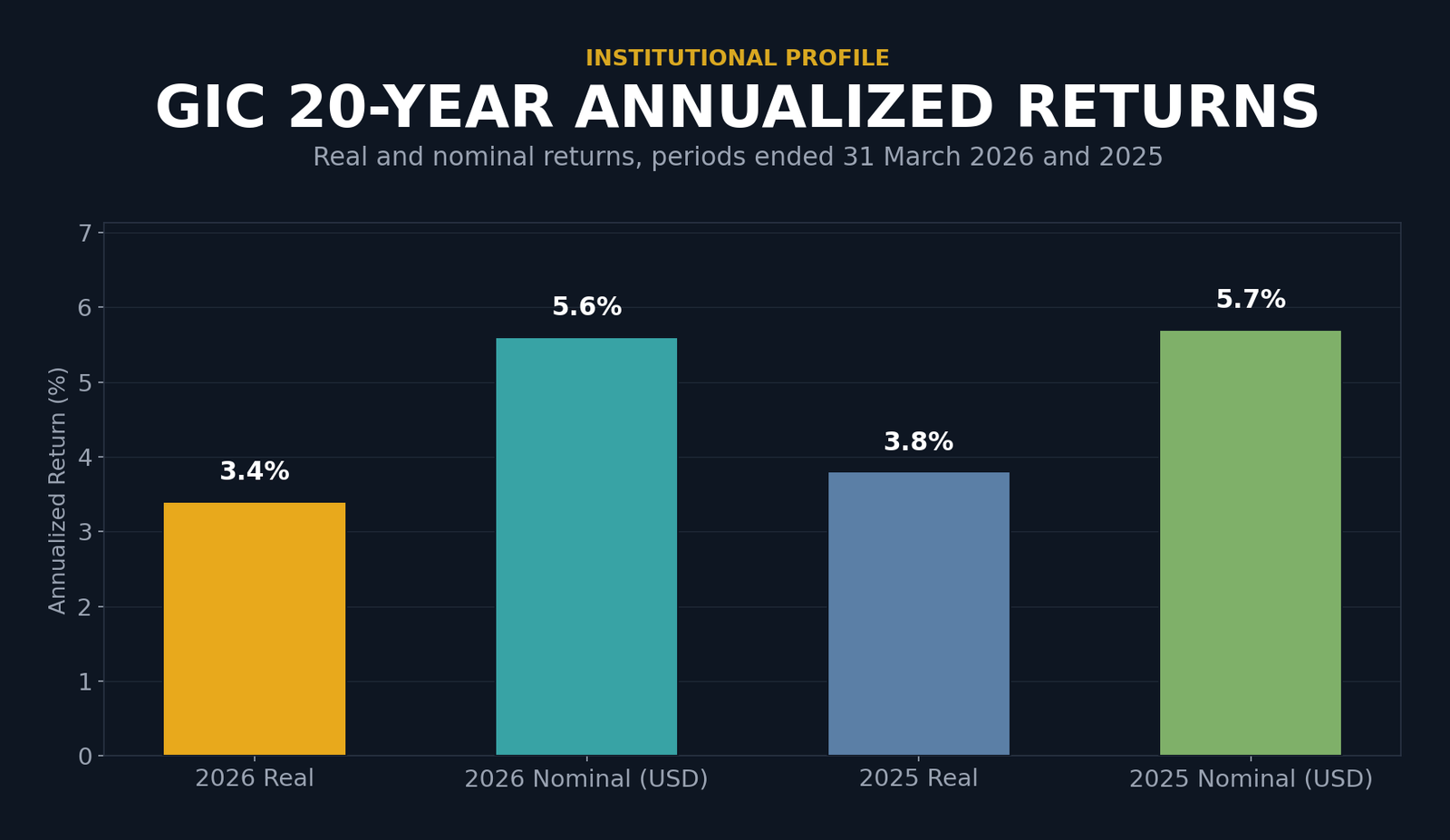
GIC's 20-year annualized real return for the period ended 31 March 2026 was 3.4 percent, with a nominal return of 5.6 percent in US dollar terms. Source: Report on the Management of the Government's Portfolio for the Year 2025/26 (published 24 July 2026).
| Period | Return (%) |
|---|---|
| 2026 Real | 3.4% |
| 2026 Nominal (USD) | 5.6% |
| 2025 Real | 3.8% |
| 2025 Nominal (USD) | 5.7% |
Financial Position
GIC's 20-year annualized real return for the period ended 31 March 2026 was 3.4 percent, with a 20-year annualized nominal return of 5.6 percent in US dollar terms. For the prior year ended 31 March 2025, the 20-year annualized real return was 3.8 percent and the nominal return was 5.7 percent. The fund does not disclose 10-year or 5-year annualized returns in the sources provided. The Net Investment Returns Contribution (NIRC) was estimated at S$28.5 billion in fiscal year 2026, supporting the Government budget.
- Assets under management: Not disclosed. GIC does not publish AUM or reserves under management as a stated policy.
- 20-year annualized real return (to 31 March 2026): 3.4 percent
- 20-year annualized nominal return (to 31 March 2026): 5.6 percent (US dollar terms)
- Workforce: Not disclosed in sources
DEEP Disclosure Rating
The DEEP Disclosure Rating measures how much a fund discloses about itself. It is a disclosure and governance measure only, and not a judgment of investment quality or creditworthiness. GIC's DEEP Disclosure Score is 45 of 100, band Limited. It publishes an annual report with audited financial statements, investment performance and return earned, an Investment Policy Statement or equivalent mandate document, names of governing board and trustees and senior investment staff, and makes all disclosures freely and publicly accessible without paywall, current within the fund's reporting cycle, and reasonably findable and consolidated. It does not disclose assets under management or reserves with as-of date, fees or investment costs, target asset allocation, actual asset allocation, portfolio holdings, how it selects managers or names its investment consultant, an RFP or procurement process or portal, or board and committee meeting materials or minutes, which places it in the Limited band. Last assessed October 2026, on the Report on the Management of the Government's Portfolio for the Year 2025/26 (published 24 July 2026) and published governance materials. Items that cannot apply to a fund's type are excluded from its score rather than scored as zero. The fund-specific basis is included in the DEEP Disclosure Report. The full scoring rubric is public on the DEEP Disclosure Rating methodology page. A detailed, pillar-by-pillar and item-by-item breakdown of this fund's score is available as a DEEP Disclosure Report on request.
Manager Approach and Matching Profile
Pursuit verdict: Active managers across public and private markets: GIC engages external fund managers to access investment capabilities and opportunities, and has built a network of over 100 active fund managers in private equity, but does not disclose manager names, an RFP process, or a procurement portal. Entry depends on direct relationships with GIC's investment teams; no public pathway for unsolicited proposals is stated. Passive managers: no disclosed opportunity; GIC's mandate and approach are active. Consultants: GIC does not name an investment consultant or describe a formal manager-selection process in its publications.
- Target vs. actual allocation: GIC discloses the Strategic Portfolio framework comprising three broad asset groups (Equities for growth, Fixed Income for income, Real Assets for inflation resilience) representing the Client's risk appetite and long-term return expectations, but does not disclose specific target allocation percentages or ranges in the sources provided. The annual report shows the structure of asset-class allocation and geographic distribution. Asset-class totals are disclosed in table format for 31 March 2026 and 31 March 2025, but the actual percentage figures appear to be redacted or not filled in the source template provided. Geographic mix percentages are disclosed. The fund does not allocate by geography but monitors regional exposures.
- Historical AUM and return series: GIC discloses rolling 20-year real and nominal returns for periods ended 31 March 2026 and 31 March 2025. The fund does not disclose assets under management or reserves under management.
Period AUM Return 20-year period ended 31 March 2026 (real) Not disclosed 3.4% 20-year period ended 31 March 2026 (nominal USD) Not disclosed 5.6% 20-year period ended 31 March 2025 (real) Not disclosed 3.8% 20-year period ended 31 March 2025 (nominal USD) Not disclosed 5.7% - External manager roster and consultant detail: GIC does not disclose a roster of named external managers. The sources state that GIC engages external fund managers to access investment capabilities and opportunities, and has built a network of over 100 active fund managers in private equity, but specific manager names are not published. No investment consultant is named in the sources. GIC's investment departments (Public Equities, Fixed Income and Multi Asset, Private Equity, Real Estate, Infrastructure, Integrated Strategies Group) manage portfolios directly and engage external managers as needed, but the fund does not publish a mandate table or fee schedule.
Mandate Benchmark or strategy AUM Manager Fee or expense Not publicly disclosed Not publicly disclosed Not publicly disclosed Not publicly disclosed Not publicly disclosed - Commitment pacing: GIC invests in private equity, real estate, and infrastructure but does not disclose commitment pacing or capital deployment schedules in the sources provided. The Private Equity department adds value to boards and management of investee companies by providing advice and access to GIC's global business network. The Real Estate and Infrastructure departments have dedicated asset management teams that work alongside investment professionals to monitor and enhance governance and operations of portfolio companies. GIC invests directly in companies and through funds, and engages with entrepreneurs and families for bespoke solutions through its Integrated Strategies Group.
- RFP, procurement, and board calendar: GIC does not disclose an RFP process, procurement portal, or board and committee meeting calendar. No public route for manager selection or unsolicited proposals is stated. The fund's governance structure includes a Board of Directors supported by five board committees (Investment Strategies Committee, Investment Board, Risk Committee, Audit Committee, and Human Resource and Organization Committee) and an International Advisory Board, but meeting schedules and materials are not published. The Government, represented by the Ministry of Finance, mandates GIC and holds the board accountable but neither directs nor interferes in individual investment decisions. The President of Singapore has discretionary powers to protect past reserves through a two-key system and must concur with all board appointments and removals.
Matching profile: these data points feed the cross-fund manager matching profile.
Sources: Report on the Management of the Government's Portfolio for the Year 2025/26 (published 24 July 2026); GIC website sections on governance, investment approach, and portfolio; GIC Newsroom releases dated 24 July 2026 and 25 July 2025.
Governance and Leadership
The GIC Board is responsible for overall performance and adherence to risk and return objectives set by the Government. The Board is supported by five board committees: Investment Strategies Committee, Investment Board, Risk Committee, Audit Committee, and Human Resource and Organization Committee. An International Advisory Board provides global and regional perspectives on geopolitical, economic, and market developments. The Government, represented by the Ministry of Finance, mandates GIC and holds the board accountable; neither directs nor interferes in individual investment decisions. The President of Singapore has discretionary powers to protect past reserves (accumulated before the current government term) through a two-key system. The President must concur with all board appointments and removals. GIC is a Fifth Schedule company under the Singapore Constitution, directly accountable to the President in key areas.
- Lim Chow Kiat, Chief Executive Officer
- Bryan Yeo, Group Chief Investment Officer
- Sam Kim, Chief Operating Officer and Director, Investment Insights Group
- Liew Tzu Mi, Deputy Group Chief Investment Officer and Director, Portfolio Execution and Solutions Group (effective 1 October 2026)
- Choo Yong Cheen, Deputy Group Chief Investment Officer and Chief Investment Officer, Private Equity (effective 1 October 2026)
- Jin Yuen Yee, Chief Risk Officer
- Deanna Ong, Chief People Officer
- Boon Chin Hau, Chief Investment Officer, Infrastructure
- Mark Ong, Chief Investment Officer, Public Equities
- Goh Chin Kiong, Chief Investment Officer and Head of Europe, Real Estate
- Charles Lim Sing Siong, General Counsel
Leadership changes effective 1 October 2026 were announced on 10 July 2026, including the appointments of Choo Yong Cheen and Liew Tzu Mi as Deputy Group Chief Investment Officers, and Liang Jiajie as Chief Investment Officer for Fixed Income and Multi Asset.
How to Engage
GIC engages external fund managers to access investment capabilities and opportunities across public and private markets. The fund has built a network of over 100 active fund managers in private equity and invests directly in companies and through funds. GIC's Integrated Strategies Group engages with entrepreneurs and families for bespoke solutions. The fund does not disclose an RFP process, procurement portal, or formal manager-selection process in its publications. No public route for unsolicited proposals is stated. Entry depends on direct relationships with GIC's investment teams.
GIC monitors investee companies and exercises ownership rights to protect and enhance long-term investment value. The Private Equity department adds value to boards and management of investee companies by providing advice and access to GIC's global business network. The Real Estate and Infrastructure departments have dedicated asset management teams that work alongside investment professionals to monitor and enhance governance and operations of portfolio companies. GIC is a Board Member of the International Forum of Sovereign Wealth Funds (IFSWF) and supports the Santiago Principles.
Sources and Documents
- GIC Newsroom: Report on the Management of the Government's Portfolio for the Year 2025/26 (published 24 July 2026)
- GIC Newsroom: Report on the Management of the Government's Portfolio for the Year 2024/25 (published 25 July 2025)
- GIC Website: Who We Are
- GIC Website: Our Governance
- GIC Website: How we invest
- GIC Website: Our Portfolio
- GIC Website: Santiago Principles
- GIC Newsroom: GIC Senior Leadership Appointments (10 July 2026)
- GIC Report 2025/26: Investment Report
- GIC Report 2025/26: Managing the Portfolio
Data Notes and Methodology
This profile is based on the Report on the Management of the Government's Portfolio for the Year 2025/26 (published 24 July 2026, covering the period ended 31 March 2026), GIC's official website sections on governance, investment approach, and portfolio, and newsroom releases dated 24 July 2026, 25 July 2025, and 10 July 2026. GIC does not disclose assets under management or reserves under management; this is a stated policy position. The 2025/26 Report template shows placeholder values for 10-year and 5-year nominal returns; the actual figures are not disclosed in the sources provided. Asset-class allocation percentages and geographic mix percentages are shown in the report structure, but the actual percentage values for asset classes as of 31 March 2026 appear to be redacted or not filled in the source template provided; geographic distribution is disclosed. GIC's Strategic Portfolio framework was introduced from 1 April 2026; the prior framework (Reference Portfolio, Policy Portfolio, Active Portfolio) was used through 31 March 2026. No external manager names are disclosed in the sources; GIC states it engages external fund managers and has built a network of over 100 active fund managers but does not name them publicly. No investment consultant is named in the sources. Leadership changes effective 1 October 2026 were announced on 10 July 2026. Assessment date is 1 October 2026.