
Mars Family Office
Overview
Mars, Incorporated was founded in 1911 by Frank C. Mars, who started making and selling butter cream candy from his kitchen in Tacoma, Washington. The company has been a private, family-owned business for over 100 years and has been headquartered in McLean, Virginia since 1984. Mars operates as a global company with operations in more than 130 countries, serving three primary business segments: petcare, food and nutrition, and snacking. The company has been led by non-family management since 2001 and is guided by The Five Principles (Quality, Responsibility, Mutuality, Efficiency, Freedom) established by founder Frank C. Mars and articulated by second-generation leadership.
The Mars history page reports more than $47 billion in annual sales in 2022. The company operates through three business segments: Mars Petcare (100,000 Associates serving pet health and nutrition in 130 countries), Mars Snacking (the world's leading manufacturer of chocolate, chewing gum, mints and fruity confections), and Mars Food and Nutrition (rice, pasta, and health and life sciences products). As a private operating company, Mars does not function as an institutional capital allocator and does not disclose investment portfolio holdings, asset allocations, or external manager selection processes.
The Mars family and thousands of Mars Associates steward The Five Principles in daily decision-making. The company's private ownership structure allows management to think in generations rather than quarters, supporting long-term strategic investments in sustainability, innovation, and community impact. Mars has committed to invest $2 billion into U.S. manufacturing through 2026 and $1 billion over several years in its Sustainable in a Generation Plan to address climate change, poverty in the value chain, and resource scarcity.
Investment Mandate
Mars operates as an integrated business across three segments with distinct purpose-driven strategies. Mars Petcare operates under the mission "A Better World for Pets," Mars Snacking pursues "Inspiring Happiness with Better Snacks for Better Days," and Mars Food and Nutrition follows "Better Food Today. A Better World Tomorrow." These purpose statements guide business decisions across the company's global operations. Mars Petcare serves pet health and nutrition in more than 130 countries through veterinary hospitals (Banfield, VCA, BluePearl, Linnaeus) and pet diagnostic and monitoring services. The segment launched The Companion Fund in 2018 to back pet-tech, products and services.
The company's Sustainable in a Generation Plan, launched in 2017, commits to zero carbon, water and waste impact from operations by 2040. All U.S. operations are powered by 100 percent renewable electricity as of 2025. Sourcing commitments include 100 percent sustainable cocoa, palm oil from certified sources, and fish and seafood from sustainable sources. Mars invests in innovation and science through the Waltham Centre for Pet Nutrition (established 1965), the Mars Center for Cocoa Science in Brazil, and the Mars Global Food Safety Center in China. The company launched the Farmer Income Lab in 2017 to address smallholder farmer income issues and established the Cocoa for Generations plan in 2018 to increase farmer income, safeguard children and forests, and create pathways for cocoa farming communities to thrive.
Mars signed on as a founding partner of the UN Development Programme's Lion's Share Fund in 2018 to tackle wildlife conservation and animal welfare. The Mars Impact Fund was launched to drive lasting change in community resilience, scientific opportunity and companion animal wellbeing, committing $3 million to Worldwide Veterinary Service (announced September 28, 2026). The company is investing $20 million in sustainable rice sourcing. As a private operating company in consumer goods, Mars does not manage institutional investment portfolios or allocate capital to external asset managers, and therefore does not maintain target asset allocations, investment policy statements, or external manager selection processes applicable to institutional capital allocators.
Financial Position
The Mars history page reports more than $47 billion in annual sales in 2022. This figure represents operating revenue from the company's three business segments (petcare, snacking, food and nutrition) and is not an assets under management figure. As a private company, Mars does not publish audited financial statements, annual reports, or investment returns. The family-owned structure allows the company to focus on long-term value creation without quarterly reporting requirements.
- Annual sales: over $47 billion (2022, as reported on the Mars history page)
- U.S. operations: 100 percent powered by renewable electricity as of 2025
- Manufacturing investment commitment: $2 billion into U.S. manufacturing through 2026
- Sustainability investment commitment: $1 billion over several years in Sustainable in a Generation Plan
DEEP Disclosure Rating
The DEEP Disclosure Rating measures how much a fund discloses about itself. It is a disclosure and governance measure only, and not a judgment of investment quality or creditworthiness. Mars, Incorporated is assessed under the standard DEEP Disclosure worksheet as a private operating company in petcare, food and nutrition, and snacking, not an institutional capital allocator (sovereign wealth fund, pension, endowment, foundation, family office managing external investments, or insurer). Its score reflects only what it publicly discloses. The sources confirm Mars is a family-owned business with no published investment fund disclosures, assets under management, returns, or external manager selection process. No investment policy statement, target allocations, or holdings are disclosed because Mars does not manage institutional investment portfolios.
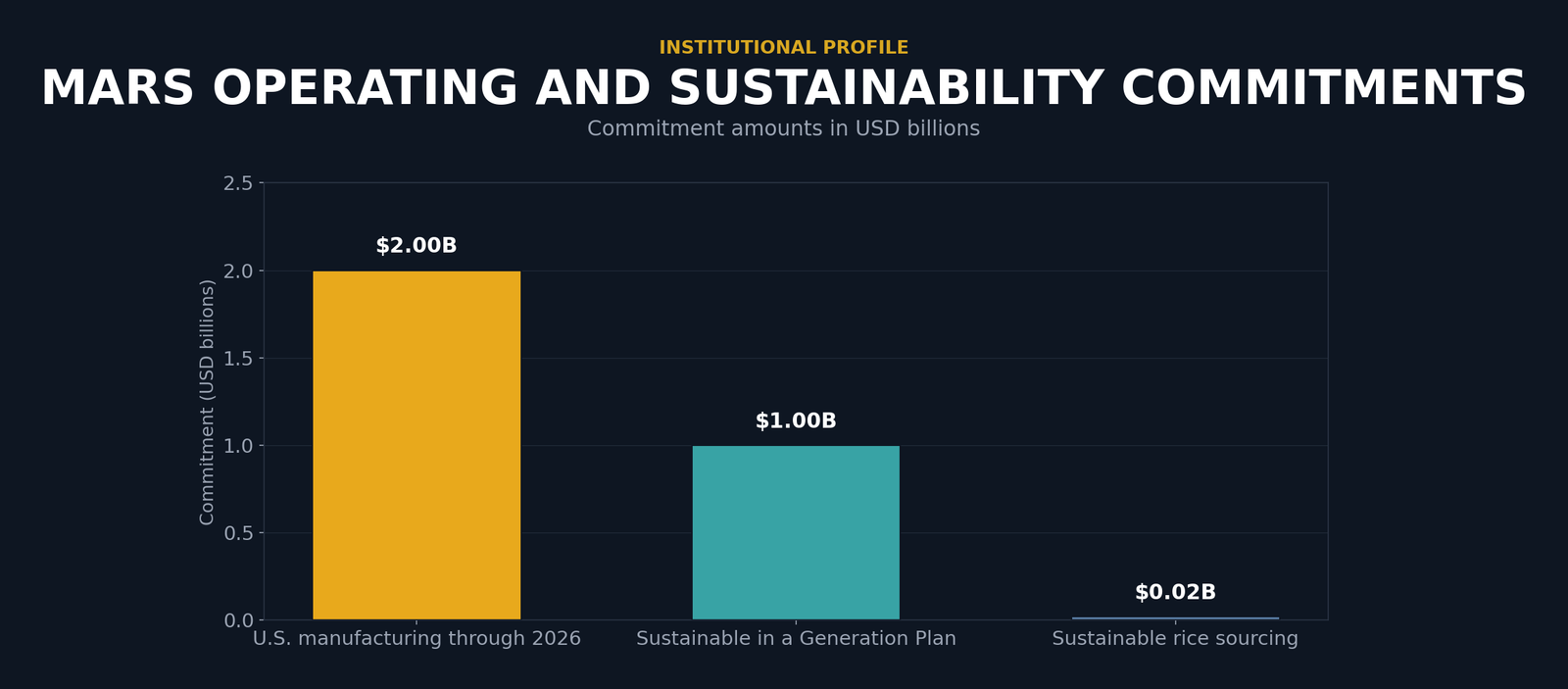
Mars has committed $2 billion to U.S. manufacturing through 2026, $1 billion over several years to the Sustainable in a Generation Plan launched in 2017, and $20 million to sustainable rice sourcing. These are operating and sustainability commitments, not investment portfolio allocations. Source: Mars, Incorporated homepage and history pages, accessed October 1, 2026.
| Commitment | Amount (USD billions) |
|---|---|
| U.S. manufacturing through 2026 | $2.00B |
| Sustainable in a Generation Plan | $1.00B |
| Sustainable rice sourcing | $0.02B |
Mars publishes corporate information on its official website, including company overview, leadership team, history, and The Five Principles. The CEO and senior leadership team (CFO, General Counsel, VPs of key functions, and three business segment presidents) are named on the leadership page. All corporate website content is freely accessible with no paywall, and the website is current as of September 29, 2026. However, as a private company, Mars does not publish board minutes, governance materials, audited financial statements, or annual reports. The score is a disclosure measure only and is not a judgment of the operating business.
Manager Approach and Matching Profile
Pursuit verdict: Mars, Incorporated is a private operating company in consumer goods (petcare, food and nutrition, snacking), not an institutional capital allocator. No opportunity exists for asset managers seeking institutional mandates because Mars does not manage external investment portfolios, select external asset managers, or publish procurement processes for investment services. The company does not disclose assets under management, target allocations, investment policy statements, or external manager rosters because it does not function as an institutional investor.
- Target vs. actual allocation: Mars, Incorporated is a private operating company, not an institutional capital allocator. It does not disclose investment portfolio allocations, target asset allocations, or investment policy statements. The company operates three business segments (petcare, snacking, food and nutrition) and reports operational revenue, not investment portfolio composition.
- Historical AUM and return series: Mars, Incorporated does not disclose assets under management or investment returns because it is a private operating company, not an institutional capital allocator. The Mars history page reports more than $47 billion in annual sales in 2022, which represents operating revenue from its business segments, not investment assets. No historical investment portfolio series are published.
- External manager roster and consultant detail: Mars, Incorporated does not manage external investment mandates or select asset managers because it is an operating company in consumer goods. No external manager roster, investment consultant, or mandate table is applicable. The company operates through three business segments (Mars Petcare with 100,000 Associates in 130 countries, Mars Snacking as the world's leading manufacturer of chocolate and confections, and Mars Food and Nutrition covering rice, pasta, and health products) but does not allocate capital to external investment managers.
Mandate Benchmark or strategy AUM Manager Fee or expense No external investment mandates disclosed Not disclosed Not disclosed Not disclosed Not disclosed - Commitment pacing: Mars does not disclose institutional commitment pacing. Mars, Incorporated is a private operating company, not an institutional capital allocator managing private market commitments or participant-directed investment flows. The company makes strategic business investments (such as the $2 billion commitment to U.S. manufacturing through 2026, the $1 billion Sustainable in a Generation Plan investment, and the $20 million sustainable rice sourcing investment) but these are operational capital expenditures, not institutional investment portfolio commitments.
- RFP, procurement, and board calendar: Mars, Incorporated does not publish an RFP calendar, procurement process, or board calendar for investment manager selection because it is a private operating company, not an institutional capital allocator. The company completed the acquisition of Kellanova in 2025 and operates through established business segments, but no public pathway exists for asset managers to pursue investment mandates. Mars Petcare launched The Companion Fund in 2018 to back pet-tech, products and services, but this is a strategic business initiative, not an institutional investment procurement process.
Matching profile: these data points feed the cross-fund manager matching profile.
Sources: Mars corporate website (homepage, about, leadership, history, The Five Principles pages, accessed September 29, 2026).
Governance and Leadership
Mars, Incorporated has been led by non-family management since 2001. Poul Weihrauch serves as CEO and Office of the President. The company is guided by The Five Principles (Quality, Responsibility, Mutuality, Efficiency, Freedom) established by founder Frank C. Mars and articulated by second-generation leadership (Forrest E. Mars, Jr., John F. Mars, Jacqueline Badger Mars). The Mars family and thousands of Mars Associates steward The Five Principles in daily decision-making. As a private company, Mars does not publish board structure, committee details, board minutes, or governance materials.
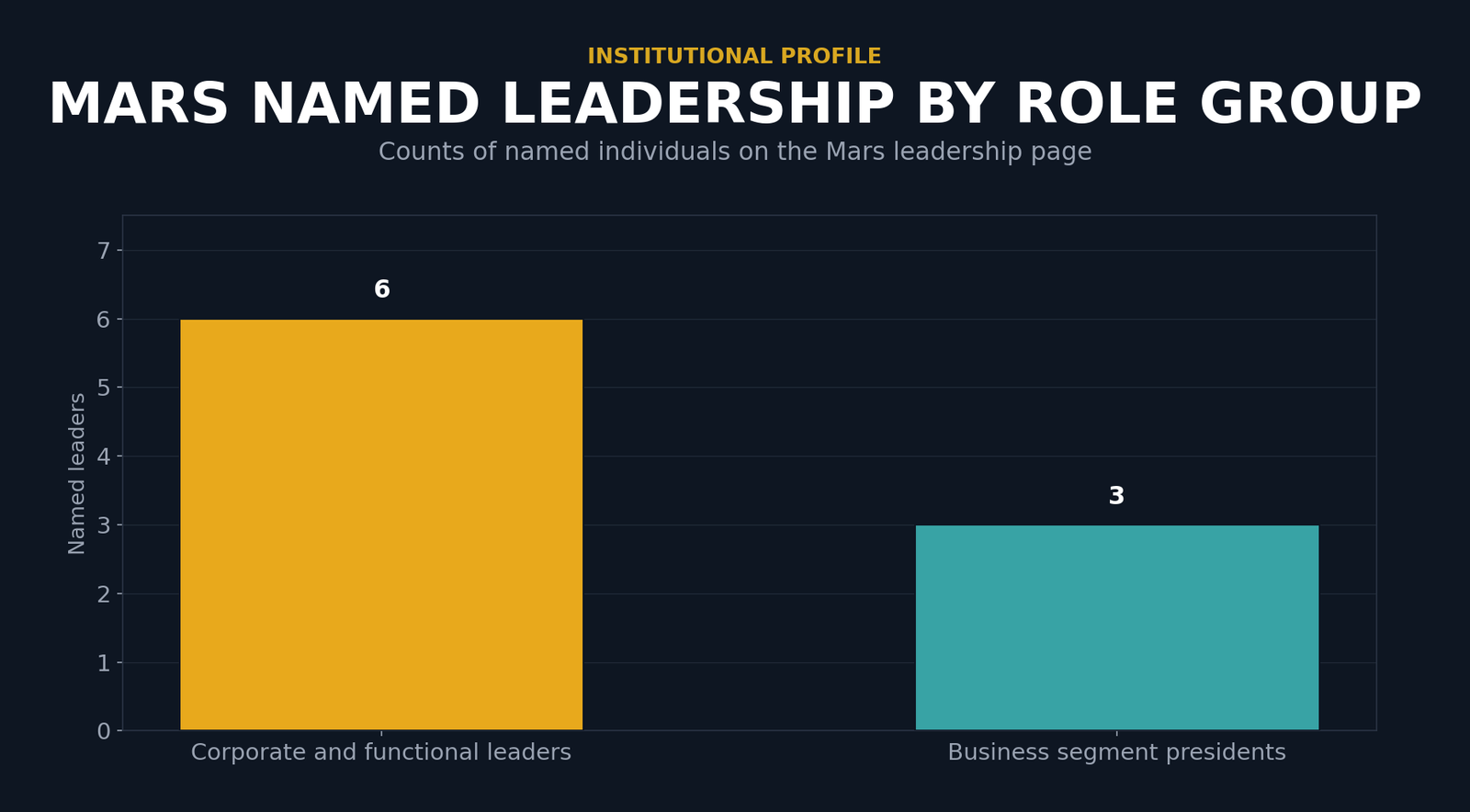
The Mars leadership page names six corporate and functional leaders and three business segment presidents. Mars does not disclose a board of directors or trustees on the pages reviewed. Source: Mars, Incorporated leadership page, accessed October 1, 2026.
| Role group | Named leaders |
|---|---|
| Corporate and functional leaders | 6 |
| Business segment presidents | 3 |
- Poul Weihrauch, CEO and Office of the President
- Claus Aagaard, Chief Financial Officer
- Stefanie Straub, Vice President, General Counsel and Corporate Secretary
- Andy Pharoah, Vice President, Corporate Affairs and Sustainability
- Rebecca Snow, Vice President, People and Organization
- Nici Bush, Vice President, Innovation, Science and Technology
- Andrew Clarke, Global President, Mars Snacking
- Shaid Shah, Global President, Mars Food and Nutrition, Multisales and Global Customer
- Marc Carena, Global President, Mars Petcare
How to Engage
Mars, Incorporated is a private operating company in consumer goods, not an institutional capital allocator. No manager sourcing method, procurement portal, investment consultant, or policy on unsolicited investment proposals exists because Mars does not select external asset managers or manage institutional investment portfolios. The company operates through three business segments (petcare, snacking, food and nutrition) and makes strategic business investments in sustainability, innovation, and manufacturing, but these are operational decisions, not institutional investment procurement processes. Asset managers seeking institutional mandates have no applicable pathway to engage with Mars as an allocator.
Sources and Documents
- Mars, Incorporated homepage (accessed September 29, 2026)
- Mars, Incorporated company overview (accessed September 29, 2026)
- Mars, Incorporated leadership team (accessed September 29, 2026)
- Mars, Incorporated company history (accessed September 29, 2026)
- Mars, Incorporated The Five Principles (accessed September 29, 2026)
Data Notes and Methodology
This profile is based on Mars, Incorporated's corporate website pages (homepage, about, leadership, history, The Five Principles) accessed September 29, 2026. Mars is a private operating company in consumer goods (petcare, food and nutrition, snacking), not an institutional capital allocator. Third-party estimates referenced in analyst notes are not from Mars official publications and are not used in this profile. Mars discloses no assets under management, investment returns, target allocations, investment policy statements, or external manager selection processes because it does not manage institutional investment portfolios. The Mars history page reports more than $47 billion in annual sales in 2022. This is operating revenue, not assets under management. A separate combined Mars and Kellanova management-reporting footnote on the About page relates to fiscal year ended December 27, 2025 brand data and is not the basis for the 2022 sales figure. As a private company, Mars does not publish audited financial statements, annual reports, board minutes, or governance materials. The profile assesses Mars under the standard disclosure worksheet as a private operating company; Mars does not manage external institutional investment capital.