
Robert Wood Johnson Foundation
Overview
The Robert Wood Johnson Foundation (RWJF) was founded in 1936 by Robert Wood Johnson II, former president and chairman of Johnson & Johnson, through periodic gifts of J&J shares during his lifetime and a final bequest of 10.4 million shares upon his death. Headquartered in Princeton, New Jersey, RWJF operates as one of the nation's leading philanthropies focused on health equity. The foundation's mission is to pave the way toward a future where health is no longer a privilege but a right, with an explicit commitment to addressing structural racism as a root cause of health inequities in the United States.
RWJF uses a multi-faceted approach to advance its mission: funding, convening, advocacy, evidence building, and impact investing. The foundation works alongside communities, practitioners, and institutions to drive systemic change. Over its history, RWJF has diversified its investment portfolio away from its original concentration in Johnson & Johnson stock and now incorporates human rights and environmental, social, and governance (ESG) considerations into investment decision-making. The foundation avoids investments in companies predominantly related to firearms, alcohol, cannabis, or tobacco.
The foundation's scale and operating model position it as a significant institutional allocator in the philanthropic sector, though it does not disclose total assets in the fund-direct materials reviewed for this profile. No third-party estimate is presented as a foundation figure. RWJF operates with a board of trustees drawn from diverse sectors and communities, setting policies that advance the foundation's mission to achieve health equity and dismantle structural racism.
Investment Mandate
RWJF's investment mandate centers on achieving health equity faster and together, with a particular focus on addressing structural racism and health inequities in the United States. The foundation's grantmaking focuses on community development, economic inclusion for families, government, health science knowledge, healthcare, media, and public health. The investment return target is designed to earn returns over time equal to or exceeding the sum of annual spending as a percentage of assets plus the inflation rate, a structure intended to spread risk and promote a steady flow of support to grantees and partners.
The foundation's impact investing strategy targets three primary areas: advancing racial equity through homeownership preservation and economic inclusion; strengthening the community development finance system; and program-directed investments that complement grantmaking portfolios. RWJF has made diversity and inclusion central to its investment approaches, establishing partnerships with women-owned and minority-owned investment managers and running an internship program for individuals from underrepresented backgrounds in financial services. New Jersey, the foundation's home state, receives priority consideration in both grantmaking and investment activity.
RWJF does not disclose target or actual asset allocation percentages in the reviewed materials. Its impact investments are United States focused and use deposits, loans, equity investments, and guarantees; the broader portfolio allocation and active or passive approach are not disclosed.
Financial Position
In the fund-direct materials reviewed for this profile, the Robert Wood Johnson Foundation does not state a total-assets or assets-under-management figure with an as-of date. The foundation's Financials page lists audited financial statements and Form 990-PF returns, including the 2025 Audited Financial Statement. The extracted Form 990-PF text available in the reviewed source set was garbled and truncated, so no AUM figure is taken from it.
Since 2010, RWJF has committed $625 million to impact investments targeting health and racial equity. In 2024, the foundation surpassed its goal to attract or leverage $1 billion from other investors, including banks, insurance companies, and private investors, by 2025. This co-investment model amplifies the foundation's direct capital commitments through partnerships with public and private-sector entities. The foundation does not disclose investment returns, whether annual, annualized, or since inception, in its accessible public materials.
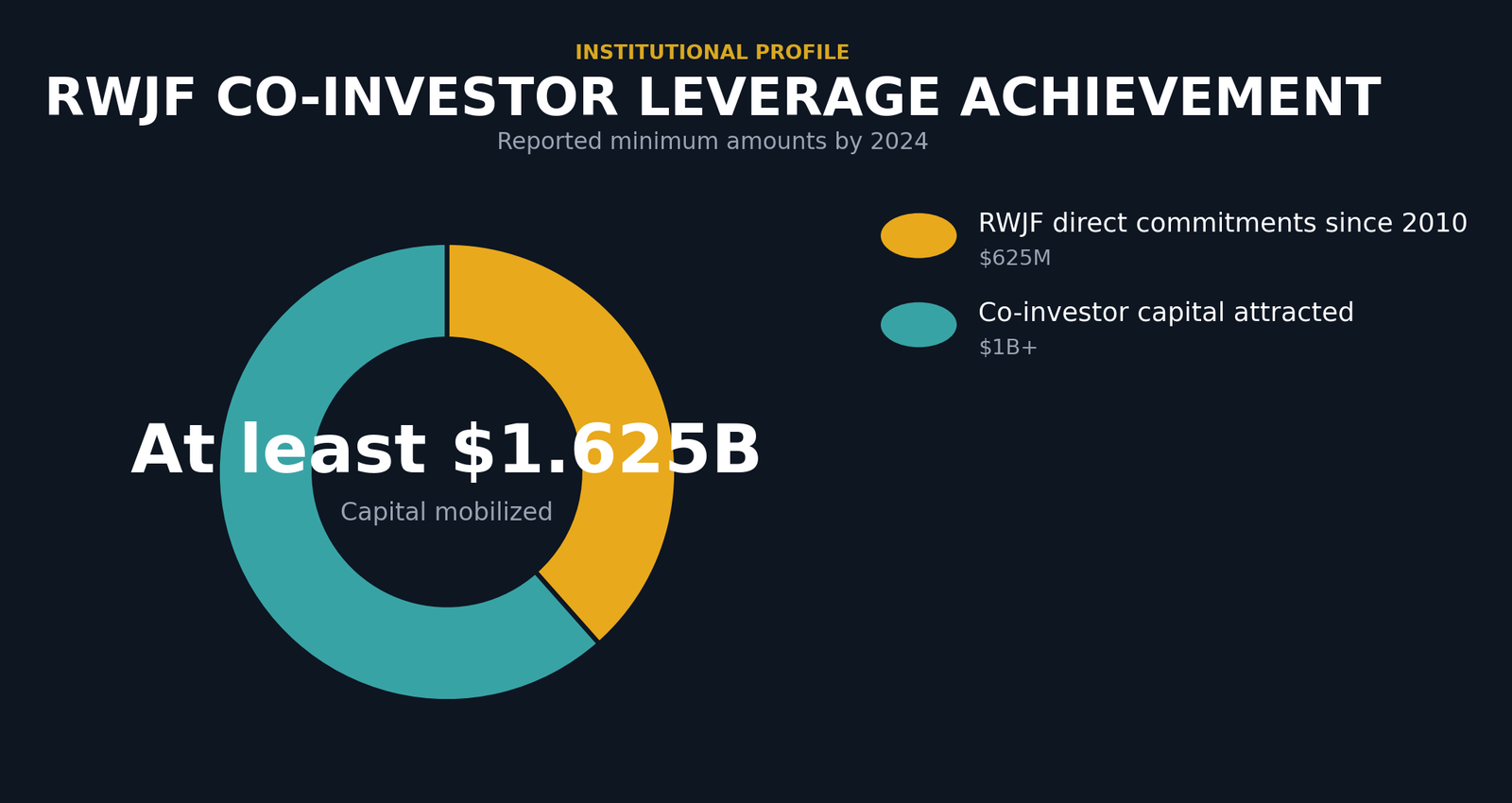
RWJF committed $625 million directly since 2010 and attracted over $1 billion from banks, insurance companies, and private investors by 2024, surpassing its 2025 leverage goal. The co-investor bar uses the $1 billion reported floor, so total capital mobilized was at least $1.625 billion. Source: RWJF Impact Investing page, accessed 2026-10-01.
| Capital source | Amount (USD millions) |
|---|---|
| RWJF direct commitments since 2010 | $625M |
| Co-investor capital attracted | $1B+ |
- Assets: Not disclosed
- Impact investments committed since 2010: $625 million
- Co-investor leverage achieved in 2024: Surpassed $1 billion goal (capital attracted from banks, insurance companies, and private investors)
- 2024 impact investments: $50+ million in loans, equity investments, and guarantees to nine organizations
- 2025 impact investments: $24+ million in loans, equity investments, and guarantees to six organizations
- 2023 impact investments: $48 million in loans, equity investments, and guarantees to eight organizations
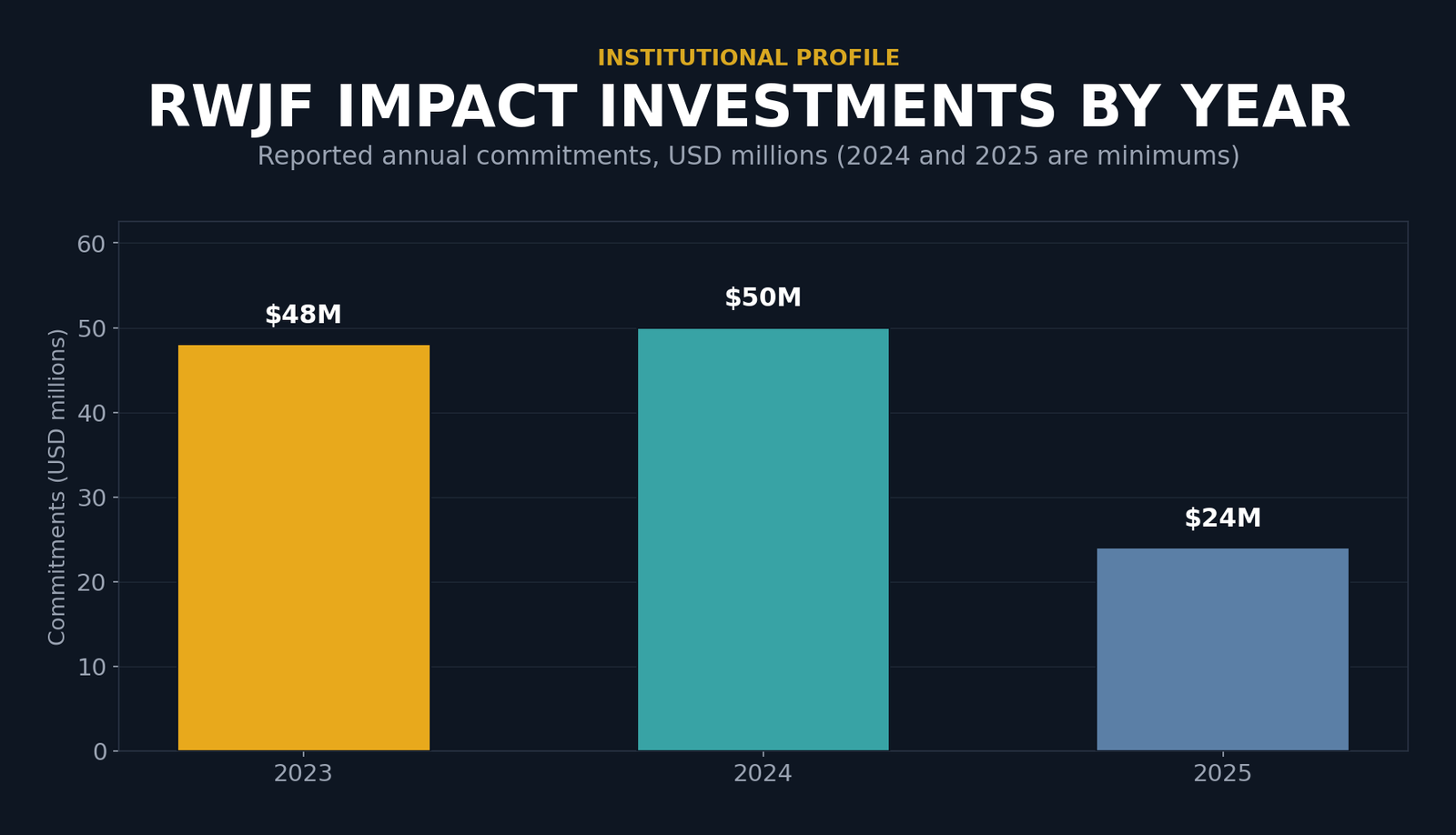
RWJF committed $48 million in 2023, more than $50 million in 2024, and more than $24 million in 2025 to organizations advancing health equity and racial equity. The 2024 and 2025 bars use the reported floor amounts. Source: RWJF Impact Investing page, accessed 2026-10-01.
| Year | Commitments (USD millions) |
|---|---|
| 2023 | $48M |
| 2024 | $50M |
| 2025 | $24M |
DEEP Disclosure Rating
The DEEP Disclosure Rating measures how much a fund discloses about itself. It is a disclosure and governance measure only, and not a judgment of investment quality or creditworthiness.The Robert Wood Johnson Foundation's DEEP Disclosure Score is 23 of 100, band Opaque. The foundation lists audited financial statements and Form 990-PF returns and publishes a board of trustees roster, grantmaking strategy, and impact investing activity descriptions. It names its trustees and President and CEO, but the reviewed sources do not name senior investment staff. It does not disclose assets under management, investment returns, target or actual asset allocation percentages, external manager rosters, investment fees or expense ratios, or board meeting materials. Items that cannot apply to a fund's type are excluded from its score rather than scored as zero. The fund-specific basis is included in the DEEP Disclosure Report. The full scoring rubric is public on the DEEP Disclosure Rating methodology page. A detailed, pillar-by-pillar and item-by-item breakdown of this fund's score is available as a DEEP Disclosure Report on request.
RWJF's disclosure profile reflects a common pattern among private foundations: transparency on mission, programmatic activity, trustees, and impact investing, combined with limited disclosure of investment portfolio details. In the reviewed fund-direct materials, the foundation does not state AUM, investment returns, allocation, fees, or senior investment staff names. Last assessed 1 October 2026, based on RWJF's Financials, Impact Investing, Board of Trustees, and Grants pages and the filings listed there.
Manager Approach and Matching Profile
Pursuit verdict: External investment managers: limited and selective opportunity due to lack of disclosed manager roster, RFP calendar, or procurement process. The foundation expresses interest in collaboration with firms demonstrating diversity in leadership and ownership, but does not publish a pathway for unsolicited proposals or a formal manager-selection process. Impact investing managers and community development financial institutions (CDFIs): selective opportunity through the foundation's impact investing program, which has committed $625 million since 2010 and partners with organizations aligned with health equity and racial equity missions. Prospective external managers may contact the foundation's investment team for inquiries about investment-related programs, but no public procurement portal or RFP calendar exists. Entry depends on alignment with the foundation's mission, demonstrated diversity in leadership and ownership, and the foundation's initiative to seek partnerships.
- Target vs. actual allocation: The foundation does not disclose target or actual asset allocation percentages in its public materials. The allocation ranges, target percentages, and actual percentages across asset classes are not published in the reviewed materials.
- Historical AUM and return series: The foundation does not disclose historical AUM or investment return series in its public materials. The reviewed materials do not state total assets with an as-of date, annual investment returns, annualized returns, or returns since inception. The foundation's investment return target is described as earning returns over time equal to or exceeding the sum of annual spending as a percentage of assets plus the inflation rate, but actual performance against this target is not disclosed.
- External manager roster and consultant detail: The foundation does not disclose a roster of external investment managers or named consultants in its public materials. The foundation describes partnerships with women-owned and minority-owned investment managers and states interest in collaboration with firms demonstrating diversity in leadership and ownership, but does not name specific managers, consultants, or advisors. Impact investing partnerships are disclosed by organization name (such as Oweesta Corporation, Fahe, Apis & Heritage Capital Partners) but these are grantees and co-investment partners rather than traditional external asset managers. No investment consultant of record is named.
- Commitment pacing: The foundation discloses annual impact investment commitments and co-investor leverage achieved but does not disclose commitment pacing or deployment schedules. Since 2010, RWJF has committed $625 million to impact investments. In 2024, the foundation committed $50+ million in loans, equity investments, and guarantees to nine organizations. In 2025, the foundation committed $24+ million to six organizations. In 2023, the foundation committed $48 million to eight organizations. In 2024, the foundation surpassed its goal to attract or leverage $1 billion from other investors by 2025. The foundation's impact investing strategy targets three areas: advancing racial equity through homeownership preservation and economic inclusion; strengthening the community development finance system; and program-directed investments complementing grantmaking. No multi-year pacing schedule, vintage-year targets, or deployment timelines are published.
- RFP, procurement, and board calendar: The foundation does not publish an RFP calendar, procurement portal, or board meeting calendar. Board of Trustees meetings are not publicly calendared or open to the public. The foundation's website states that prospective external managers may contact the foundation's investment team for inquiries about investment-related programs, indicating a selective approach to unsolicited proposals rather than a closed or open stance. No formal procurement process, registration portal, or scheduled RFP cycles are disclosed. The realistic entry route for external managers is alignment with the foundation's mission (health equity, racial equity), demonstrated diversity in leadership and ownership, and the foundation's initiative to seek partnerships. No consultant of record is named in public materials.
Per-mandate detail:
| Mandate | Benchmark or strategy | AUM | Manager | Fee |
|---|---|---|---|---|
| Diversified investment portfolio | Return objective: annual spending as a percentage of assets plus inflation; stated exclusions and human-rights considerations | Not publicly disclosed | Not publicly disclosed | Not publicly disclosed |
| Impact investments | Deposits, loans, equity investments, and guarantees; $625 million committed since 2010 (commitment total, not current AUM) | Not publicly disclosed | Not publicly disclosed | Not publicly disclosed |
Matching profile: these data points feed the cross-fund manager matching profile.
Sources: 2024 Audited Financial Statements, 2024 Form 990-PF Full Return, https://www.rwjf.org/en/about-rwjf/impact-investing.html, https://www.rwjf.org/en/about-rwjf/financials.html.
Governance and Leadership
The Robert Wood Johnson Foundation is governed by a Board of Trustees composed of 15 members from diverse sectors and communities. The board sets policies advancing RWJF's mission to achieve health equity and address structural racism. Starsky D. Wilson, DMin, MDiv, serves as Chair of the Board of Trustees. Richard E. Besser, MD, serves as President and CEO. The board includes trustees with backgrounds in public health, healthcare, community development, finance, and social justice. No Chief Investment Officer or CIO title was identified in the foundation's public materials.
Board members include Starsky D. Wilson (Chair), Daniel E. Dawes, Azita Emami, Barbara Ferrer, Vicki L. Fuller, Kelley K. Hall, Ryan P. Haygood, W. Louise Mehrotra, Ruth S. Shim, Michael E. Sneed, Edgar Villanueva, Jing Wang, David R. Williams, and Patricia Miller Zollar. The foundation does not publish board meeting minutes, materials, or a public calendar of board meetings. Governance structure and board composition are disclosed on the foundation's website, but the operational details of board oversight, committee structure, and meeting frequency are not publicly available.
- Richard E. Besser, MD: President and CEO
- Starsky D. Wilson, DMin, MDiv: Chair, Board of Trustees
- Daniel E. Dawes: Board of Trustees
- Azita Emami: Board of Trustees
- Barbara Ferrer: Board of Trustees
- Vicki L. Fuller: Board of Trustees
- Kelley K. Hall: Board of Trustees
- Ryan P. Haygood: Board of Trustees
- W. Louise Mehrotra: Board of Trustees
- Ruth S. Shim: Board of Trustees
- Michael E. Sneed: Board of Trustees
- Edgar Villanueva: Board of Trustees
- Jing Wang: Board of Trustees
- David R. Williams: Board of Trustees
- Patricia Miller Zollar: Board of Trustees
How to Engage
The Robert Wood Johnson Foundation does not operate a formal procurement portal, publish an RFP calendar, or maintain a public manager-selection process. The foundation's approach to external manager sourcing is selective, with an expressed interest in collaboration with firms demonstrating diversity in leadership and ownership. Prospective external managers may contact the foundation's investment team for inquiries about investment-related programs, but no structured pathway for unsolicited proposals is published. The foundation's impact investing program operates through partnerships with community development financial institutions (CDFIs), homeownership preservation organizations, and program-linked investments that complement grantmaking portfolios.
The foundation's co-investment model involves committing capital alongside public and private-sector investors, including banks, insurance companies, and private investors, to leverage impact. Partnerships have been established with organizations such as Oweesta Corporation (supporting Native CDFIs), Fahe (Appalachian homeownership), Apis & Heritage Capital Partners (employee-owned enterprises), and others. Program-linked investments focus on water infrastructure, New Jersey community development, and reproductive care access. The realistic entry route for external managers is alignment with the foundation's mission (health equity, racial equity, structural racism), demonstrated diversity in leadership and ownership, and the foundation's initiative to seek partnerships. No consultant of record is named in public materials, and no formal RFP or procurement process is disclosed.
Sources and Documents
- About RWJF (website page)
- Financials (website page)
- Impact Investing (website page)
- Board of Trustees (website page)
- Grants (website page)
- 2024 Audited Financial Statements (PDF, 25 pages, available on financials page)
- 2024 Annual Tax Return, Form 990-PF, Full return (PDF, 722 pages, available on financials page)
- 2025 Audited Financial Statements (available on financials page)
Data Notes and Methodology
This profile is based on the Robert Wood Johnson Foundation's 2024 Audited Financial Statements (25 pages), 2024 Form 990-PF Full Return (722 pages), 2025 Audited Financial Statements, and website materials published on the foundation's financials, impact investing, board of trustees, and grants pages, all accessed as of 1 October 2026. No total-assets or assets-under-management figure is stated in the reviewed materials, and no directory estimate is presented as a foundation figure. The foundation does not disclose investment returns (annual, annualized, or since inception), target or actual asset allocation percentages, external manager rosters, investment fees or expense ratios, or board meeting materials in its public filings or website. Impact investment commitments and co-investor leverage figures are disclosed in the foundation's impact investing materials and represent the foundation's direct capital commitments and the capital attracted from other investors. The Form 990-PF full return (722 pages) was truncated in the source material reviewed; detailed financial schedules may contain additional information not captured in this extraction. The foundation's next expected update is the 2026 Audited Financial Statements, anticipated in 2027. Assessment date: 1 October 2026.