
Ford Foundation
Overview
The Ford Foundation was founded in 1936 by Edsel Ford as an independent organization working to address inequality and build a future grounded in justice. The foundation is headquartered at 320 East 43rd Street in New York, New York, with 10 regional offices across Africa, Asia, Latin America, and the Middle East. Although it shares a name with Ford Motor Company, the two entities have been legally separate and independent for more than 50 years. The foundation operates with an endowment of $17.16 billion in investments as of December 31, 2025, making it one of the largest private foundations in the United States. It is governed by a Board of Trustees that includes the President, and operates with grant-making directors and regional representatives across its global offices. The foundation's mission is to strengthen democratic values, reduce poverty and injustice, promote international cooperation, and advance human achievement.
The Ford Foundation has maintained its independence and philanthropic focus for over 85 years. Its operating model centers on grant-making, program-related investments, and mission-related investments designed to improve how capitalism works for people. The foundation established a Good Neighbor Committee in 1996 to support organizations near its Midtown Manhattan headquarters, and similar committees have been formed in regional offices in Asia, Africa, and Latin America. The foundation's governance structure includes specialized committees overseeing audit, investment, and mission-related investment activities, each operating under published charters. The foundation does not accept unsolicited grant proposals by mail, email, or phone. Separately, the Mission Investments page invites organizations that believe their strategy and proposal fit its criteria to submit materials through the contact route published there; that route is for mission-investment proposals, not a published investment-manager procurement process.
Investment Mandate
The Ford Foundation's mission is to reduce poverty and injustice, strengthen democratic values, promote international cooperation, and advance human achievement. Its grant-making supports institutions, networks, and standards that encourage capital markets to work for social justice. The foundation operates three distinct investment vehicles: traditional endowment investments, Mission Investments, and Program-Related Investments (PRIs). The Mission Investments program, launched in 2017, commits up to $1 billion of the endowment over 10 years in mission-related investments that seek risk-adjusted financial returns while advancing the foundation's social justice goals. The Program-Related Investments program, in operation since 1968, has committed over $865 million to date and maintains a current $350 million PRI Fund supporting IRS-qualifying charitable investments that prioritize social impact over financial return.
The foundation's geographic focus spans the United States and the Global South, including Latin America, Africa, China, India, Indonesia, and the Middle East. The Mission Investments program specifically supports private equity and venture capital firms addressing impact themes in these regions. The foundation has dedicated $2 billion of its budget to the BUILD initiative, which strengthens social justice institutions. The foundation's investment approach is mixed, combining traditional asset classes such as public equity, fixed income, private equity, real estate, hedge funds, and cash with mission-aligned investments. The foundation does not disclose target allocation percentages or ranges by asset class, nor does it publish an Investment Policy Statement or equivalent mandate document. Its audited financial statements do disclose actual investment categories at fair value in Note B. Investment management expenses are netted within the net investment return figure and are not separately disclosed in the audited financial statements.
Financial Position
The Ford Foundation held $17.16 billion in investments at fair value as of December 31, 2025, an increase from $16.40 billion at December 31, 2024. The foundation reported a net investment return of $2.24 billion for the year ended December 31, 2025, compared to $1.55 billion for the year ended December 31, 2024. Total net assets without donor restrictions stood at $16.10 billion as of December 31, 2025, up from $14.90 billion at December 31, 2024. The foundation approved $773 million in grants during 2025, consistent with the $771 million approved in 2024. Total expenditures for 2025 were $1.03 billion, comprising $881 million in program activities, $84 million in operational support, $23 million in depreciation, and $39 million in interest expense. Program-related investments (net) totaled $152 million as of December 31, 2025.
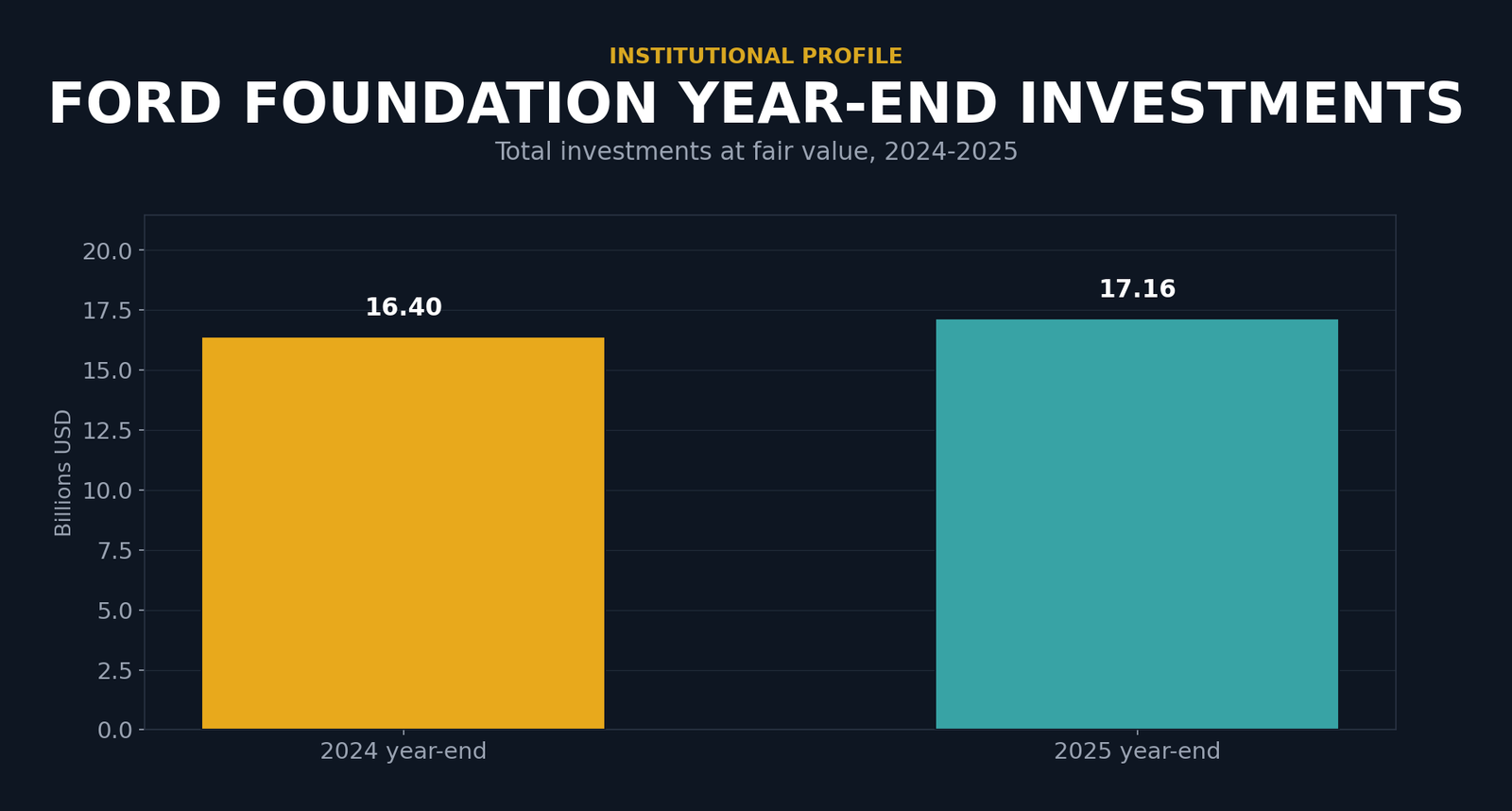
The Ford Foundation held $17.16 billion in investments at fair value as of December 31, 2025, an increase from $16.40 billion at December 31, 2024. Source: 2025 Audited Financial Statements, Statement of Financial Position.
| Period | Investments (Billions USD) |
|---|---|
| 2024 year-end | 16.40 |
| 2025 year-end | 17.16 |
- Total investments at fair value: $17.16 billion as of December 31, 2025 (up from $16.40 billion at December 31, 2024)
- Net investment return: $2.24 billion for 2025 (compared to $1.55 billion for 2024)
- Grants approved: $773 million in 2025 ($771 million in 2024)
- Total expenditures: $1.03 billion in 2025, including $881 million in program activities and $39 million in interest expense
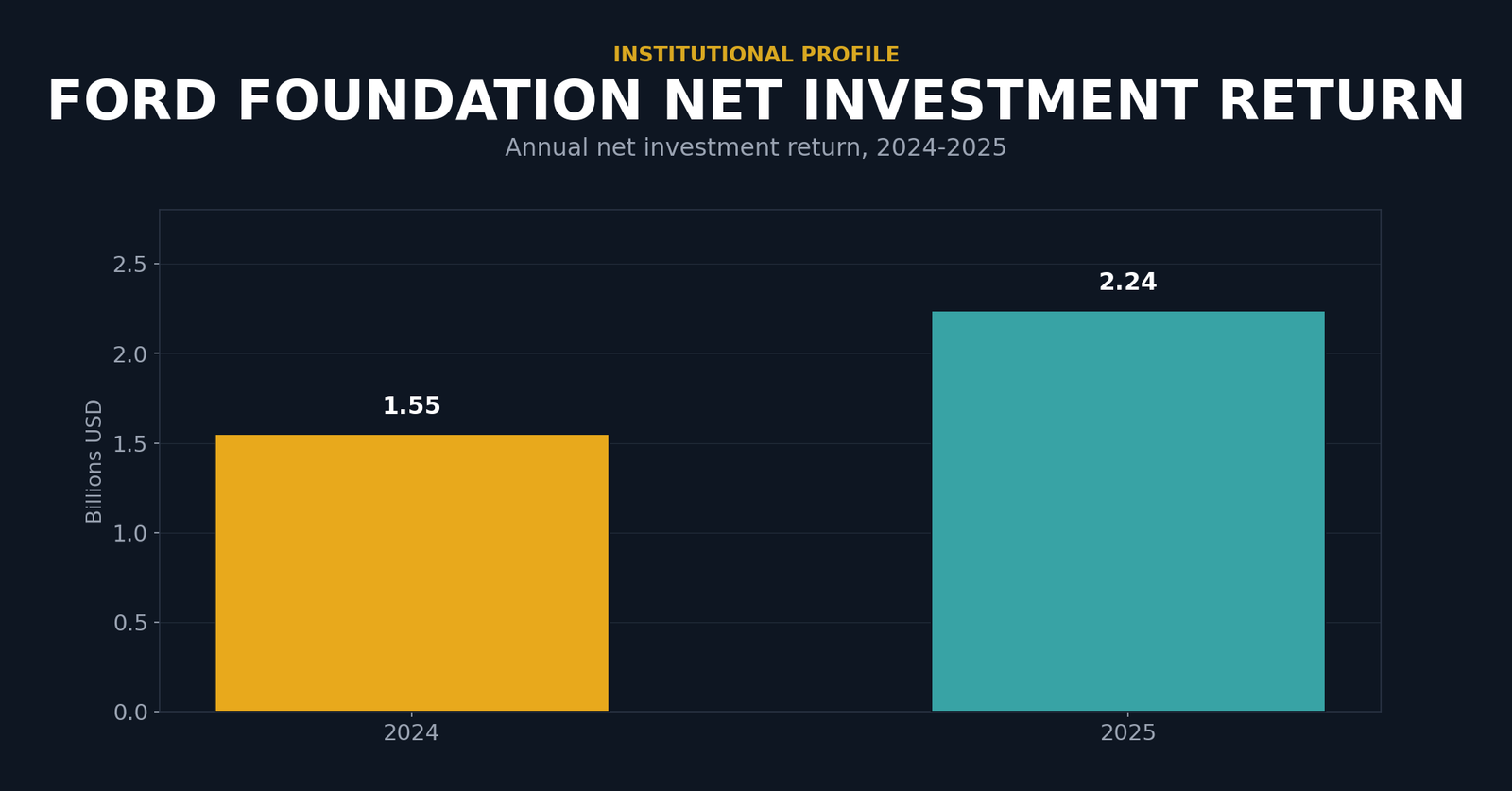
The Ford Foundation reported a net investment return of $2.24 billion for 2025, compared to $1.55 billion for 2024. Source: 2025 Audited Financial Statements, Statement of Activities.
| Year | Net Return (Billions USD) |
|---|---|
| 2024 | 1.55 |
| 2025 | 2.24 |
DEEP Disclosure Rating
The DEEP Disclosure Rating measures how much a fund discloses about itself. It is a disclosure and governance measure only, and not a judgment of investment quality or creditworthiness.The Ford Foundation's DEEP Disclosure Score is 42 of 100, band Limited. The foundation publishes audited financial statements annually with detailed asset positions and investment returns, governance documents including board committee charters, and ethics and conflict of interest policies. It discloses actual investment categories at fair value, but it does not disclose target allocation, external manager rosters, manager selection processes, an RFP calendar, or investment strategy and policy documents. The foundation explicitly does not accept unsolicited proposals by mail, email, or phone. Items that cannot apply to a fund's type are excluded from its score rather than scored as zero. The fund-specific basis is included in the DEEP Disclosure Report. The full scoring rubric is public on the DEEP Disclosure Rating methodology page. A detailed, pillar-by-pillar and item-by-item breakdown of this fund's score is available as a DEEP Disclosure Report on request.
Manager Approach and Matching Profile
Pursuit verdict: The Ford Foundation does not disclose its external manager roster, manager selection process, or RFP calendar, and explicitly does not accept unsolicited proposals by mail, email, or phone. Active managers and index managers have no documented pathway for entry. The foundation operates Mission Investments and Program-Related Investments programs that support private equity and venture capital firms addressing specific impact themes in the United States and Global South, but these opportunities are sourced through undisclosed channels rather than open procurement. Organizations that believe a strategy or proposal fits the Mission Investments criteria may submit materials through the contact route published on that program page, but no formal investment manager selection process is published.
- Target vs. actual allocation: The Ford Foundation does not disclose target allocation percentages or ranges. Its 2025 audited financial statements disclose actual investment categories at fair value in Note B: diversified strategies $7.962 billion, private equities $6.002 billion, real assets $1,321 million, equities $0.930 billion, fixed income $0.739 billion, and cash and cash equivalents $0.203 billion, totaling $17.156 billion at December 31, 2025. The Mission Investments program commits up to $1 billion of the endowment over 10 years in mission-related investments, and the Program-Related Investments program maintains a current $350 million PRI Fund, but these figures are not presented as percentages of total assets or with target ranges.
- Historical AUM and return series: The foundation discloses investments at fair value for 2025 and 2024 in Note B. The 2023 row below uses beginning-of-year net assets reported in the comparative statements; it is not an investments-at-fair-value figure. Dollar net investment return is disclosed for 2025 and 2024; no percentage return is published. Investment management expenses are netted within net investment return and are not separately disclosed.
Period Investments at fair value Net assets without donor restrictions Net investment return 2025 year-end $17.16 billion $16.10 billion $2.24 billion 2024 year-end $16.40 billion $14.90 billion $1.55 billion 2023 year-end Not disclosed in reviewed statements $14.34 billion Not disclosed in reviewed statements - External manager roster and consultant detail: The Ford Foundation does not disclose a roster of external investment managers, their mandates, benchmarks, assets under management, or fees. No investment consultant is named in the published sources. The foundation's audited financial statements note that investment management expenses are netted within the net investment return, but individual manager relationships and fee arrangements are not disclosed. The Mission Investments program supports private equity and venture capital firms addressing impact themes, and the Program-Related Investments program has committed over $865 million since 1968, but the specific firms and terms are not publicly disclosed.
- Commitment pacing: The Ford Foundation does not disclose commitment pacing or capital deployment schedules for its private equity, real estate, or other private market investments. The Mission Investments program commits up to $1 billion of the endowment over 10 years (launched 2017), and the Program-Related Investments program maintains a current $350 million PRI Fund, but annual commitment targets, pacing models, or vintage year allocations are not published. The foundation approved $773 million in grants during 2025, but this figure represents grant-making rather than investment commitments.
- RFP, procurement, and board calendar: The Ford Foundation does not disclose an RFP calendar, procurement portal, or formal manager selection process. No investment consultant is named. The foundation explicitly does not accept unsolicited proposals by mail, email, or phone; prospective grantees may submit materials to the contact route published on the foundation's website if they believe they meet the foundation's criteria, but this channel is for grant proposals rather than investment manager proposals. The foundation is governed by a Board of Trustees which includes the President, and operates with specialized committees (Audit Committee, Investment Committee, Mission-Related Investment Committee) under published charters, but board meeting dates, investment committee calendars, and manager review schedules are not disclosed. The realistic entry route for investment managers is not documented in the published sources.
Per-mandate detail:
| Mandate | Benchmark or strategy | AUM | Manager | Fee |
|---|---|---|---|---|
| Cash and cash equivalents | Note B category; benchmark not disclosed | $0.203 billion | Not publicly disclosed | Not publicly disclosed |
| Equities | Note B category; benchmark not disclosed | $0.930 billion | Not publicly disclosed | Not publicly disclosed |
| Fixed income | Note B category; benchmark not disclosed | $0.739 billion | Not publicly disclosed | Not publicly disclosed |
| Diversified strategies investment funds | Note B category; benchmark not disclosed | $7.962 billion | Not publicly disclosed | Not publicly disclosed |
| Real assets | Note B category; benchmark not disclosed | $1,321 million | Not publicly disclosed | Not publicly disclosed |
| Private equities | Note B category; benchmark not disclosed | $6.002 billion | Not publicly disclosed | Not publicly disclosed |
Matching profile: these data points feed the cross-fund manager matching profile.
Sources: 2025 Audited Financial Statements and Footnotes (published June 18, 2026), Ford Foundation Governance and Financial Statements page, Ford Foundation Mission Investments page, Ford Foundation Our Grants page.
Governance and Leadership
The Ford Foundation is governed by a Board of Trustees which includes the President. Heather Gerken serves as President of the Ford Foundation; she is a leading expert on democracy and rule of law and previously served as the first woman dean of Yale Law School. The foundation operates with specialized committees overseeing key functions: the Audit Committee, Investment Committee, and Mission-Related Investment Committee, each operating under published charters dated July 13, 2026. The foundation also maintains a Trustee and Officer Code of Ethics and Conflict of Interest Policy and Bylaws, both dated July 13, 2026. The Good Neighbor Committee, established in 1996, supports organizations near the foundation's Midtown Manhattan headquarters, and similar committees have been formed in regional offices in Asia, Africa, and Latin America.
- Heather Gerken, President of the Ford Foundation
The Board of Trustees members and senior investment staff are not named in the published sources. The foundation's governance documents, including the Audit Committee Charter, Investment Committee Charter, Mission-Related Investment Committee Charter, Trustee and Officer Code of Ethics and Conflict of Interest Policy, and Bylaws, are available on the Governance and Financial Statements page of the foundation's website.
How to Engage
The Ford Foundation does not disclose its manager sourcing method, procurement portal, or investment consultant of record. The foundation explicitly does not accept unsolicited grant proposals by mail, email, or phone. Prospective grantees may submit materials to the contact route published on the foundation's website if they believe they meet the foundation's criteria, but this channel is for grant proposals rather than investment manager proposals. The Mission Investments program supports private equity and venture capital firms addressing specific impact themes in the United States and Global South, and the Program-Related Investments program has committed over $865 million since 1968, but the foundation does not publish a formal process for investment managers to engage with these programs. The foundation makes grants, program-related investments, and mission-related investments to improve how capitalism works for people, but the realistic pathway for external investment managers to enter the foundation's roster is not documented in the published sources.
Sources and Documents
- Ford Foundation About page
- Ford Foundation Governance and Financial Statements page (includes 2025 Audited Financial Statements and Footnotes published June 18, 2026, and 2024 Audited Financial Statements and Footnotes published June 30, 2025)
- Ford Foundation People page
- Ford Foundation Our Grants page
- Ford Foundation Mission Investments page
Data Notes and Methodology
This profile is based on the Ford Foundation's 2025 Audited Financial Statements and Footnotes (published June 18, 2026), covering the year ended December 31, 2025, and governance documents published on the foundation's website as of October 1, 2026. All financial figures are as of December 31, 2025 unless otherwise stated. The foundation's inception year is stated as over 80 years and more than 85 years in different sources; 1936 is the commonly cited founding year. The sources do not name the CIO or senior investment staff beyond the President. Note B to the audited financial statements discloses actual investment categories at fair value; the sources do not disclose target allocation, external manager names, or manager selection processes. Investment management expenses are netted within the net investment return figure and are not separately disclosed. The 2025 Audited Financial Statements were published on June 18, 2026, which is the most current filing available as of the assessment date of October 1, 2026.