
Ping An Insurance
Overview
Ping An Insurance (Group) Company of China, Ltd. was established on March 21, 1988, and is headquartered in Shenzhen, China. The company is dually listed on the Stock Exchange of Hong Kong (2318.HK) and Shanghai Stock Exchange (601318.SH). Ping An is a world-leading integrated finance, health, and senior care services group serving 251 million retail customers as of December 31, 2025. The group operates through multiple subsidiaries including Ping An Life, Ping An Property & Casualty, Ping An Bank, Ping An Asset Management, Ping An Health, and PKU Healthcare Group. Total consolidated assets reached $1.99 trillion as of December 31, 2025.
The company operates under a diversified business model spanning life insurance, property and casualty insurance, banking, asset management, and health and senior care services. Ping An provides worry-free, time-saving, and money-saving one-stop services via professional financial advisers, health advisers, and senior care concierges. The group manages investments internally through its subsidiaries rather than allocating capital to external managers, distinguishing it from traditional institutional capital allocators such as sovereign wealth funds, pensions, endowments, or foundations. The company is registered with the Market Supervision Administration of Shenzhen Municipality with unified social credit code 91440300100012316L.
Ping An's corporate structure reflects its integrated finance and health care model. The group's subsidiaries operate across multiple financial and health care verticals, with each entity contributing to the consolidated financial results reported in the annual report. The company's scale and diversification across insurance, banking, asset management, and health care services position it as one of China's largest financial services groups. As of December 31, 2025, the retail customer base reached 250.97 million customers, up from 242.47 million in 2024.
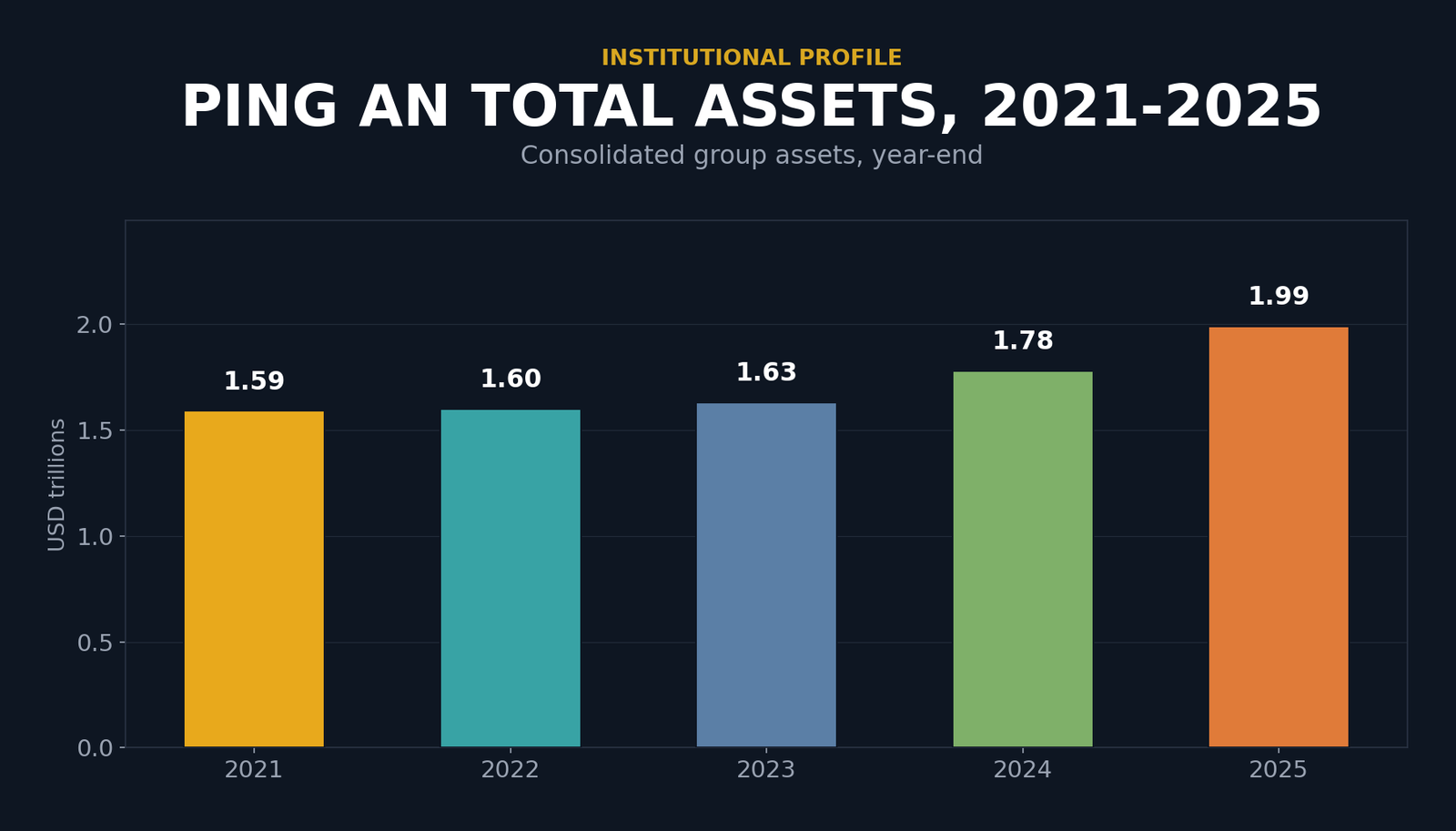
Total assets grew from $1.59 trillion at year-end 2021 to $1.99 trillion at year-end 2025, converted from RMB millions in the Five-Year Summary at Federal Reserve H.10 year-end rates (2021: 6.3726; 2022: 6.8972; 2023: 7.0999; 2024: 7.2993; 2025: 6.9931 CNY per USD). Source: Ping An 2025 Annual Report, Five-Year Summary; Federal Reserve H.10.
| Period | Total Assets (USD trillions) |
|---|---|
| 2021 | 1.59 |
| 2022 | 1.60 |
| 2023 | 1.63 |
| 2024 | 1.78 |
| 2025 | 1.99 |
Investment Mandate
Ping An's corporate mission is to become a world-leading integrated finance, health, and senior care services group, creating value for customers, employees, shareholders, and society. The group's investment strategy focuses on integrated finance and health and senior care services across domestic China markets. Unlike traditional institutional allocators, Ping An does not publish an investment policy statement or target asset allocation percentages. It does publish the actual composition of its insurance funds investment portfolio by asset class. The company manages investments internally through its subsidiaries, with investment operations embedded within the insurance, banking, and asset management business segments.
The group's business segments reflect its diversified operating model. On an operating profit after tax attributable to shareholders basis, life and health insurance generated $14.3 billion in 2025, banking $3.5 billion, property and casualty insurance $2.4 billion, and asset management a loss of $0.5 billion; group operating profit after tax attributable to shareholders was $19.2 billion. Ping An Property & Casualty achieved a combined ratio of 96.8 percent in 2025. The group does not disclose geographic allocation ranges or active versus passive splits for its internal investment operations.
Ping An's investment approach is mixed, reflecting the diverse nature of its insurance, banking, and asset management operations. The company invests across public equity, fixed income, real estate, and cash, and publishes the composition of its insurance funds investment portfolio by asset class, though not position-level holdings. That portfolio achieved a comprehensive investment yield of 6.3 percent and a net investment yield of 3.7 percent in 2025. The group's investment activities support its insurance liabilities, banking operations, and asset management services, with investment performance reflected in business segment results rather than standalone portfolio returns. The company's geographic focus is domestic-only, concentrating on China markets across all business lines.
Financial Position
Ping An reported total consolidated assets of $1.99 trillion as of December 31, 2025, up from $1.78 trillion in 2024. Net profit attributable to shareholders reached $19.3 billion in 2025, up from $18.1 billion in 2024. Operating profit after tax attributable to shareholders was $19.2 billion in 2025, up from $17.4 billion in 2024. Equity attributable to shareholders stood at $143.0 billion as of December 31, 2025, up from $132.8 billion in 2024. The group's comprehensive solvency margin ratio was 193.3 percent as of December 31, 2025, down from 204.1 percent in 2024. Operating ROE was 12.7 percent in 2025, unchanged from 2024.
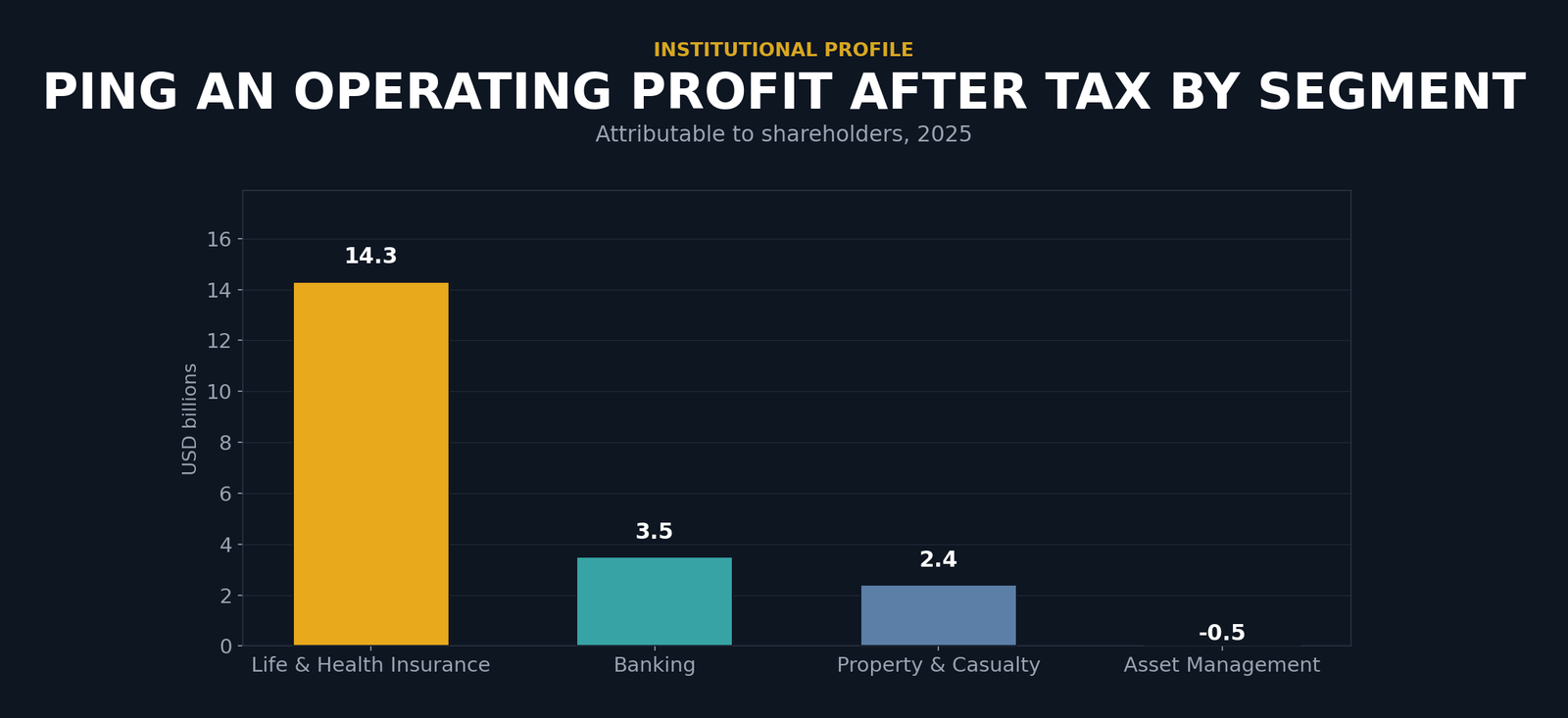
Operating profit after tax attributable to shareholders in 2025: Life and Health Insurance $14.3 billion, Banking $3.5 billion, Property and Casualty $2.4 billion, and Asset Management a loss of $0.5 billion, converted from RMB million figures at 6.9931 CNY per USD. Source: Ping An 2025 Annual Report, operating profit after tax by segment; Federal Reserve H.10.
| Business Segment | Operating Profit After Tax (USD billions) |
|---|---|
| Life & Health Insurance | 14.3 |
| Banking | 3.5 |
| Property & Casualty | 2.4 |
| Asset Management | -0.5 |
The company's financial position reflects its scale and diversification across multiple business lines. Key financial metrics include:
- Total assets: $1.99 trillion as of December 31, 2025, representing consolidated group assets across insurance, banking, asset management, and health care operations.
- Net profit attributable to shareholders: $19.3 billion in 2025, reflecting profitability across all business segments.
- Operating ROE: 12.7 percent in 2025, a measure of return on equity attributable to shareholders.
- Retail customer base: 250.97 million customers as of December 31, 2025, up from 242.47 million in 2024.
- Dividend per share: $0.39 in 2025, up from $0.36 in 2024.
Ping An reports investment performance for its insurance funds investment portfolio: a comprehensive investment yield of 6.3 percent and a net investment yield of 3.7 percent in 2025 (2024: 5.8 percent and 3.8 percent). Life and Health reported a comprehensive yield of 6.6 percent and a net yield of 3.8 percent in 2025, and Ping An Property & Casualty a comprehensive yield of 3.4 percent and a net yield of 2.9 percent. The group's financial results are also reported by business segment (Life and Health Insurance, Property and Casualty, Banking, Asset Management).
DEEP Disclosure Rating
Under the DEEP Disclosure Rating, Ping An Insurance scores 49 of 100 (Limited) for disclosure and governance transparency as of this assessment. Ping An publishes an audited annual report with total assets, investment results including the insurance funds portfolio's investment yields, the actual composition of its insurance funds investment portfolio, and its board and senior management. It does not publish an investment policy statement, target allocation, position-level holdings, an investment fee or cost schedule, a manager-selection process, an RFP process, or board and committee meeting minutes and materials. The DEEP Disclosure Rating measures disclosure and governance practices; it does not assess investment quality, performance, or creditworthiness. Last assessed October 2026. Items that cannot apply to a fund's type are excluded from its score rather than scored as zero. The fund-specific basis is set out in the DEEP Disclosure Report. The full scoring rubric is public on the DEEP Disclosure Rating methodology page. A detailed, pillar-by-pillar and item-by-item breakdown of this fund's score is available as a DEEP Disclosure Report on request.
Manager Approach and Matching Profile
Pursuit verdict: Active managers: no opportunity. Ping An is an insurance group that manages investments internally through subsidiaries (Ping An Asset Management, Ping An Life, Ping An P&C, Ping An Bank); it does not allocate capital to external managers. Index managers: no opportunity. The company does not operate as an institutional capital allocator with external manager mandates. All investment management is conducted in-house across the group's insurance, banking, and asset management operations. No public procurement process, RFP calendar, or external manager selection pathway exists.
- Target vs. actual allocation: Ping An does not disclose target asset allocation percentages. It discloses the actual composition of its insurance funds investment portfolio at December 31, 2025 (total $928.0 billion): debt financial assets $586.8 billion (63.2 percent of the portfolio), equity financial assets $200.5 billion (21.6 percent), term deposits $46.7 billion, cash and cash equivalents $40.1 billion, long-term equity stakes $24.8 billion, investment properties $20.6 billion, and other investments $8.5 billion. Within debt financial assets, bond investments alone were 55.0 percent of the portfolio; stocks were 14.8 percent.
- Historical AUM and return series: Total assets are disclosed annually from 2021 to 2025 in the Five-Year Summary and are converted here at Federal Reserve H.10 year-end rates. The insurance funds investment portfolio achieved a comprehensive investment yield of 6.3 percent in 2025 (2024: 5.8 percent) and a net investment yield of 3.7 percent (2024: 3.8 percent).
Period Total Assets (USD) Comprehensive Investment Yield 2025 year-end $1.99 trillion 6.3% 2024 year-end $1.78 trillion 5.8% 2023 year-end $1.63 trillion Not disclosed 2022 year-end $1.60 trillion Not disclosed 2021 year-end $1.59 trillion Not disclosed - External manager roster and consultant detail: Ping An manages investments internally through subsidiaries (Ping An Asset Management, Ping An Life, Ping An P&C, Ping An Bank); no external manager roster, mandate benchmarks, or manager fees are published, and no investment consultant is named. The insurance funds investment portfolio, totaling $928.0 billion at December 31, 2025, breaks down as follows:
Mandate Benchmark or Strategy AUM (USD) Manager Fee or Expense Debt financial assets Not publicly disclosed $586.8 billion Ping An insurance subsidiaries (managed internally) Not publicly disclosed Equity financial assets Not publicly disclosed $200.5 billion Ping An insurance subsidiaries (managed internally) Not publicly disclosed Term deposits Not publicly disclosed $46.7 billion Ping An insurance subsidiaries (managed internally) Not publicly disclosed Cash and cash equivalents Not publicly disclosed $40.1 billion Ping An insurance subsidiaries (managed internally) Not publicly disclosed Long-term equity stakes Not publicly disclosed $24.8 billion Ping An insurance subsidiaries (managed internally) Not publicly disclosed Investment properties Not publicly disclosed $20.6 billion Ping An insurance subsidiaries (managed internally) Not publicly disclosed Other investments Not publicly disclosed $8.5 billion Ping An insurance subsidiaries (managed internally) Not publicly disclosed - Commitment pacing: The fund does not disclose this. Ping An is an insurance group with internal investment operations; commitment pacing is not a relevant disclosure metric. The company does not operate a private markets program with external commitments or a defined contribution plan with participant flows. Investment activities support insurance liabilities, banking operations, and asset management services, with no public disclosure of pacing schedules or capital deployment timelines.
- RFP, procurement, and board calendar: The fund does not disclose this. Ping An is an insurance group, not an institutional capital allocator with a public procurement process or RFP calendar. The company does not publish a consultant of record, procurement portal, RFP schedule, or stated policy on unsolicited proposals. No public pathway exists for external managers to access the group's investment operations. The Board of Directors meets regularly to oversee the group's operations, but meeting dates and agendas are not published. Board and committee meeting minutes are not disclosed. The realistic entry route for external managers is: no opportunity, as all investment management is conducted internally.
Matching profile: these data points feed the cross-fund manager matching profile.
Sources: 2025 Annual Report, Five-Year Summary; Governance page (group.pingan.com).
Governance and Leadership
The Board of Directors comprises 15 members: 5 executive directors (Ma Mingzhe, Xie Yonglin, Michael Guo, Fu Xin, Cai Fangfang), 4 non-executive directors (Soopakij Chearavanont, Yang Xiaoping, He Jianfeng, Cai Xun), and 6 independent non-executive directors (Ng Kong Ping Albert, Jin Li, Wang Guangqian, Hong Xiaoyuan, Song Xianzhong, Chan Hiu Fung Nicholas). Directors are nominated by the Board, the Nomination and Remuneration Committee, or shareholders meeting the qualification requirements, and elected by shareholders' general meeting. The Board has four main committees: Strategy and Investment Committee (chaired by Ma Mingzhe), Audit and Risk Management Committee (chaired by Ng Kong Ping Albert), Nomination and Remuneration Committee (chaired by Jin Li), and Related Party Transaction Control and Consumer Rights Protection Committee (chaired by Wang Guangqian).
An Executive Committee serves as the highest execution authority under the Board, with responsibility for reviewing business reports, investment and profit distribution policies, and management decisions on material development strategies, compliance risk management, and capital allocation. The company has established several management committees under the Executive Committee, including the Risk Management Executive Committee, Investment Management Committee, Investor Relations and ESG Committee, and Technology Development Committee. Senior management includes:
- Ma Mingzhe, Founder, Chairman (Executive Director)
- Xie Yonglin, Executive Director, President and Co-CEO
- Michael Guo, Executive Director, Co-CEO, Senior Vice President
- Fu Xin, Executive Director, Senior Vice President, Chief Financial Officer
- Cai Fangfang, Senior Vice President
- Huang Baoxin, Senior Vice President
- Sheng Ruisheng, Board Secretary, Company Secretary
- Guo Shibang, Assistant President, Chief Risk Officer
- Zhang Zhichun, Assistant President, Person-in-charge of Auditing
- Xu Jing, Chief Compliance Officer
- Shi Liangxun, Chief Investment Officer, Ping An Property & Casualty
How to Engage
Ping An operates as an integrated finance and health and senior care services group with internal investment management across multiple subsidiaries. The group provides professional financial advisory services, health advisory services, and senior care concierge services to 251 million retail customers. Ping An owns and operates multiple financial and health care entities, including Ping An Life, Ping An Property & Casualty, Ping An Bank, Ping An Asset Management, Ping An Health, and PKU Healthcare Group. The company engages in direct investment and asset management through its subsidiaries rather than through external manager relationships.
No public procurement process, RFP calendar, or external manager selection pathway exists. The company does not publish a consultant of record, procurement portal, or stated policy on unsolicited proposals. All investment operations are conducted in-house across the group's insurance, banking, and asset management business segments. External managers seeking to engage with Ping An have no realistic pathway, as the company does not allocate capital to external managers. The group's investment activities support its insurance liabilities, banking operations, and asset management services, with no external manager mandates disclosed in the 2025 Annual Report or governance materials.
Sources and Documents
- Ping An Group Investor Relations homepage
- Results and Presentations page
- 2025 Annual Results page
- Our Leadership page (accessed May 2026)
- Governance page (accessed September 2026)
- 2025 Annual Report (pingan-ar25-report.pdf, published March 26, 2026)
Data Notes and Methodology
This profile is based on the 2025 Annual Report (published March 26, 2026), governance pages accessed in May and September 2026, and investor relations materials published on group.pingan.com. All financial figures are as of December 31, 2025, unless otherwise stated. Total assets of RMB 13,898,471 million represent consolidated group assets across insurance, banking, asset management, and health care operations. USD figures are converted at the Federal Reserve H.10 noon rate of 6.9931 CNY per USD as of 31 December 2025; prior-year total assets are converted at year-end rates of 7.2993 in 2024, 7.0999 in 2023, 6.8972 in 2022, and 6.3726 in 2021 CNY per USD. Ping An is an insurance group, not a traditional institutional capital allocator (sovereign wealth fund, pension, endowment, foundation, or family office). The company manages investments internally through subsidiaries rather than allocating capital to external managers. An investment policy statement, target asset allocation, position-level holdings, external manager roster, and procurement process are not disclosed; the actual composition of the insurance funds investment portfolio and its investment yields are disclosed in the annual report. The next expected update is the 2026 Annual Report (expected March 2027). Verification status: verified against primary filings from group.pingan.com. Last updated October 1, 2026.