
Public Investment Fund
Overview
The Public Investment Fund (PIF) was established on August 16, 1971 under Royal Decree No. M/24 as part of the Ministry of Finance. In 2015, oversight transferred to the Council of Economic and Development Affairs (CEDA), marking the beginning of a transformation phase that repositioned PIF as Saudi Arabia's primary sovereign wealth vehicle. Headquartered in Riyadh, PIF operates international subsidiary offices in London, New York, Paris, Beijing, Shanghai and Hong Kong. As of December 31, 2025, PIF managed assets of SAR 3,396 billion (USD 906 billion, converted from SAR at 3.75 per USD as of December 31, 2025), with a portfolio of 211 companies.
PIF operates with public legal personality, financial and administrative independence under PIF Law (Royal Decree No. M/92, dated April 18, 2019). The fund reports to the Council of Economic and Development Affairs and is chaired by His Royal Highness Prince Mohammed bin Salman bin Abdulaziz Al Saud, Crown Prince and Prime Minister. PIF's mandate is to actively invest over the long term to maximize sustainable returns, be the investment partner of choice for global opportunities, and enable economic development and diversification of the Saudi economy. In 2025, PIF contributed 11 percent of Saudi Arabia's non-oil GDP, with cumulative real non-oil GDP contribution of SAR 1,286 billion from 2021 through 2025.
The fund operates under a three-portfolio structure introduced in the 2026-2030 strategy: the Vision Portfolio catalyzes development of six integrated economic ecosystems (Tourism/Travel/Entertainment, Urban Development/Livability, Advanced Manufacturing/Innovation, Industrials/Logistics, Clean Energy/Water/Renewables, NEOM); the Strategic Portfolio manages key strategic assets and future sectors; and the Financial Portfolio maximizes risk-adjusted returns through thematic investments. This structure replaced the previous investment pools (Local, International, Treasury) that operated during the 2021-2025 Vision Realization Program. PIF's workforce totaled 3,321 employees as of 2025.
PIF achieved credit ratings of Aa3 (Moody's, stable outlook), A+ (Fitch, stable outlook), and A-1 short-term (S&P, stable outlook). The fund adopted the Santiago Principles (Generally Accepted Principles and Practices for Sovereign Wealth Funds) and published a self-assessment report demonstrating alignment with all 24 principles. While not a member of the International Forum of Sovereign Wealth Funds, PIF committed to voluntary compliance. In 2025, PIF achieved a 100 percent score in the Global SWF Governance, Sustainability and Resilience rankings, compared to 28 percent in 2020. PIF also implemented voluntary compliance with the CFA Institute's Global Investment Performance Standards (GIPS) across all activities.
Investment Mandate
PIF's vision is to be a global investment powerhouse and the world's most impactful investor, enabling creation of new sectors and opportunities while driving economic transformation of Saudi Arabia. The mission is to actively invest over the long term to maximize sustainable returns, be the investment partner of choice for global opportunities, and enable economic development and diversification of the Saudi economy. The 2026-2030 strategy structures investments into three portfolios, each with distinct objectives: the Vision Portfolio focuses on six integrated ecosystems to catalyze economic diversification; the Strategic Portfolio manages key strategic assets and future sectors; and the Financial Portfolio maximizes risk-adjusted returns through thematic investments.
As of 2025, PIF's asset allocation was 76 percent Local Investments, 20 percent International Investments, and 4 percent Treasury. International investments reached SAR 663 billion in 2025, representing 12 percent growth. The management approach is 86 percent internally managed and 14 percent externally managed. PIF invests across public equity, fixed income, private equity, real estate, infrastructure and cash. The fund operates as a global investor with both domestic and international portfolios, maintaining strategic partnerships with leading global asset managers including BlackRock, Franklin Templeton, Neuberger Berman, Northern Trust, I Squared Capital, Goldman Sachs Asset Management, Macquarie Asset Management and SACE.
PIF's investment approach is active, with focus on ecosystem development, national champions, giga-projects and strategic partnerships. The Vision Portfolio's ecosystem model defines an expanding role for the private sector as investor, partner and supplier. Direct investments include giga-projects such as NEOM, Red Sea Global, Qiddiya, ROSHN and Diriyah, as well as national champions across strategic sectors including automotive, artificial intelligence, gaming, renewable energy and tourism. PIF allocated more than SAR 33.75 billion in green bond proceeds across 146 projects and issued a EUR 1.65 billion green bond in 2025, demonstrating commitment to sustainability. The fund aims to generate value through focused and diligent selection of investments consistent with its long-term investment roadmap and strategic asset allocation.
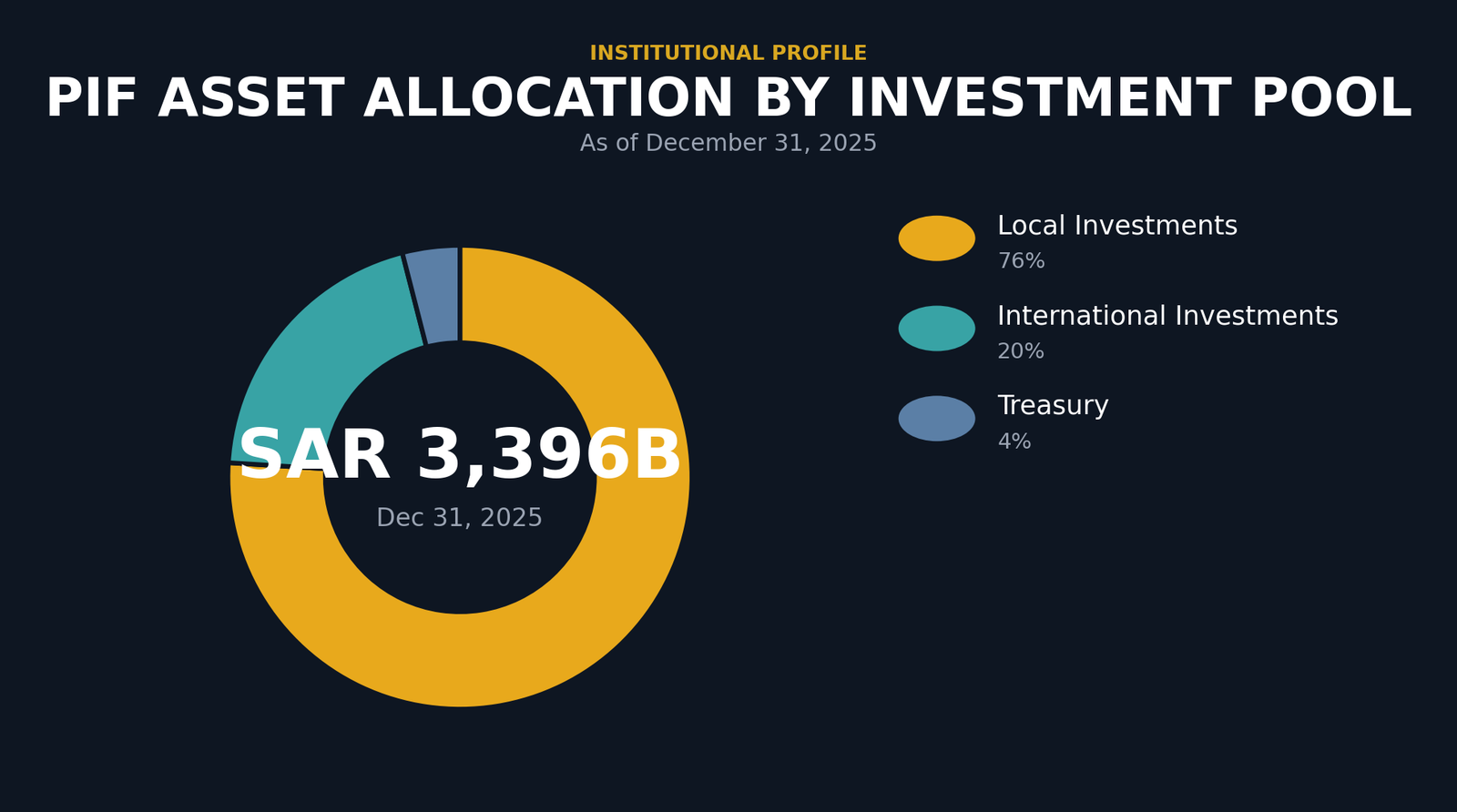
Local Investments comprised 76 percent of PIF assets as of year-end 2025, with International Investments at 20 percent and Treasury at 4 percent. Source: PIF 2025 Annual Report, p. 11 (At a Glance).
| Investment Pool | Share of Assets |
|---|---|
| Local Investments | 76% |
| International Investments | 20% |
| Treasury | 4% |
Financial Position
The Public Investment Fund reported assets under management of SAR 3,396 billion (USD 906 billion) as of December 31, 2025. The 2025 AUM outcome reflects prevailing market conditions, portfolio valuation movements and transaction timing; the 2025 target of SAR 4 trillion was not met due to global macroeconomic volatility and U.S. tariff impacts on asset valuations. PIF achieved a total shareholder return of 5.8 percent annualized since the Vision Realization Program inception in 2017. The fund invested more than SAR 750 billion domestically in new local projects cumulatively from 2021 through 2025, with annual new local investments in 2025 of SAR 171.1 billion, exceeding the SAR 150 billion target. PIF and its portfolio companies spent more than SAR 157 billion with the local private sector from 2021 through 2024.
PIF raised SAR 34.4 billion in international debt issuances in 2025 across multiple currencies and maturities, bringing total public market financing to USD 31 billion (approximately SAR 116.25 billion) by end of 2025. The fund's 2025 Annual Report includes a Consolidated Statement of Financial Position, Consolidated Statement of Profit or Loss and Other Comprehensive Income, and Consolidated Statement of Cash Flows. Key financial metrics:
- Assets under management: SAR 3,396 billion (USD 906 billion) as of December 31, 2025
- Total shareholder return: 5.8 percent annualized since 2017
- Portfolio companies: 211 as of 2025
- Workforce: 3,321 employees as of 2025
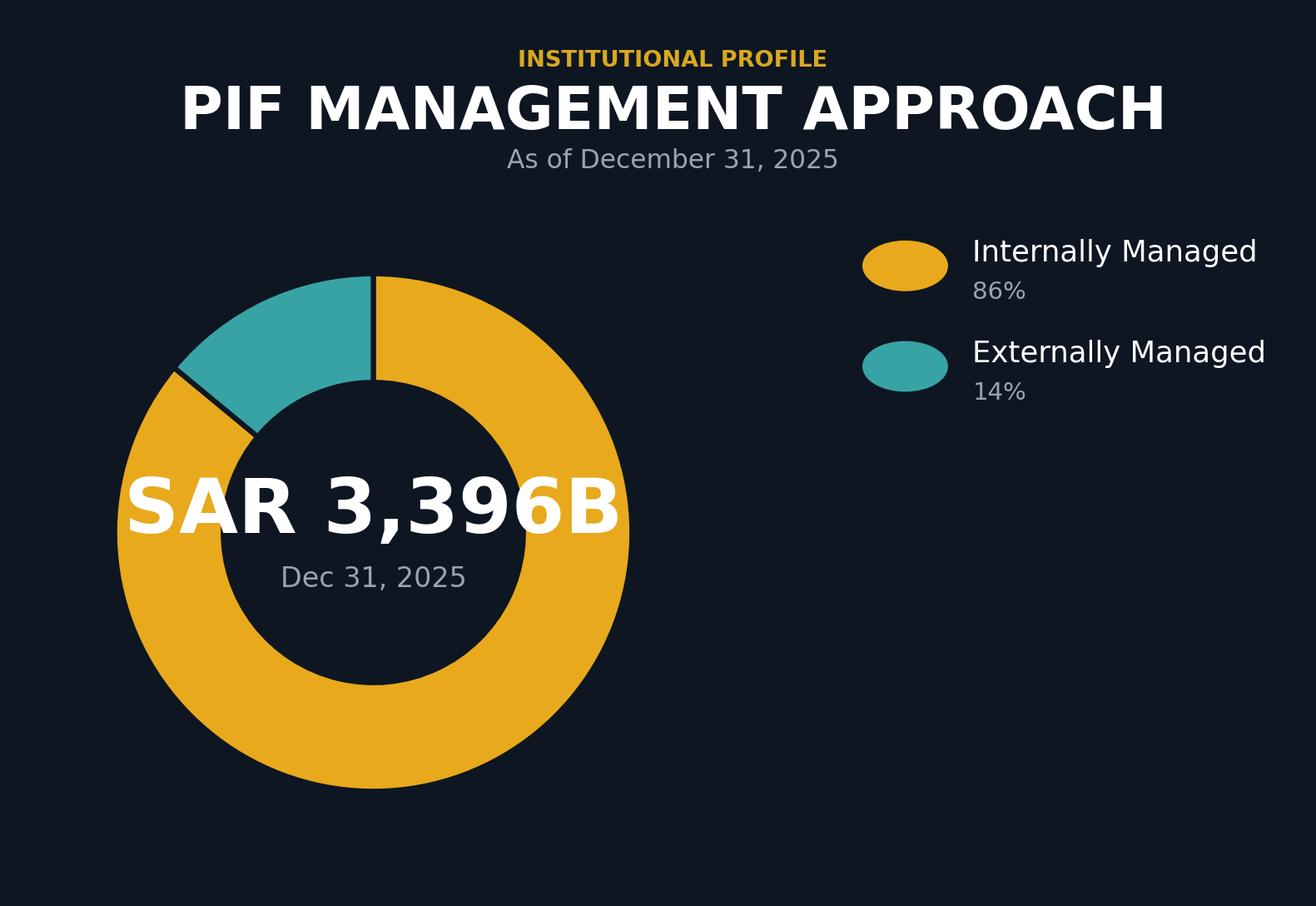
PIF managed 86 percent of assets internally and 14 percent externally as of year-end 2025. Source: PIF 2025 Annual Report, p. 11 (At a Glance).
| Management Type | Share of Assets |
|---|---|
| Internally Managed | 86% |
| Externally Managed | 14% |
DEEP Disclosure Rating
The DEEP Disclosure Rating measures how much a fund discloses about itself. It is a disclosure and governance measure only, and not a judgment of investment quality or creditworthiness. The Public Investment Fund's DEEP Disclosure Score is 61 of 100, band Adequate. It publishes an annual report with audited financial statements, discloses assets under management with as-of date, discloses investment performance, publishes an Investment Policy Statement or equivalent mandate document, discloses actual asset allocation, discloses how it selects managers or names its investment consultant, names governing board and senior investment staff, makes disclosures freely and publicly accessible without paywall, publishes current disclosures within its reporting cycle, and consolidates disclosures in reasonably findable locations. It does not disclose fees or investment costs, does not disclose target asset allocation for its 2026-2030 portfolios, does not disclose complete position-level portfolio holdings, does not publish an RFP or procurement process documentation, and does not publish board or committee meeting materials or minutes, which places it in the Adequate band. Last assessed October 2026, on the 2025 Annual Report and published governance materials. Items that cannot apply to a fund's type are excluded from its score rather than scored as zero. The fund-specific basis is included in the DEEP Disclosure Report. The full scoring rubric is public on the DEEP Disclosure Rating methodology page. A detailed, pillar-by-pillar and item-by-item breakdown of this fund's score is available as a DEEP Disclosure Report on request.
Manager Approach and Matching Profile
Pursuit verdict: Active managers: limited opportunity; PIF is 86 percent internally managed with strategic partnerships already established with major global asset managers (BlackRock, Franklin Templeton, Neuberger Berman, Northern Trust, I Squared Capital, Goldman Sachs, Macquarie, SACE). Passive managers: no disclosed opportunity; PIF's mandate emphasizes active investment in ecosystem development, giga-projects and national champions. Specialist managers in private equity, infrastructure, real estate and thematic sectors: realistic pathway through the procurement portal (become-a-supplier and vendor gate) for managers aligned with PIF's Vision, Strategic or Financial portfolio objectives, particularly those offering innovation, knowledge transfer and capability development in target sectors (tourism, urban development, advanced manufacturing, industrials, clean energy, NEOM). No public RFP calendar or unsolicited-proposal policy is disclosed, so entry depends on proactive engagement through official procurement channels and alignment with PIF's strategic priorities.
- Target vs. actual allocation: PIF discloses actual allocation percentages by investment pool: Local Investments 76 percent, International Investments 20 percent, Treasury 4 percent as of 2025. Management type: Internally Managed 86 percent, Externally Managed 14 percent. The 2025 Annual Report discloses 2025 targets for share of assets in new sectors (target greater than 21 percent, actual approximately 45 percent) and international sectors (target less than 24 percent, actual approximately 20 percent). The 2026-2030 strategy introduces a three-portfolio structure (Vision, Strategic, Financial) but specific target allocations for these portfolios are not disclosed in the sources.
- Historical AUM and return series: PIF discloses AUM for 2015 (USD 150 billion, at the inception of the transformation phase) and 2025 year-end (SAR 3,396 billion, USD 906 billion). A single annualized total shareholder return of 5.8 percent since 2017 is disclosed; no annual or period-specific returns are provided.
Period AUM Return 2015 (inception of transformation phase) USD 150 billion Not disclosed 2025 year-end USD 906 billion 5.8% annualized since 2017 - External manager roster and consultant detail: PIF does not disclose a detailed roster of external managers by mandate. The sources name strategic partnerships with BlackRock, Franklin Templeton, Neuberger Berman, Northern Trust, I Squared Capital, Goldman Sachs Asset Management, Macquarie Asset Management and SACE, focused on innovation, knowledge transfer and capability development. Specific mandates, AUM allocations and fees are not attributed to each manager. The governance page states that PIF aims to generate value through focused and diligent selection of investments in funds consistent with its long-term investment roadmap and strategic asset allocation. No investment consultant is named.
- Commitment pacing: PIF does not disclose commitment pacing or capital deployment schedules. The sources report annual new local investments of SAR 171.1 billion in 2025 and cumulative investments of more than SAR 750 billion domestically from 2021 through 2025, but do not detail forward commitment pipelines or deployment timelines. International investments reached SAR 663 billion in 2025, representing 12 percent growth, but no pacing schedule is provided.
- RFP, procurement, and board calendar: PIF discloses a procurement portal (become-a-supplier and vendor gate) but does not publish an RFP calendar or upcoming board or committee meeting schedule. The sources do not state an unsolicited-proposal policy. The Board of Directors is chaired by His Royal Highness Prince Mohammed bin Salman bin Abdulaziz Al Saud and comprises 11 members including ministers and the Governor of PIF. The board is responsible for overseeing PIF's long-term strategy, investment policy and performance, and reports to the Council of Economic and Development Affairs. Five management committees evaluate investment and non-investment proposals before Board submission, but meeting dates are not disclosed. Realistic entry route: proactive engagement through the procurement portal for managers aligned with PIF's strategic priorities in the Vision, Strategic or Financial portfolios.
Matching profile: these data points feed the cross-fund manager matching profile.
Sources: 2025 Annual Report, PIF governance page, PIF investment portfolios page, PIF leadership page.
| Mandate | Benchmark | AUM | Manager | Fee |
|---|---|---|---|---|
| Vision Portfolio (giga-projects and development) | Not publicly disclosed | Not publicly disclosed | Not publicly disclosed | Not publicly disclosed |
| Strategic Portfolio (sector development) | Not publicly disclosed | Not publicly disclosed | Not publicly disclosed | Not publicly disclosed |
| Financial Portfolio (diversified investments) | Not publicly disclosed | Not publicly disclosed | Not publicly disclosed | Not publicly disclosed |
Governance and Leadership
The Public Investment Fund is governed by a Board of Directors chaired by His Royal Highness Prince Mohammed bin Salman bin Abdulaziz Al Saud, Crown Prince and Prime Minister. The board comprises 11 members including ministers and the Governor of PIF. The board is responsible for overseeing PIF's long-term strategy, investment policy and performance, and reports to the Council of Economic and Development Affairs. PIF has public legal personality, financial and administrative independence, and operates under PIF Law (Royal Decree No. M/92, dated April 18, 2019). The governance model includes board-level committees and management-level committees, with some tasks delegated to administrative committees. Five management committees evaluate investment and non-investment proposals before Board submission.
Executive management is led by H.E. Yasir Othman Al-Rumayyan, Governor of PIF. Named senior leaders include Turqi A. Al-Nowaiser (Deputy Governor, Head of International Investments Division and Acting Head of Shared Services Division), Yazeed A. Al-Humied (Deputy Governor, Head of MENA Investments Division), Saad Alkroud (Head of Local Real Estate Investments Division), Yasir A. AlSalman (Chief Financial Officer and Head of Finance Division and Acting Head of Global Capital Finance), Rania Nashar (Head of Compliance & Governance Division), Maram Al Johani (Chief of Staff and Secretary General to the Board and Board Committees), Kevin Foster (Head of Corporate Affairs Division), Jerry Todd (Head of National Development Division and Acting Head of Investment Strategy and Economic Insights Division), Mike Cheng (Head of Internal Audit Division), and Feta Zabeli (Head of Risk Division and Chief Risk Officer). PIF achieved a 100 percent score in the Global SWF Governance, Sustainability and Resilience rankings in 2025, compared to 28 percent in 2020.
How to Engage
PIF sources managers through strategic partnerships and a procurement portal. The fund has established partnerships with leading global asset managers including BlackRock, Franklin Templeton, Neuberger Berman, Northern Trust, I Squared Capital, Goldman Sachs Asset Management, Macquarie Asset Management and SACE, focused on innovation, knowledge transfer and capability development. PIF discloses a procurement portal (become-a-supplier and vendor gate) for external managers and suppliers. No public RFP calendar or unsolicited-proposal policy is disclosed in the sources. The governance page states that PIF aims to generate value through focused and diligent selection of investments in funds consistent with its long-term investment roadmap and strategic asset allocation.
Managers aligned with PIF's Vision, Strategic or Financial portfolio objectives may pursue engagement through the procurement portal. The Vision Portfolio catalyzes development of six integrated ecosystems (Tourism/Travel/Entertainment, Urban Development/Livability, Advanced Manufacturing/Innovation, Industrials/Logistics, Clean Energy/Water/Renewables, NEOM). The Strategic Portfolio manages key strategic assets and future sectors. The Financial Portfolio maximizes risk-adjusted returns through thematic investments. PIF is 86 percent internally managed and 14 percent externally managed as of 2025. Realistic entry depends on proactive engagement through official procurement channels and alignment with PIF's strategic priorities. No investment consultant is named in the sources.
Sources and Documents
- PIF 2025 Annual Report (published 2026)
- PIF Leadership page
- PIF Who We Are page
- PIF Governance and Investment Decisions page
- PIF Investment Portfolios page
- PIF Press Release: Chaired by HRH Crown Prince, PIF Board of Directors approves PIF 2026-2030 strategy (April 15, 2026)
Data Notes and Methodology
This profile is based on the Public Investment Fund 2025 Annual Report (published 2026), official PIF website pages (leadership, governance, investment portfolios, who we are), and the April 15, 2026 press release announcing the 2026-2030 strategy. Assets under management of SAR 3,396 billion as of December 31, 2025 were converted to USD 906 billion using the pegged foreign exchange rate of 3.75 SAR per USD as of December 31, 2025. The 2025 AUM outcome reflects prevailing market conditions, portfolio valuation movements and transaction timing; the 2025 target of SAR 4 trillion was not met due to global macroeconomic volatility and U.S. tariff impacts on asset valuations. The total shareholder return of 5.8 percent is annualized since the Vision Realization Program inception in 2017; no annual or period-specific returns are disclosed. The 2026-2030 strategy introduces a three-portfolio structure (Vision, Strategic, Financial) but specific target allocations for these portfolios are not disclosed in the sources. PIF does not disclose investment fees, expense ratios, or investment costs. Strategic partnerships with global asset managers are named but specific mandates, AUM allocations and fees are not attributed to each manager. Assessment date is October 1, 2026.