
Kuwait Investment Authority
Overview
The Kuwait Investment Authority (KIA) is the world's first sovereign wealth fund, tracing its roots to the Kuwait Investment Board established in London in February 1953. Established by Law No. 47 of 1982 as an independent public authority, KIA manages Kuwait's General Reserve Fund (GRF) and Future Generations Fund (FGF). The authority is headquartered in Kuwait City with international offices in London (operating since 1953 as the Kuwait Investment Office) and Shanghai (opened in 2018). KIA's mandate is to manage the State's financial reserves, diversify Kuwait's economy away from oil dependence, and provide sustainable returns for current and future generations.
KIA operates under a governance structure established by Law No. 47 of 1982, which grants the authority complete independence in its investment decision-making. The authority is governed by a Board of Directors composed of nine members: four ex-officio government members (the State Minister for Economic Affairs and Investment as Chairman, the Minister of Oil, the Central Bank of Kuwait Governor, and the Finance Undersecretary) and five private-sector appointees appointed by Amiri Decree for four-year terms. At least three of the private-sector members must not hold public office. The Board appoints a Managing Director who chairs an Executive Committee composed of five Board members, at least three from the private sector. KIA reports annually to the Council of Ministers and National Assembly, and senior representatives appear periodically before various parliamentary committees including the Finance and Economic Committee, the Budgetary and Closing Accounts Committee, and the Public Funds Protection Committee.
KIA manages two distinct funds with separate mandates. The General Reserve Fund serves as the Government's Public Treasury, consolidating State revenues including oil revenues and financing government expenditures. GRF also manages a broad portfolio of assets supporting national economic development and directs the State's contributions and shares in various major economic entities. The Future Generations Fund, established by Amiri Decree in 1976, is an intergenerational savings platform that receives a minimum of 10 percent of State annual revenues (amended by Law 18/2020 to require budget surplus and ministerial recommendation). FGF invests outside Kuwait in diversified asset classes across global markets. GRF focuses investment in the Middle East and North Africa region and holds all government assets, including Kuwait's participation in public enterprises and international organizations.
The authority's operating model combines external fund management with direct investment capabilities. KIA invests primarily through external fund managers, while the Kuwait Investment Office in London trades directly in marketable securities. KIA has established specialized standalone entities to excel in specific asset classes and conduct direct investments: St. Martins for real estate in the United Kingdom and globally, Fosterlane and Breadstreet for real estate in the United States, and Wren House Infrastructure for infrastructure investments. KIA is constitutionally prohibited from borrowing for investment purposes and does not use derivative products as investment vehicles. The authority does not seek to purchase majority or controlling interests in companies, except in real estate investment entities and investment holding companies established for particular transactions.
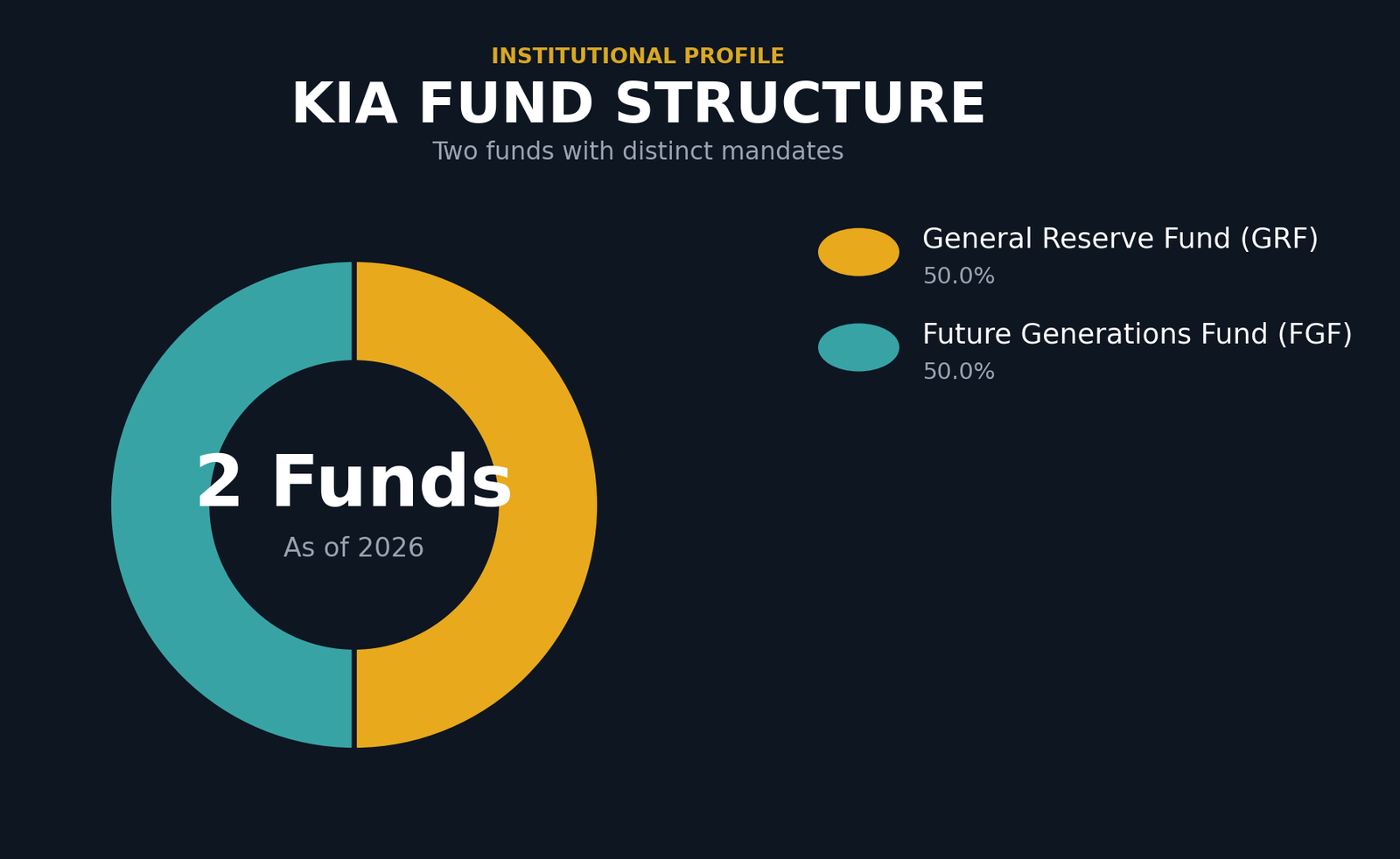
KIA manages two funds: the General Reserve Fund (Government's Public Treasury, consolidating State revenues and financing expenditures, focused on MENA region) and the Future Generations Fund (intergenerational savings platform receiving minimum 10% of State annual revenues, invested globally outside Kuwait). Source: kia.gov.kw.
| Fund | Share |
|---|---|
| General Reserve Fund (GRF) | 50.0% |
| Future Generations Fund (FGF) | 50.0% |
KIA's investment mandate is defined by its dual-fund structure, with each fund serving distinct purposes within Kuwait's sovereign wealth framework. The Future Generations Fund operates with a long-term investment horizon focused on intergenerational wealth preservation and growth. FGF invests in a diversified portfolio of asset classes including public equity, fixed income, private equity, real estate, and infrastructure across global markets spanning North America, Europe, Asia-Pacific, and the Middle East. The fund's asset allocation is based on World GDP contributions and market capitalizations, and the strategy is reviewed by KIA's Executive Committee to the Board on a monthly basis and updated every three to five years by the Board of Directors. The General Reserve Fund focuses on supporting the State's immediate financial needs while managing a portfolio of assets that includes Kuwait's participation in public enterprises, international organizations, and investments in the Middle East and North Africa region.
The authority's investment objective is to achieve a three-year rolling average return exceeding composite benchmarks through uncorrelated asset allocation consistent with mandated return and risk objectives. KIA operates with a mixed investment approach, combining internal management capabilities through the Kuwait Investment Office in London with extensive use of external fund managers. The authority establishes third-party relationships through a formal shortlisting and Request for Proposals process based on pre-determined criteria, governed by service-level agreements and investment management agreements. KIA exercises voting rights in portfolio companies in a manner it believes will protect its financial interests. When voting for board members of portfolio companies, those members are subject to all applicable legal obligations.
KIA's investment strategy emphasizes geographic diversification beyond Kuwait's borders for the Future Generations Fund, while the General Reserve Fund maintains a regional focus supporting Kuwait's economic development objectives. The authority promotes and supports institutionalization of the market through setting up funds and companies to promote and finance local business. KIA's specialized standalone entities (St. Martins, Fosterlane, Breadstreet, and Wren House Infrastructure) enable the authority to conduct direct investments in real estate and infrastructure alongside its external manager program. The authority's constitutional prohibition on borrowing and policy against using derivatives as investment vehicles shape its risk management approach and capital deployment strategy.
Financial Position
The Kuwait Investment Authority does not disclose assets under management or investment returns publicly. Law No. 47 of 1982, Clause 8, prohibits disclosure of information related to KIA's work to the public. The authority reports performance internally to the State of Kuwait, Council of Ministers, and National Assembly, but these reports are not publicly available. External trackers and sovereign wealth fund databases do not publish estimates for KIA's total assets under management due to the authority's non-disclosure policy and the legal prohibition on public disclosure.
- Assets under management: Not publicly disclosed per Law No. 47 Clause 8
- Investment returns: Not publicly disclosed; reported internally to Council of Ministers and National Assembly
- Governance: Nine-member Board of Directors (four ex-officio government members, five private-sector appointees); Executive Committee of five Board members chaired by Managing Director
- Audit and oversight: Annual audit by one of the Big Four independent audit firms; oversight by State Audit Bureau, Civil Service Commission, and Ministry of Finance controllers
KIA's accounts are audited annually by one of the Big Four independent audit firms, and the authority's financial statements are reviewed by the independent State Audit Bureau. Financial statements follow International Financial Reporting Standards (IFRS) and are prepared on an annual basis following the conclusion of each fiscal year. KIA submits semi-annual statements of assets under management to the State Audit Bureau and annual statements to the Council of Ministers and National Assembly. Investment performance and risk are reported quarterly by the Risk Management and Performance Measurement Unit. The External Auditor reports directly to the Board, and KIA maintains an Internal Audit Office reporting to the Board Chairman. Despite this comprehensive internal reporting and audit framework, no financial information is published to the public.
DEEP Disclosure Rating
The DEEP Disclosure Rating measures how much a fund discloses about itself. It is a disclosure and governance measure only, and not a judgment of investment quality or creditworthiness. The Kuwait Investment Authority's DEEP Disclosure Score is 26 of 100, band Opaque. It publishes names governing board or trustees and senior investment staff, disclosures freely and publicly accessible with no paywall, most recent disclosures current within the fund's reporting cycle, and disclosures reasonably findable and consolidated. It does not disclose publishes an annual report or audited financial statements, discloses assets under management or reserves with as-of date, discloses investment performance or return earned, discloses fees or investment costs, publishes an Investment Policy Statement or equivalent mandate document, discloses target asset allocation, discloses actual asset allocation, discloses portfolio holdings, discloses how it selects managers or names its investment consultant, publishes an RFP or procurement process or portal, or publishes board or committee meeting materials or minutes, which places it in the Opaque band. Last assessed October 2026, on KIA Santiago Principles self-assessment (2022, hosted by IFSWF) and kia.gov.kw website (About and Investments pages). Items that cannot apply to a fund's type are excluded from its score rather than scored as zero. The fund-specific basis is included in the DEEP Disclosure Report. The full scoring rubric is public on the DEEP Disclosure Rating methodology page. A detailed, pillar-by-pillar and item-by-item breakdown of this fund's score is available as a DEEP Disclosure Report on request.
Manager Approach and Matching Profile
Pursuit verdict: Active managers across public equity, fixed income, private equity, real estate, and infrastructure: opportunity exists but access pathway is opaque. KIA invests primarily through external fund managers and has established specialized standalone entities (St. Martins, Fosterlane, Breadstreet, Wren House Infrastructure) for specific asset classes. The Santiago Principles self-assessment states that third-party relationships are established through a formal shortlisting and Request for Proposals process based on pre-determined criteria, but KIA publishes no RFP calendar, procurement portal, or consultant name. Law No. 47 Clause 8 prohibits public disclosure of information related to KIA's work, so manager rosters, mandate details, and procurement timelines are not published. Entry depends on direct relationship development or introduction through existing relationships, as no public pathway is disclosed.
- Target vs. actual allocation: The fund does not disclose target or actual asset allocation percentages publicly. The Santiago Principles self-assessment states that the Future Generations Fund's asset allocation is based on World GDP contributions and market capitalizations and that the strategy is reviewed by KIA's Executive Committee to the Board on a monthly basis and is updated every three to five years by the Board of Directors, but specific allocation figures are not published. The General Reserve Fund focuses investment in the Middle East and North Africa region and holds all government assets including Kuwait's participation in public enterprises and international organizations, but no allocation percentages or ranges are disclosed.
- Historical AUM and return series: The fund does not disclose this. KIA publishes no AUM or returns figures. Law No. 47 Clause 8 prohibits public disclosure of information related to KIA's work. Performance is reported internally to the State of Kuwait, Council of Ministers, and National Assembly, but these reports are not publicly available. KIA's accounts are audited annually by one of the Big Four independent audit firms and reviewed by the State Audit Bureau, but no financial information is published to the public.
- External manager roster and consultant detail: The fund does not disclose a comprehensive manager roster. KIA's Santiago Principles self-assessment names three specialized standalone entities: St. Martins for real estate in the United Kingdom and globally, Fosterlane and Breadstreet for real estate in the United States, and Wren House Infrastructure for infrastructure investments. These entities conduct direct investments in their respective asset classes. KIA invests primarily through external fund managers and the Kuwait Investment Office in London trades directly in marketable securities, but the authority does not publish a roster of external fund managers, their mandates, benchmarks, or fee arrangements. No investment consultant is named in the sources. The Santiago Principles self-assessment states that third-party relationships are established through a formal shortlisting and Request for Proposals process based on pre-determined criteria and are governed by service-level agreements and investment management agreements, but no details of the manager-selection process are published on the website.
- Commitment pacing: The fund does not disclose this. No information on commitment pacing, deployment schedules, capital call timing, or private-market allocation targets is published. The Future Generations Fund receives a minimum of 10 percent of State annual revenues (amended by Law 18/2020 to require budget surplus and ministerial recommendation), but KIA does not disclose how these inflows are deployed across asset classes or over time.
- RFP, procurement, and board calendar: The fund does not disclose this. KIA's Santiago Principles self-assessment states that third-party relationships are established through a formal shortlisting and Request for Proposals process based on pre-determined criteria, but no public RFP calendar, procurement portal, or board or committee meeting calendar is published. Law No. 47 Clause 8 prohibits public disclosure of information related to KIA's work. The Board of Directors is composed of nine members (four ex-officio government members and five private-sector appointees appointed by Amiri Decree for four-year terms), and the Board appoints an Executive Committee of five members chaired by the Managing Director. The Board has an Audit Committee with members from the private sector chaired by the Undersecretary of the Ministry of Finance. KIA reports annually to the Council of Ministers and National Assembly, and senior representatives appear periodically before various parliamentary committees, but no meeting schedules or materials are published. No realistic entry route is disclosed beyond the existence of a formal RFP process.
Matching profile: these data points feed the cross-fund manager matching profile.
Sources: kia.gov.kw (About and Investments pages); KIA Santiago Principles self-assessment (2022, hosted by IFSWF).
| Mandate | Benchmark | AUM | Manager | Fee |
|---|---|---|---|---|
| General Reserve Fund (GRF) | Not publicly disclosed | Not publicly disclosed | Not publicly disclosed | Not publicly disclosed |
| Future Generations Fund (FGF) | Not publicly disclosed | Not publicly disclosed | Not publicly disclosed | Not publicly disclosed |
Governance and Leadership
The Kuwait Investment Authority is governed by a Board of Directors composed of nine members: four ex-officio government members and five private-sector appointees. The ex-officio members are the State Minister for Economic Affairs and Investment (who serves as Chairman), the Minister of Oil, the Central Bank of Kuwait Governor, and the Undersecretary of the Ministry of Finance. The five private-sector members are appointed by Amiri Decree for four-year terms, and at least three must not hold public office. The Board has complete independence in its decision-making process and is responsible for long-term asset allocation and overall performance. The Board appoints a Managing Director and an Executive Committee composed of five Board members (at least three from the private sector) chaired by the Managing Director. The Board also has an Audit Committee with members from the private sector, chaired by the Undersecretary of the Ministry of Finance.
- Abdulaziz AlMarzooq, State Minister for Economic Affairs and Investment, Chairman of the Board of Directors
- Tareq Al-Roumi, Minister of Oil, Board Member
- Basel Al-Haroon, Central Bank of Kuwait Governor, Board Member
- Aseel Al-Munifi, Undersecretary of Ministry of Finance, Board Member
- Sheikh Dr. Meshaal Jaber Al-Ahmad Al-Sabah, Board Member
- Sheikh Saoud Salem Abdulaziz Al-Sabah, Board Member and Managing Director
- Mahmoud Al-Marzouq, Board Member
- Danah Al-Mulla, Board Member
- Salah Al-Fouzan, Board Member
- Abdulmohsen Almukhaizeem, President and CEO, Kuwait Investment Office (London)
- Abdulaziz Alhudaib, Acting Executive Director, Planning and Senior Management Support
- Rana Almuzaini, Acting Executive Director, Operations and Administration
- Hadeel Boukhadour, Acting Executive Director, Alternative Investments
- Huda Almousa, Acting Executive Director, General Reserve
- Sarah Al-Sane, Acting Executive Director, Marketable Securities
- Abdulrazaq Al-Buaijan, Chief Representative, Kuwait Investment Office (Shanghai)
KIA reports annually to the Council of Ministers and National Assembly. Senior representatives appear periodically before various parliamentary committees including the Finance and Economic Committee, the Budgetary and Closing Accounts Committee, and the Public Funds Protection Committee. The authority is audited annually by one of the Big Four independent audit firms, with the External Auditor reporting directly to the Board. KIA maintains an Internal Audit Office reporting to the Board Chairman and is subject to oversight by the Civil Service Commission and Ministry of Finance controllers. The authority submits semi-annual statements of assets under management to the independent State Audit Bureau and annual statements to the Council of Ministers and National Assembly.
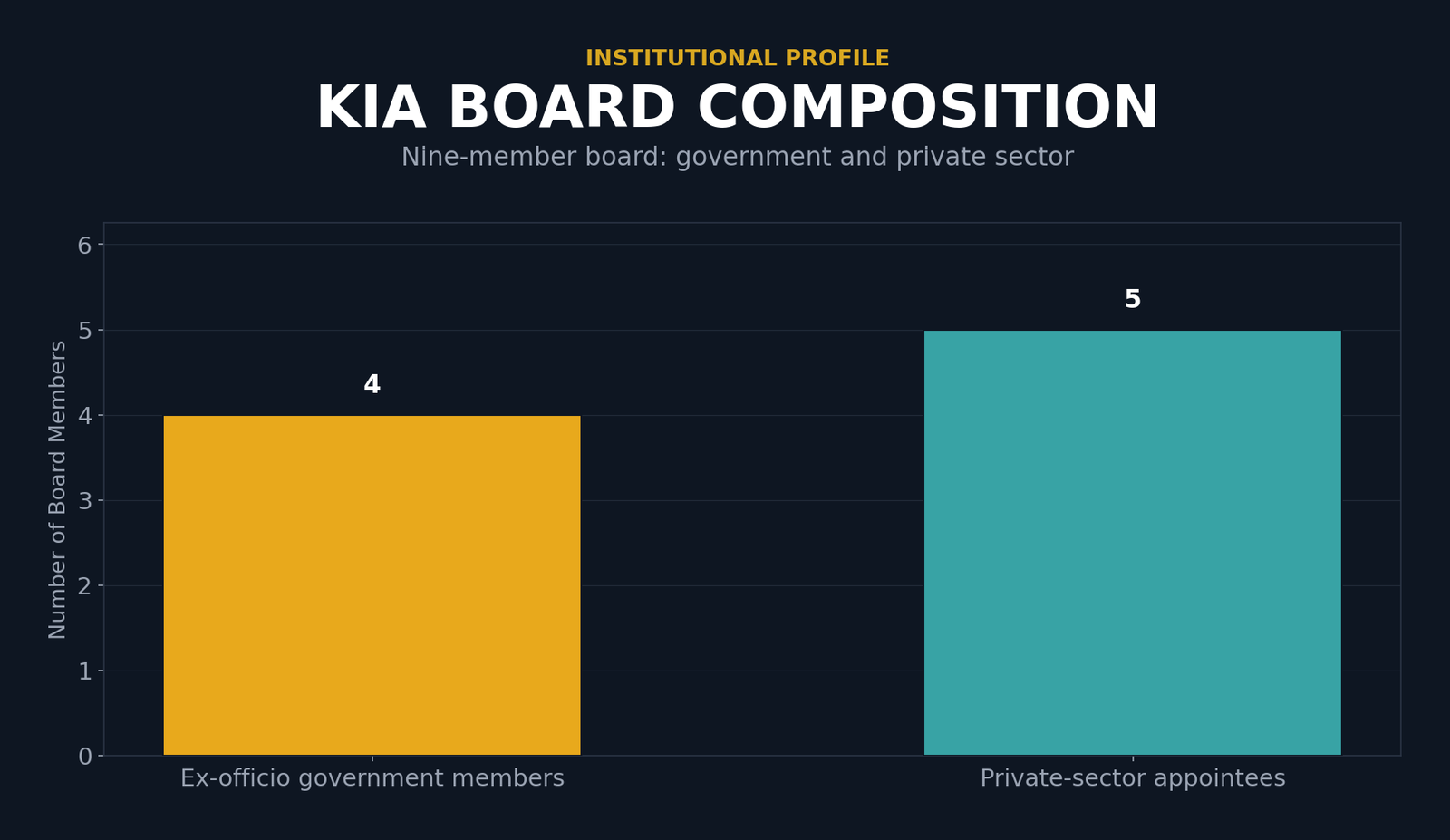
KIA's Board of Directors is composed of four ex-officio government members and five private-sector appointees appointed by Amiri Decree for four-year terms. Source: kia.gov.kw.
| Board Member Type | Count |
|---|---|
| Ex-officio government members | 4 |
| Private-sector appointees | 5 |
How to Engage
KIA's manager sourcing method is a formal shortlisting and Request for Proposals process based on pre-determined criteria, as stated in the authority's Santiago Principles self-assessment. Third-party relationships are governed by service-level agreements and investment management agreements. However, KIA does not publish an RFP calendar, procurement portal, or details of its manager-selection process. No investment consultant is named in the sources. Law No. 47 of 1982, Clause 8, prohibits disclosure of information related to KIA's work to the public, which extends to procurement processes and manager rosters. The authority does not disclose a stated policy on unsolicited proposals.
KIA invests primarily through external fund managers across public equity, fixed income, private equity, real estate, and infrastructure. The Kuwait Investment Office in London trades directly in marketable securities. KIA has established specialized standalone entities (St. Martins for real estate in the United Kingdom and globally, Fosterlane and Breadstreet for real estate in the United States, and Wren House Infrastructure for infrastructure investments) that conduct direct investments in their respective asset classes. The authority does not seek to purchase majority or controlling interests in companies, except in real estate investment entities and investment holding companies established for particular transactions. No public pathway for manager engagement is disclosed; entry depends on direct relationship development or introduction through existing relationships.
Sources and Documents
- kia.gov.kw About page (accessed for board, executive management, governance, audit, risk, transparency, and history)
- kia.gov.kw Investments page (accessed for GRF/FGF structure, strategy, asset classes, and investment approach)
- KIA Santiago Principles self-assessment (2022, PDF hosted by IFSWF)
Data Notes and Methodology
This profile is based on KIA's official website (kia.gov.kw, accessed October 2026) and the authority's Santiago Principles self-assessment (2022, hosted by the International Forum of Sovereign Wealth Funds). The Santiago Principles self-assessment is authored by KIA and is treated as a primary source. KIA does not disclose assets under management or investment returns publicly. Law No. 47 of 1982, Clause 8, prohibits disclosure of information related to KIA's work to the public. All financial information is reported internally to the State of Kuwait, Council of Ministers, National Assembly, and State Audit Bureau, but not to the public. The sources do not contain target or actual asset allocation percentages, returns by fund, AUM series, return series, flows data, commitment pacing information, or comprehensive manager rosters beyond the three named specialized entities (St. Martins, Fosterlane/Breadstreet, Wren House Infrastructure). No investment consultant, RFP calendar, procurement portal, or unsolicited-proposal policy is disclosed. KIA's inception year is listed as 1982 (establishment of KIA by Law No. 47), though the Kuwait Investment Board was established in 1953 and the Kuwait Investment Office in 1965.