
National Pension Service
Overview
National Pension Service Investment Management (NPSIM) is the fund management arm of South Korea's National Pension Service, headquartered in Jeonju. The National Pension Fund (NPF) is governed by the National Pension Act and administered by the Minister of Health and Welfare. Key fund management decisions are approved by the National Pension Fund Management Committee (FMC), chaired by the Minister. The fund operates under an in-house research institute, the National Pension Research Institute, and conducts extensive stewardship and responsible investment activities.
As of end-July 2026, the fund manages $1.17 trillion in assets across domestic and global equities, fixed income, alternatives, and cash. The fund posted an 18.8% return in 2025 and has delivered over 8% annualized returns since inception. NPSIM operates a mixed in-house and delegated investment model, with asset-class-specific delegation targets ranging from 10% to 99% depending on the asset class. The fund emphasizes diversification by decreasing domestic fixed income allocation and increasing overseas and alternative investments to deliver steady returns and hedge risks.
The National Pension Service was established in 1988 to provide retirement security for South Korean workers. The fund is managed in three areas (Financials, Welfare, and Others) in line with the Guideline for National Pension Fund Management, with the vast majority invested in financial assets. NPSIM's investment approach balances in-house portfolio management with external delegation across all major asset classes, supported by a comprehensive governance structure that includes specialized committees for investment policy, responsible investment, and risk management.
Investment Mandate
The National Pension Fund's mission is to provide stable retirement income for South Korean workers through prudent long-term investment management. The fund's target allocation by 2026 is: Domestic Equity 14.9%, Domestic Fixed Income 24.9%, Global Equity 37.2%, Global Fixed Income 8.0%, Alternatives 15.0%. The mid-term target allocation by 2030 shifts to: Equity 50%, Fixed Income 35%, Alternatives 15%. This strategic rebalancing reflects the fund's emphasis on diversification by decreasing domestic fixed income allocation and increasing overseas and alternative investments.
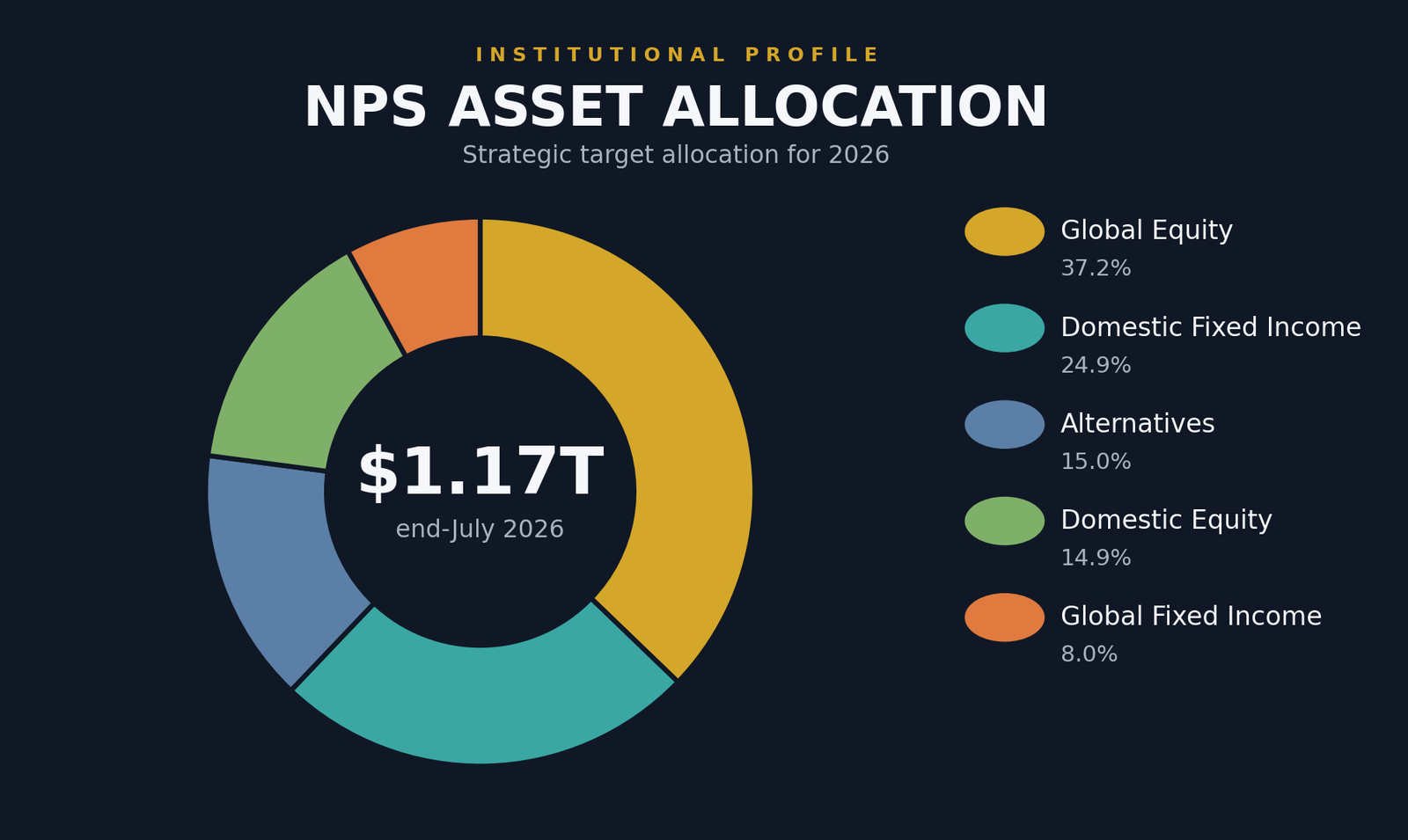
Strategic target allocation for 2026, as published by NPS. Source: NPS Investment Management, strategic asset allocation.
| Asset class | 2026 target |
|---|---|
| Global Equity | 37.2% |
| Domestic Fixed Income | 24.9% |
| Alternatives | 15.0% |
| Domestic Equity | 14.9% |
| Global Fixed Income | 8.0% |
The fund's target return is defined as Real GDP Growth (%) plus CPI Growth (%) with adjustments. Risk tolerance is set at CVaR (α equals 0.05) greater than or equal to negative 15%. The strategy emphasizes diversification to deliver steady returns and hedge risks. Asset-class-specific delegation targets guide the fund's mixed in-house and external management approach: Domestic Equity 45 to 65%, Domestic Fixed Income 10 to 20%, Global Equity 45 to 65%, Global Fixed Income 40 to 80%, Alternatives 65 to 99%. These ranges allow NPSIM to balance direct portfolio management with external manager expertise across all major asset classes.
As of end-July 2026, actual allocations diverge from targets in several areas: Domestic Equity 24.9% (target 14.9%), Domestic Fixed Income 16.8% (target 24.9%), Global Equity 37.0% (target 37.2%), Global Fixed Income 6.1% (target 8.0%), Alternatives 14.8% (target 15.0%), Short-term Assets 0.3%. The overweight to domestic equity and underweight to domestic fixed income reflect the fund's ongoing portfolio transition toward the 2030 targets. The fund's global investment footprint spans developed and emerging markets, with a significant allocation to overseas equities and a growing alternatives program that includes private equity, real estate, and infrastructure.
Financial Position
As of end-July 2026, the National Pension Fund manages $1.17 trillion (KRW 1,684.2 trillion) in assets, divided into Financials ($1,171 billion) and Welfare and Others ($0.7 billion). The fund posted earnings of $161.2 billion in 2025, delivering an 18.8% return for the year. The fund has delivered over 8% annualized returns since inception. Recent quarterly performance includes: Q1 2026 return over 4%, Q3 2025 return 11.31%, H1 2025 return 4.08%, and 2024 return 15.00%. NPS reports in Korean won. All USD figures in this profile are converted at 1 USD = KRW 1,436.81 as of July 31, 2026. The most recent AUM figure is sourced from the portfolio breakdown page as of end-July 2026. An earlier press release from September 2026 mentions $1.30 trillion for H1 2026, which may reflect a different reporting date or provisional figure.
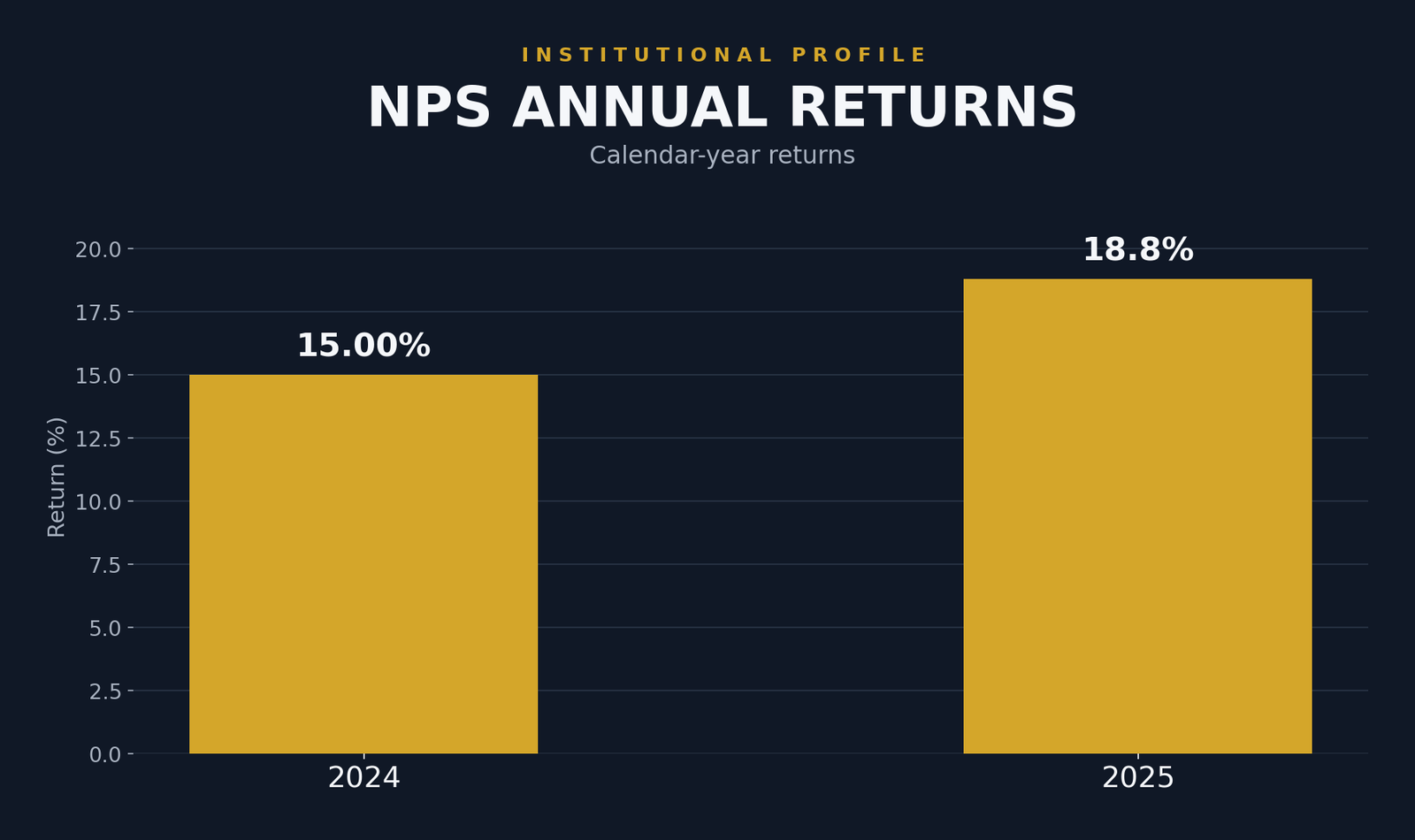
Annual calendar-year returns, 2024 to 2025. Source: NPS Investment Management press releases.
| Year | Return |
|---|---|
| 2024 | 15.00% |
| 2025 | 18.8% |
- Portfolio composition (end-July 2026): Domestic Equity 24.9% ($291.3 billion), Domestic Fixed Income 16.8% ($196.9 billion), Global Equity 37.0% ($434.1 billion), Global Fixed Income 6.1% ($71.3 billion), Alternatives 14.8% ($173.1 billion), Short-term Assets 0.3% ($3.5 billion).
- Alternative investments: In 2024, NPS committed $1.6 billion to non-traditional real estate investments, indicating direct and co-investment activity in the alternatives portfolio.
- Return series: The fund discloses quarterly and annual returns with a track record of consistent positive performance. The 2025 return of 18.8% represents a strong year following the 15.00% return in 2024.
- Workforce and research capacity: The fund operates through the National Pension Service structure with a dedicated research institute (National Pension Research Institute) that conducts research and performance assessment to support investment decision-making.
DEEP Disclosure Rating
The DEEP Disclosure Rating measures how much a fund discloses about itself. It is a disclosure and governance measure only, and not a judgment of investment quality or creditworthiness. The National Pension Service Investment Management's DEEP Disclosure Score is 79 of 100, band Strong. It publishes an annual report and audited financial statements, discloses assets under management or reserves with as-of date, discloses investment performance and return earned, publishes an Investment Policy Statement or equivalent mandate document, discloses target asset allocation, discloses actual asset allocation, discloses how it selects managers or names its investment consultant, publishes an RFP or procurement process and portal, names governing board and trustees and senior investment staff, makes disclosures freely and publicly accessible with no paywall, publishes most recent disclosures current within the fund's reporting cycle, and consolidates disclosures in a reasonably findable manner. It does not disclose fees or investment costs, does not disclose portfolio holdings, and does not publish board or committee meeting materials or minutes, which places it in the Strong band. Last assessed September 2026, on National Pension Fund Report 2025 (published 2026-09-30) and published governance materials. Items that cannot apply to a fund's type are excluded from its score rather than scored as zero. The fund-specific basis is included in the DEEP Disclosure Report. The full scoring rubric is public on the DEEP Disclosure Rating methodology page. A detailed, pillar-by-pillar and item-by-item breakdown of this fund's score is available as a DEEP Disclosure Report on request.
Manager Approach and Matching Profile
- Target vs. actual allocation: NPS discloses both target allocations (annual and mid-term) and actual allocations by asset class. As of end-July 2026, actual allocations are: Domestic Equity 24.9% (target 14.9%), Domestic Fixed Income 16.8% (target 24.9%), Global Equity 37.0% (target 37.2%), Global Fixed Income 6.1% (target 8.0%), Alternatives 14.8% (target 15.0%). The overweight to domestic equity and underweight to domestic fixed income reflect the fund's ongoing portfolio transition toward the 2030 mid-term targets of Equity 50%, Fixed Income 35%, Alternatives 15%. The fund publishes annual asset allocation plans that guide this transition, with specific percentage targets by asset class and geography. The target return is defined as Real GDP Growth (%) plus CPI Growth (%) with adjustments, and risk tolerance is set at CVaR (α equals 0.05) greater than or equal to negative 15%. Asset-class-specific delegation targets provide additional granularity: Domestic Equity 45 to 65%, Domestic Fixed Income 10 to 20%, Global Equity 45 to 65%, Global Fixed Income 40 to 80%, Alternatives 65 to 99%. These delegation ranges indicate the fund's strategic balance between in-house management and external delegation, with alternatives heavily delegated and fixed income more concentrated in-house. The fund's strategic rebalancing emphasizes diversification by decreasing domestic fixed income allocation and increasing overseas and alternative investments to deliver steady returns and hedge risks.
- Historical AUM and return series: NPS discloses quarterly and annual returns and AUM figures. Recent series: 2025 return 18.8% (earnings $161.2 billion), 2024 return 15.00%, Q3 2025 return 11.31%, H1 2025 return 4.08%, Q1 2026 return over 4%. AUM series: end-July 2026 $1.17 trillion, H1 2026 $1.30 trillion, Q1 2025 $854.0 billion. Annualized return since inception disclosed as over 8%. The fund publishes these figures through its portfolio breakdown page (updated monthly or quarterly) and through press releases announcing quarterly and annual performance. The 2025 return of 18.8% represents a strong year following the 15.00% return in 2024, demonstrating consistent positive performance across market cycles. The AUM growth from $854.0 billion in Q1 2025 to $1.17 trillion at end-July 2026 reflects both investment returns and ongoing contributions from the national pension system. NPS reports in Korean won. All USD figures in this profile are converted at 1 USD = KRW 1,436.81 as of July 31, 2026. The most recent AUM figure of $1.17 trillion as of end-July 2026 is sourced from the portfolio breakdown page. An earlier press release from September 2026 mentions $1.30 trillion for H1 2026, which may reflect a different reporting date or provisional figure. The fund's disclosure of annualized returns since inception (over 8%) provides long-term performance context for manager matching and benchmarking purposes.
- External manager roster and consultant detail: NPS publishes a procurement and manager-selection portal listing ongoing RFPs and selected managers and service providers. Recent selections include domestic and overseas custodians, MMF managers, domestic private equity and real estate delegated managers, and alternative investment advisors. The procurement portal (fund.nps.or.kr/impa/dlnginstslctnpbanclist) indexes 121 procurement notices across asset classes and service types. A full roster of external managers is not published in a consolidated list. The fund operates a mixed in-house and delegated investment model with asset-class-specific delegation targets: Domestic Equity 45 to 65%, Domestic Fixed Income 10 to 20%, Global Equity 45 to 65%, Global Fixed Income 40 to 80%, Alternatives 65 to 99%. These ranges indicate that alternatives are heavily delegated (65 to 99% of the portfolio managed externally), while fixed income is more concentrated in-house (10 to 20% delegated). The delegation policy is published on the fund's website with detailed asset-class-specific target ranges and selection processes. Recent procurement activity includes selections of domestic and overseas custodians, MMF managers, domestic private equity and real estate delegated managers, and alternative investment advisors. The fund does not name a general investment consultant, but the procurement portal lists specific advisor and service provider selections by mandate type. In 2024, NPS committed $1.6 billion to non-traditional real estate investments, indicating direct and co-investment activity alongside external manager relationships.
- Commitment pacing: The fund does not disclose commitment pacing or pipeline detail. Annual fund management plans are formulated to guide portfolio transition, but specific commitment schedules are not published. The fund's mid-term target allocation by 2030 (Equity 50%, Fixed Income 35%, Alternatives 15%) implies ongoing rebalancing from the current actual allocation (end-July 2026: Equity 61.9%, Fixed Income 22.9%, Alternatives 14.8%), but the pace and timing of this transition are not disclosed. The fund's 2024 commitment of $1.6 billion to non-traditional real estate investments provides a single data point on alternatives commitment activity, but a forward-looking commitment schedule or pacing plan is not published. The fund's asset-class-specific delegation targets (Alternatives 65 to 99%) suggest significant ongoing external manager activity in the alternatives portfolio, but the timing and sizing of future commitments are not disclosed. The annual fund management plans guide portfolio transition, but these plans do not include published commitment pacing or pipeline detail.
- RFP, procurement, and board calendar: NPS publishes an active procurement portal (fund.nps.or.kr/impa/dlnginstslctnpbanclist) listing RFPs and manager selections by asset class and service type. Recent RFPs include domestic and overseas custodians, MMF managers, private equity and real estate delegated managers, and alternative investment advisors. The portal indexes 121 procurement notices, providing a historical record of manager selections and ongoing RFP activity. A forward-looking RFP calendar is not published. The fund's governance structure includes the National Pension Fund Management Committee (FMC), which is the highest decision-making body and approves key fund management decisions. The FMC is chaired by the Minister of Health and Welfare and comprises a Chair, 5 ex officio members, and 14 external experts and representatives of employers, employees, contributors, and beneficiaries. The National Pension Fund Management Practice Evaluation Committee, chaired by the Vice Minister of Health and Welfare, conducts preliminary review of FMC agendas. Three Special Committees report to the FMC: Special Committee on Investment Policy, Special Committee on Responsible Investment and Governance, and Special Committee on Risk Management and Performance Evaluation and Compensation. The fund does not publish board or committee meeting materials or minutes, and a forward-looking board or committee meeting calendar is not disclosed. The procurement portal provides the primary source of information on RFP timing and manager selection activity, but this is a historical record rather than a forward-looking calendar.
Matching profile: these data points feed the cross-fund manager matching profile.
Sources: NPS Investment Management portfolio breakdown (end-July 2026), asset allocation and target plans (2026 and 2030 targets), delegation policy, procurement portal (121 procurement notices indexed), press releases (2026-09-07, 2026-09-10), National Pension Fund Report 2025.
Governance and Leadership
The National Pension Fund Management Committee (FMC), chaired by the Minister of Health and Welfare, is the highest decision-making body. It comprises a Chair, 5 ex officio members, and 14 external experts and representatives of employers, employees, contributors, and beneficiaries. The National Pension Fund Management Practice Evaluation Committee, chaired by the Vice Minister of Health and Welfare, conducts preliminary review of FMC agendas and has the same composition structure as the FMC. Three Special Committees report to the FMC: Special Committee on Investment Policy, Special Committee on Responsible Investment and Governance, and Special Committee on Risk Management and Performance Evaluation and Compensation. The National Pension Service, commissioned by the Minister to manage the NPF, houses NPSIM (fund management) and the National Pension Research Institute (research and performance assessment).
- Kim, Sung Joo (김성주): President (이사장) of the National Pension Service, overseeing the entire organization.
- Lee Kyu Hong (이규홍): Fund Director (기금이사), appointed 2026-09-15, overseeing the fund management division. Appointment is made by the President upon recommendation by the Fund Director Selection Committee.
- Han, jeonglim (한정림): Research Institute Director (연구원장), leading the National Pension Research Institute.
- You, Jee Young (류지영): Auditor (감사), responsible for internal audit and oversight.
How to Engage
NPSIM conducts responsible investment and stewardship activities as a core function, with a dedicated Special Committee on Responsible Investment and Governance. The fund publishes annual Responsible Investment and Governance Reports (most recent: 2025 report published 2026-07-15). NPSIM engages external managers across all asset classes through a structured delegation framework with asset-class-specific target ranges and selection processes published on the procurement portal. The fund operates a mixed in-house and delegated investment model, with delegation targets ranging from 10 to 20% for domestic fixed income to 65 to 99% for alternatives. Manager selection processes are described in the delegation policy, and the procurement portal lists ongoing RFPs and selected managers by asset class and service type.
The procurement portal (fund.nps.or.kr/impa/dlnginstslctnpbanclist) is the primary channel for manager engagement, listing RFPs and selections across domestic and overseas custodians, MMF managers, private equity and real estate delegated managers, and alternative investment advisors. The portal indexes 121 procurement notices, providing a historical record of manager selections and ongoing RFP activity. A forward-looking RFP calendar is not published. The fund does not disclose a stated policy on unsolicited proposals. In 2024, NPS committed $1.6 billion to non-traditional real estate investments, indicating direct and co-investment activity alongside external manager relationships. The fund's responsible investment activities include stewardship and engagement with portfolio companies, as detailed in the annual Responsible Investment and Governance Reports.
Sources and Documents
- NPS Investment Management press releases (fund.nps.or.kr/eng/pblcn/prerls), including 2026-09-07 and 2026-09-10 releases
- NPS Investment Management portfolio breakdown (fund.nps.or.kr/eng/orinsm/ptflobrkdwn), as of end-July 2026
- NPS Investment Management asset allocation and target plans (fund.nps.or.kr/eng/weinsm/astalctn), 2026 and 2030 targets
- NPS Investment Management governance model (fund.nps.or.kr/eng/aboutus/govm)
- NPS leadership directory (www.nps.or.kr/pbcpgdnc/bzadgroup), as of 2026-09-15
- NPS Investment Management annual reports and responsible investment reports (fund.nps.or.kr/eng/pblcn/anrpt), including National Pension Fund Report 2025 (published 2026-09-30) and Responsible Investment and Governance Report 2025 (published 2026-07-15)
- NPS fund management procurement portal (fund.nps.or.kr/impa/dlnginstslctnpbanclist), 121 procurement notices indexed
- NPS delegation policy (fund.nps.or.kr/oprtplcy/astaprtplcy), asset-class-specific delegation targets
Data Notes and Methodology
This profile is based on the National Pension Fund Report 2025 (published 2026-09-30), NPS Investment Management portfolio breakdown (as of end-July 2026), asset allocation and target plans (2026 and 2030 targets), delegation policy, procurement portal (121 procurement notices indexed), press releases (2026-09-07, 2026-09-10), governance model, leadership directory (as of 2026-09-15), and annual reports and responsible investment reports. The most recent dated AUM is $1.17 trillion (KRW 1,684.2 trillion) as of end-July 2026 (from the portfolio breakdown page). An earlier press release (2026-09-07) mentions $1.30 trillion (KRW 1,866 trillion) for H1 2026, which may reflect a different reporting date or provisional figure. The July 31 figure is used as primary because it is more recent and detailed. NPS reports in Korean won and does not publish USD figures. All USD amounts in this profile are converted at 1 USD = KRW 1,436.81 as of July 31, 2026. The Fund Director (Lee Kyu Hong) is the senior investment officer; the President (Kim Sung Joo) oversees the entire National Pension Service. The sources do not name a separate CIO title; the Fund Director is the functional equivalent. The National Pension Service was established in 1988, but the specific inception date of the fund management arm (NPSIM) is not stated in the sources. No fee schedule, expense ratio, or investment cost figures are disclosed in the primary sources reviewed. NPS discloses asset-class totals and allocation percentages but does not publish position-level holdings. The governance structure is described, but no board or committee meeting minutes or materials are published. The fund operates a mixed in-house and delegated model with asset-class-specific delegation targets (45 to 65% for domestic equity, 45 to 65% for global equity, 65 to 99% for alternatives). The procurement portal lists selected managers and ongoing RFPs but does not consolidate a full roster. All sources are freely accessible with no paywall. The assessment date is 2026-09-30.