
U.S. Social Security Trust Funds
Overview
The Social Security Trust Funds are two federal accounts that hold the reserves of the United States Social Security program: the Old-Age and Survivors Insurance (OASI) Trust Fund and the Disability Insurance (DI) Trust Fund. Together they are commonly referred to as the OASDI trust funds. They are the financial backbone of a program that pays benefits to more than 71 million people.
The funds are financed primarily by a dedicated payroll tax of 12.4 percent on covered wages up to an annual taxable maximum, which is $184,500 in 2026. Payroll tax receipts that are not immediately needed to pay benefits are held as reserves and invested. Since 2009, program income has not kept pace with annual costs, and the reserves have been drawn down to cover the difference.
The combined reserves stood at $2.56 trillion at the end of 2025, a decline of $160 billion during the year. Measured by assets, this makes the Social Security Trust Funds the largest single retirement pool in this directory. Their structure, however, is unlike that of a discretionary pension investor. The funds do not select external managers, allocate across asset classes, or pursue market strategies. Their mandate is set by statute.
Investment Mandate
The mandate is fixed by law and is narrow. By statute, reserves not needed for current benefits must be invested, on a daily basis, in interest-bearing obligations of the United States. In practice the funds hold only special-issue securities: nonmarketable Treasury obligations available only to the trust funds. They currently hold no marketable securities and no other asset classes.
The special issues come in two forms: short-term certificates of indebtedness for the daily investment of incoming receipts, and longer-term bonds. Unlike marketable securities, special issues can be redeemed at any time at face value, which gives the funds the same flexibility as holding cash while still earning interest. The interest rate is set by a statutory formula enacted in 1960, tied to the average market yield on marketable Treasury securities that are not due or callable for at least four years.
Because the mandate is statutory, the usual allocation and access fields do not apply. There is no asset-class allocation to chart, no external manager use, no sector or geographic focus, no typical commitment size, and no policy on unsolicited proposals. These fields are recorded as not applicable. The fund is not a discretionary allocator and does not deploy capital into private markets or external strategies of any kind.
Financial Position
Key figures from the 2026 Trustees Report, with reserves measured as of the end of 2025.
- Combined reserves (OASI plus DI): $2.56 trillion at the end of 2025.
- Change during 2025: a decline of $160 billion.
- Effective interest rate earned on reserves in 2025: 2.6 percent.
- Primary funding source: 12.4 percent payroll tax on wages up to $184,500 (2026).
- Beneficiaries: more than 71 million people.
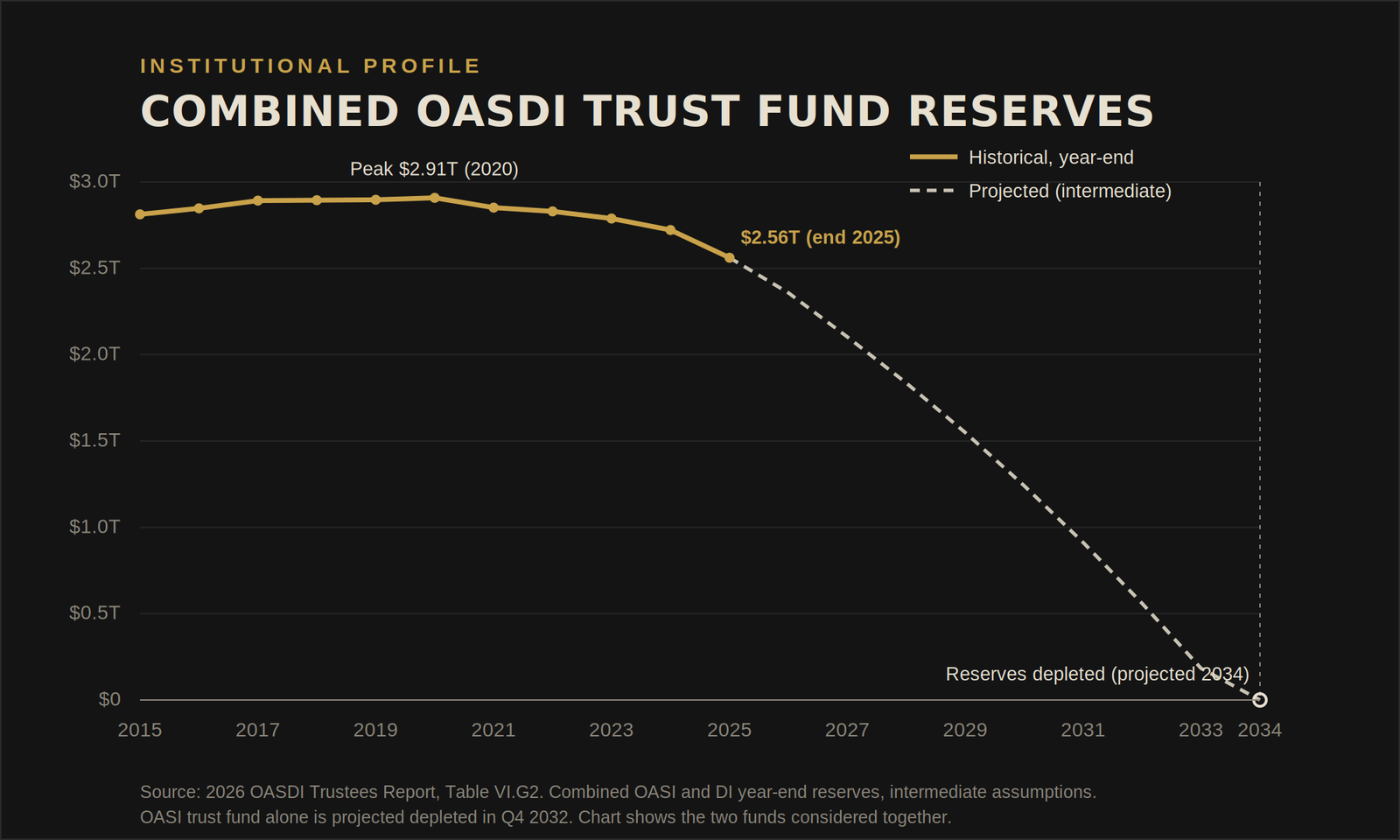
| Year | Reserves ($B) | Basis |
|---|---|---|
| 2020 | 2,908.3 | Historical |
| 2021 | 2,852.0 | Historical |
| 2022 | 2,829.9 | Historical |
| 2023 | 2,788.5 | Historical |
| 2024 | 2,721.5 | Historical |
| 2025 | 2,561.3 | Historical |
| 2026 | 2,357.7 | Projected |
| 2028 | 1,835.3 | Projected |
| 2030 | 1,240.2 | Projected |
| 2032 | 559.4 | Projected |
| 2033 | 182.9 | Projected |
| 2034 | Depleted | Projected |
Forward projections (2026 Trustees Report, intermediate assumptions)
- The OASI Trust Fund is projected to be able to pay 100 percent of scheduled benefits until the fourth quarter of 2032, one quarter earlier than the prior report projected. After depletion of its reserves, continuing program income is projected to cover 78 percent of scheduled benefits.
- The DI Trust Fund is projected to remain able to pay full scheduled benefits through at least 2100, the end of the report's 75-year projection window.
- On a combined basis, the OASDI trust funds are projected to be depleted in 2034, after which program income is projected to cover approximately 83 percent of scheduled benefits.
OASI and DI are legally separate funds. Combined figures assume the reserves of the two are considered together, which would require a change in law to actually pool.
Reserve history, projections, and rating detail
Shown in full for now. This section will become subscriber-only once accounts open.
Reserve history ($B)
| Year | Year-end |
|---|---|
| 2015 | 2,812.5 |
| 2016 | 2,847.7 |
| 2017 | 2,891.8 |
| 2018 | 2,894.9 |
| 2019 | 2,897.4 |
| 2020 | 2,908.3 |
| 2021 | 2,852.0 |
| 2022 | 2,829.9 |
| 2023 | 2,788.5 |
| 2024 | 2,721.5 |
| 2025 | 2,561.3 |
Projection ($B)
| Year | Year-end |
|---|---|
| 2026 | 2,357.7 |
| 2027 | 2,102.2 |
| 2028 | 1,835.3 |
| 2029 | 1,548.5 |
| 2030 | 1,240.2 |
| 2031 | 912.0 |
| 2032 | 559.4 |
| 2033 | 182.9 |
| 2034 | Depleted |
Interest earned on reserves: 2.5 percent in 2024, 2.6 percent in 2025. All figures from the 2026 OASDI Trustees Report, Table VI.G2, SSA Office of the Chief Actuary, and SSA press releases.
Governance and Leadership
The funds are overseen by the Social Security Board of Trustees. Four members serve by virtue of their federal positions, and two public trustee positions are currently vacant.
- Scott Bessent, Secretary of the Treasury, Managing Trustee
- Frank J. Bisignano, Commissioner of Social Security
- Robert F. Kennedy, Jr., Secretary of Health and Human Services
- Keith E. Sonderling, Acting Secretary of Labor
Benefit administration is carried out by the Social Security Administration. The investment of reserves is the responsibility of the Managing Trustee, the Secretary of the Treasury, and is administered by the Treasury's Bureau of the Fiscal Service.
How to Engage
Not applicable. The Social Security Trust Funds do not accept external capital, do not select investment managers, and do not entertain unsolicited investment proposals. Reserves are invested solely in special-issue Treasury securities under a statutory mandate. There is no RFP process, no investment consultant, and no manager registration. This fund is a reference entry in the directory and is not a target for capital raisers or the fit-matching tool.
Sources and Documents
- 2026 Annual Report of the Board of Trustees of the OASI and DI Trust Funds (2026 OASDI Trustees Report). Released June 9, 2026. ssa.gov/OACT/TR/2026/
- 2026 OASDI Trustees Report, Table VI.G2, Operations of the Combined OASI and DI Trust Funds. Source for the reserve history and projection figures and the chart. ssa.gov/oact/tr/2026/lr6g2.html
- SSA press release, "Social Security Board of Trustees," June 9, 2026. Source for the $2.56 trillion reserve figure, the $160 billion 2025 decline, the 2.6 percent effective interest rate, and the trustee roster.
- SSA Office of the Chief Actuary, special-issue securities, holdings, and trust fund investment practices. ssa.gov/oact/progdata/specialissues.html
- Congressional Research Service, "Social Security Trust Fund Investment Practices."
- DEEP Disclosure Rating methodology. /deep-disclosure-rating/
Data Notes and Methodology
Figures reflect the 2026 OASDI Trustees Report, which presents data as of the end of 2025 and projections under the Trustees' intermediate (best estimate) assumptions, set in February 2026. Depletion dates and payable-benefit percentages are projections and shift from year to year as assumptions are revised. The DEEP Disclosure Score was assessed against the published rubric on the same sources, with not-applicable items listed above.
- Last updated: August 2026
- Next expected update: 2027 Trustees Report
- DEEP Disclosure Rating last assessed: August 2026