
Abu Dhabi Investment Authority
Overview
The Abu Dhabi Investment Authority (ADIA) is the principal sovereign wealth fund of the Emirate of Abu Dhabi, established in 1976 to invest the government's financial surpluses, historically derived from oil, across global markets for the long-term prosperity of the emirate. It is headquartered in Abu Dhabi and is one of the largest sovereign wealth funds in the world.
ADIA does not publish its assets under management. Deep Institutional estimates its portfolio at roughly $800 billion to $950 billion, derived from ADIA's own disclosed allocation ranges and investment behavior rather than from external trackers (see Data Notes). On that basis it ranks among the largest sovereign wealth funds in this directory. It is owned by the government of Abu Dhabi but states that it manages its portfolio independently of the government and of other Abu Dhabi funds. As a matter of practice, ADIA does not invest in the United Arab Emirates.
ADIA is a highly diversified, global, multi-asset investor that has moved in recent years toward a total-portfolio-management approach and a heavily quantitative, data-driven process. It discloses considerably less about itself than the most transparent sovereign funds, which is reflected in its rating below.
Investment Mandate
ADIA's mission is to sustain the long-term prosperity of Abu Dhabi by prudently growing capital. It manages against a long-term strategy portfolio expressed as ranges, rather than fixed targets, across asset classes including developed and emerging-market equities, small-cap equities, government bonds, credit, financial alternatives (hedge funds), private equity, real estate, and infrastructure. Developed equities are the largest band at up to about 42 percent, and the private equity range was raised to 12 to 17 percent in recent years. These are strategy ranges within which allocations fluctuate, so they do not total 100 percent, and ADIA does not disclose its actual allocation.
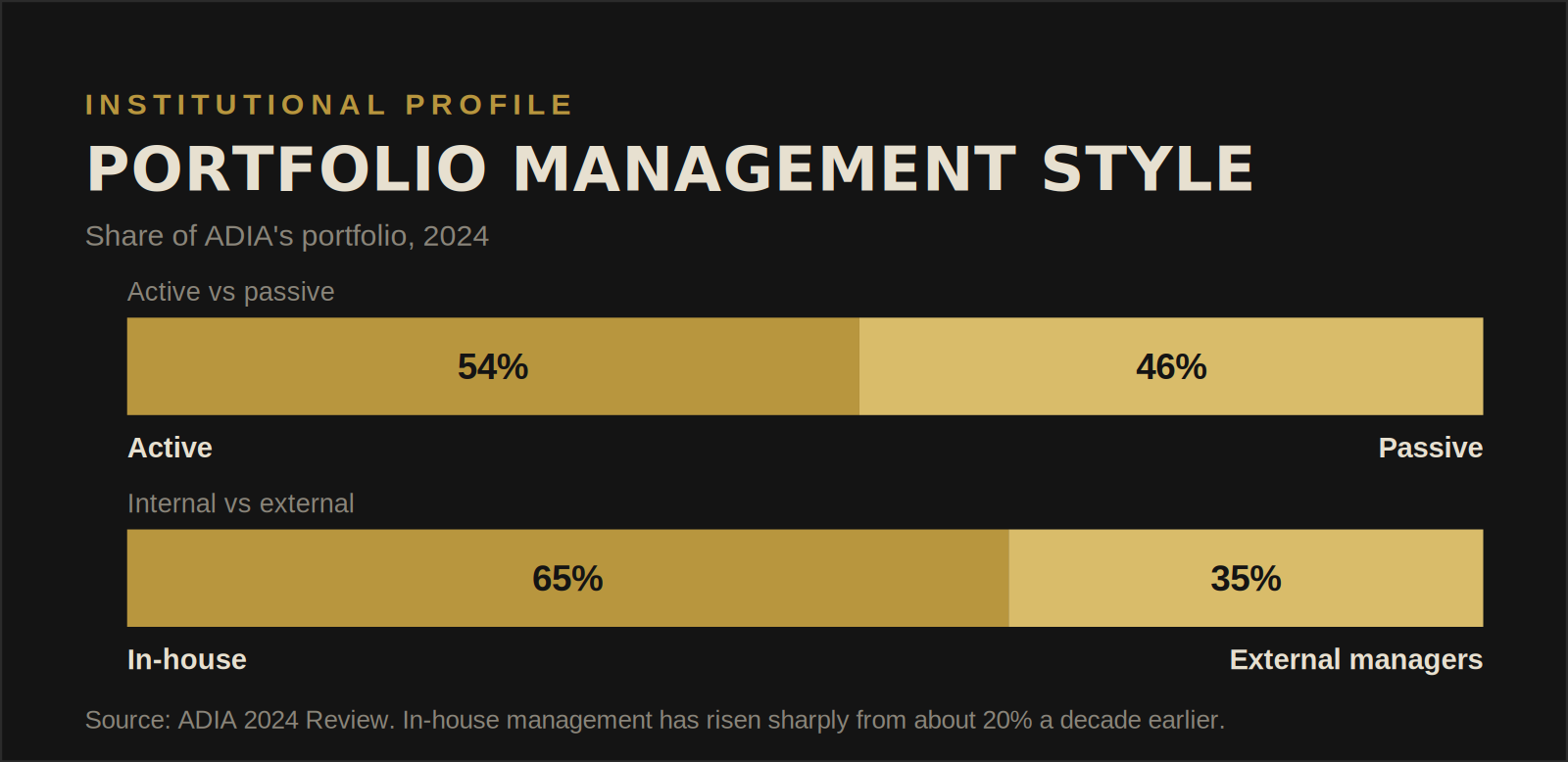
The portfolio spans North America, Europe, developed Asia, and emerging markets. Management is split between active and passive and between in-house and external managers, and ADIA has shifted markedly toward internal management over the past decade.
Financial Position
ADIA does not publish financial statements or an AUM figure. The figures below are the performance and workforce data it does disclose, from its 2024 Review.
- Assets under management: not disclosed by ADIA. Deep Institutional estimates roughly $800 billion to $950 billion, central estimate about $900 billion, derived from ADIA's disclosed allocation ranges and its private-market investment behavior. External trackers have published higher figures, around $1.0 trillion to $1.1 trillion. See Data Notes for the basis.
- Long-term returns as of 31 December 2024: 20-year annualized 6.3 percent and 30-year annualized 7.1 percent, in US dollar terms on a time-weighted basis. The 2024 figure is provisional.
- Workforce: 1,330 employees from 65 countries.
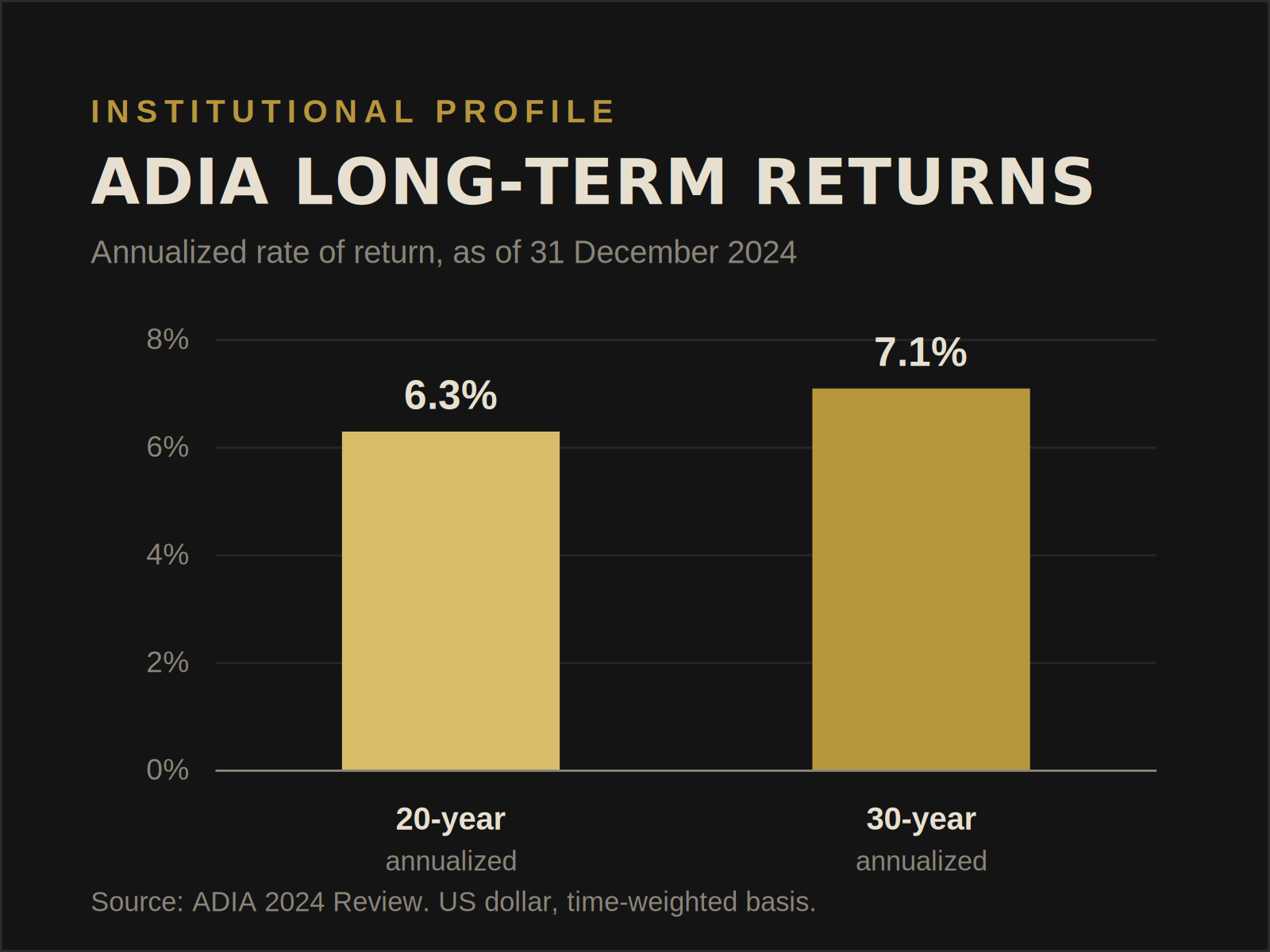
ADIA emphasizes long-term, point-to-point annualized returns rather than annual performance, noting that these figures shift as older years roll out of the calculation and the latest year rolls in. It does not disclose returns by asset class or a year-by-year series.
DEEP Disclosure Rating
The DEEP Disclosure Rating measures how much a fund discloses about itself. It is a disclosure and governance measure only, and not a judgment of investment quality or creditworthiness. The Abu Dhabi Investment Authority scores 52 of 100, band Limited. It publishes an annual Review with its investment strategy, its long-term returns, its management-style breakdown, and its board and committees, all freely and in English. It does not disclose its assets under management, its actual asset allocation, its holdings, its fees, a manager-selection process, or its board meeting materials, which places it in the Limited band.
Last assessed August 2026, on ADIA's 2024 Review and published governance materials. No items were marked not applicable, since ADIA is a full discretionary allocator. The full scoring rubric is public on the DEEP Disclosure Rating methodology page. A detailed, pillar-by-pillar and item-by-item breakdown of this fund's score is available as a DEEP Disclosure Report on request.
Manager approach and matching profile
- Asset classes: public equity, fixed income, private equity, real estate, infrastructure, and hedge funds.
- Geographic focus: global across North America, Europe, developed Asia, and emerging markets. Does not invest in the UAE.
- Investment approach: total-portfolio management, split 54 percent active and 46 percent passive, and 65 percent in-house and 35 percent external, with a growing quantitative and systematic capability.
- Manager access: relationship-based, through fund commitments, co-investments, and direct deals sourced by ADIA's asset-class departments. No published manager-selection process.
- Positioning: one of the largest and longest-standing sovereign investors in global private markets, with dedicated private equity, real estate, and infrastructure departments.
Sources: ADIA 2024 Review and public disclosures. ADIA does not publish its AUM, actual allocation, or holdings.
Governance and Leadership
ADIA is governed by a Board of Directors, appointed by the Abu Dhabi Supreme Council for Financial and Economic Affairs, which sets strategy and risk-return parameters. A Managing Director is responsible for implementing strategy and running investment and operational activities. As published in the 2024 Review, senior figures are:
- H.H. Sheikh Tahnoun bin Zayed Al Nahyan, Chairman
- H.H. Sheikh Hamed bin Zayed Al Nahyan, Managing Director and Chairman of the Investment Committee
- Board members including H.H. Sheikh Khaled bin Mohamed bin Zayed Al Nahyan, H.H. Sheikh Mansour bin Zayed Al Nahyan, and senior Abu Dhabi finance officials
ADIA publishes a description of its governance framework and the composition of its Board and Investment Committee, but it does not publish board meeting materials or minutes.
How to Engage
ADIA is a major global counterparty for asset managers and one of the largest sovereign limited partners in private markets, so the opportunity to work with it is substantial. About 35 percent of its portfolio is run by external managers, and it invests through fund commitments, co-investments, and direct transactions across private equity, real estate, infrastructure, hedge funds, public equities, and fixed income.
Access is relationship-based and handled by ADIA's asset-class departments rather than through a published selection process or open procurement. Managers typically engage through existing relationships and direct outreach to the relevant department.
Sources and Documents
- ADIA, 2024 Review (published 2025). Source for the investment strategy, long-term returns, management-style split, workforce, and governance. adia.ae
- ADIA website, governance section. Source for the Board of Directors and Investment Committee.
- External sovereign wealth fund data trackers, referenced only as an upper-bound cross-check on AUM. The headline estimate on this page is Deep Institutional's own, derived as described in Data Notes.
- DEEP Disclosure Rating methodology. /deep-disclosure-rating/
Data Notes and Methodology
ADIA does not disclose its assets under management, its financial statements, its actual asset allocation, or its holdings. The AUM figure on this page is a Deep Institutional estimate, not an ADIA disclosure, and should be treated as approximate. It is derived from ADIA's disclosed allocation ranges, its published long-term returns, and its observable behavior as a lead investor in private markets: we size ADIA's private-market sleeves (private equity, real estate, infrastructure) from disclosed deal activity and limited-partner role, gross them up by their disclosed allocation shares, and cross-check against ADIA's disclosed long-term compounding and workforce scale. This yields a range of roughly $800 billion to $950 billion, with figures near $1.0 to $1.1 trillion treated as the upper end. The allocation information ADIA does publish takes the form of long-term strategy ranges, not actual weights. Returns are reported by ADIA as long-term annualized rates in US dollar terms on a time-weighted basis, with the latest year provisional. The DEEP Disclosure Score reflects this limited disclosure and was assessed against the published rubric.
- Last updated: September 2026
- Next expected update: ADIA 2025 Review (expected 2026)
- DEEP Disclosure Rating last assessed: August 2026
- Verification status: In review